- Home
- Samurai Philosophy
Samurai Philosophy: The Truth is Revealed Under Training Pressure

Most pages about samurai philosophy sell you a fantasy. They mix old quotes, dramatic images, and modern self-help into one neat package. It looks deep. It reads fast and leaves nothing behind.
And it is empty and hollow.
This page (and site) takes a different route. The goal here is to provide you with the information I wish I had when I started on this journey.
When I started out, samurai philosophy was a mix of military propaganda and a sales gimmick used to sell samurai-themed self-help programs and business courses.
And in today's world, it is so much worse.
Thirty years ago, we were starved for information, and it was easy for people in the West to take mysticism and tropes from samurai and ninja movies and dress it up as a codified philosophy applying to all.
Now, thanks to the internet, we are oversaturated with misinformation, repeating these tropes and stereotypes with Instagram quotes, TikToks or Reels, and worse yet, long from AI-generated slop from AI-generated avatars.
It is so much harder to find the truth.
What I've learned is that true samurai philosophy is not found in books, but through a way of physical training, behaving, and holding yourself together when things get hard. You can only learn it by doing the work it asks of you.
What follows is a guide for serious readers. I will define the subject clearly, separate the sources that often get blurred together, and show you where philosophy stops being theory and starts becoming conduct.
Samurai philosophy begins as disciplined practice, not image
The first mistake most people make (I did at any rate), is treating samurai philosophy as a set of beliefs to admire. It is not. At its core, it is a set of habits to live, encoded into physical movements.
In over thirty years of training and nearly two decades teaching traditional Japanese martial arts, I have watched something simple repeat itself. The students who talk most about "the samurai spirit" rarely show it in their movement or conduct. The students who say nothing, but who bow correctly, listen carefully, and accept correction without sulking, end up carrying themselves like the warriors they admire. The philosophy reveals itself in conduct, not in commentary.
What "philosophy" means here
Unlike most commentators, I have a degree in Philosophy; however, in this context, philosophy is not detached thinking. It is not a theory you debate. It is a way of shaping how you see, how you react, and how you carry yourself. Contrary to marketing and media, it is closer to a craft than a creed.
Samurai philosophy did not live in a warrior's head. It lived in their posture, their timing, their speech, and most importantly, their choices under pressure.
That is the standard this page will hold to.
Why training is where the philosophy becomes visible
In the West, philosophy can often be undermined by big words, bigger concepts, and personalities. When you are good with words, it is easy to talk out of both sides of your mouth. Ideas become abstract, impractical, or tools for manipulation. You can weaponise words, and, as we'll see with the concept of "Bushidō", hijack a philosophy so completely that you can completely recontextualise it to suit your own agenda.
By contrast, the philosophy of the samurai is expressed and encapsulated in physical training and thus puts the body and the ego in honest situations. There are five places in particular where I find philosophy stops being abstract:
- Repetition - doing the same movement thousands of times teaches you about patience and standards.
- Correction - being told you are wrong by a senior teaches you about humility and openness.
- Restraint - holding back full force in paired practice teaches you about responsibility.
- Composure - staying steady when tired, angry, upset, embarrassed, or surprised teaches you about self-command.
- Reigi (etiquette) - bowing properly, addressing teachers correctly, handling weapons with care, teaches you that respect is action, not opinion. This is the first thing I generally teach in the dojo, and the last thing generally understood.
You cannot fake any of these for long.
The dojo, like life, reveals what is real.
What you should expect here
This article is a starting point. It will:
- give you a clear overview of what samurai philosophy is and is not
- separate the main sources that get mixed up online
- show how authentic training carries values without preaching them
- link you to deeper pages on specific topics like the Hagakure, Musashi, Bushidō, and Zen
By the end, you should be able to read claims about samurai philosophy with sharper eyes. (Learning to use the eyes sharply - metsuke - is a key aspect of the physical training that gives great insight into true samurai philosophy).
What people usually get wrong about samurai philosophy
A lot of confusion comes from three common shortcuts. Spotting them will save you years of misreading the subject, wasted time and money.
The romantic shortcut
The romantic shortcut reduces everything to honour, death, dramatic quotes, and intensity. It treats every samurai as a noble figure ready to die for his lord at any moment. It loves cherry blossoms, drawn swords, and final stands.
Think back to films like The Last Samurai, Ghost Dog: Way of the Samurai, Ruroni Kenshin, When the Last Sword is Drawn, Seven Samurai...TV shows like Shogun, Last Samurai Standing...you get the idea.
The history is messier. Samurai changed sides in battles when it suited them. The famous Battle of Sekigahara in 1600 was decided by the defection of Kobayakawa Hideaki mid-fight, which triggered other commanders to switch as well. Loyalty was real, but it was usually conditional, contractual, and pragmatic. The "die for your lord without thinking" image is mostly a modern dramatisation used as propaganda.
The modern self-help shortcut
The self-help shortcut strips out the practice and the history. It turns difficult material into motivational slogans. Famous "Samurai Quotes" plastered over stern-faced warriors and AI-generated images are everywhere nowadays. They might even sound good. Like this one attributed to Miyamoto Musashi...
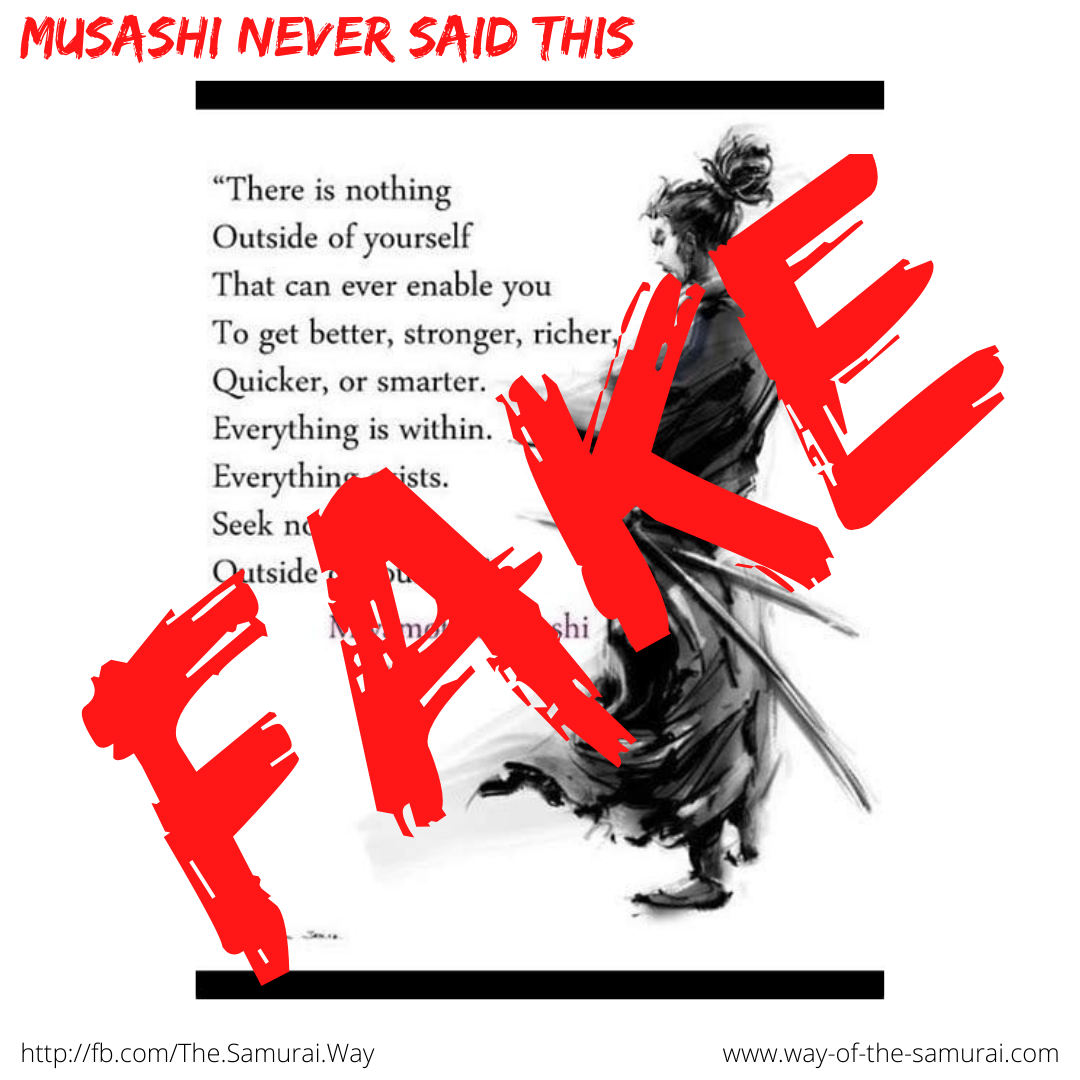
“There is nothing outside of yourself that can ever enable you to get better, stronger, richer, quicker, or smarter. Everything is within”.
Musashi never said this. This comes from a largely debunked and critically panned book published by a man with made-up fake titles, who has never trained in Musashi's school, and does not speak or read Japanese. He read a few English-language translations of Musashi's work and then decided to invent a version that he thought sounded more dramatic and cooler.
Musashi, his life and legacy, his very words are twisted out of context, so that martial arts frauds can cloak themselves in the legitimacy of his way, and "business coaches" can appeal to toxic masculinity and insecure men who want to be strategic business samurai. And when Musashi's words don't fit that narrative, why not invent Miyamoto Musashi quotes that will and just sign the man's name to them?
Musashi is not your life coach.
Don't get me wrong, there is a LOT to be learned from Musashi, but it requires context. A little later, I will have much more to say about Musashi (as a student of Hyōhō Niten Ichi Ryū, Musashi's style, under the guidance of the 12th headmaster Kajiya Takanori Soke), but for now, it is important to understand that neither Go Rin no Sho, nor any of Musashi Sensei’s writings were written for public consumption. Musashi's texts are not a how-to manual but more of a crib notes reminder series for his specific students from which they can extract the greater teachings taught in the school itself. These are teachings that have been taught in the dojo through oral instruction and hours of physical training.
Musashi's teachings, put forth in the Go Rin no Sho and as practised in Hyōhō Niten Ichi Ryū, can be understood only through the rigorous training of the body. It is this training, not book reading, that organises the body, physically and neurologically, to perform and understand the lessons of the ryū. This too is something Musashi talks about - in fact, close to 80% of the text finishes a specific bullet point with (and here are some ACTUAL Miyamoto Musashi quotes) -
"...you will never be able to achieve this without hard training"
"Practice hard"
"Practice this carefully again and again".
"We have to take the tachi in hand and practice hard".
"You should put more effort into practicing".
"You should take a tachi and train practically".
- Miyamoto Musashi, Go Rin no Sho, (trans. Miki Takeshima)
I started out as a young teen enamoured with the stoic strength of what I was sold as samurai philosophy, and there is nothing wrong with confidence or discipline.
But they were never the whole story.
The samurai who actually trained and served did so inside specific duties, specific schools, specific etiquette, and specific consequences, unique to prefecture, clan, and style.
Removing all that context leaves you with empty packaging.
The borrowed-identity problem
This one is the most personal. It is when someone admires the image of the samurai but refuses the discipline that gave the image its shape. They want the bearing without the bowing. The presence without the repetition. The composure without the correction. The status without the standing.
It's a lot easier to sell people neatly packaged samurai skills by just making them up and parting them from their money by dressing them in a samurai costume and having them make videos and tell them that's legitimate. You can be a real samurai or ninja without the years of training and discipline - just enter your credit card number. Samurai philosophy used for marketing, sales and personal profit.
The hard truth is, you cannot have the result without the practice.
The samurai look the way they look because of what they did, day after day, for years. The image is the by-product, not the goal.
Why this matters for a serious student
If you accept these shortcuts, three things go wrong:
- You build false confidence based on words rather than work.
- You develop bad source habits, treating any famous (sounding) quote as a historical fact.
- You apply samurai ideas shallowly, expecting transformation from inspiration alone.
A serious student protects himself from this by going straight to the practice and the sources, not the slogans.
There was no single, timeless samurai philosophy

This is the point that most pages and authors skip. There was no master code that every samurai followed across the centuries. "Samurai philosophy" is a modern umbrella term. It covers different texts, different periods, different teachers, and different purposes.
Why the umbrella term is useful but incomplete
The umbrella is helpful as a doorway. It tells you, roughly, what topic you are looking at. But it hides important differences. Treating "samurai philosophy" as one fixed doctrine is like treating "European thought" as one idea. The label is too broad to be exact.
Different periods shaped different emphases
The samurai existed in Japan for around seven centuries. The challenges they faced changed dramatically over that time:
- Warring periods (12th–16th centuries) - actual combat, shifting alliances, practical survival.
- Edo period (1603–1868) - over 250 years of peace. Samurai became administrators, not battlefield fighters. Ethics became more about civic conduct, study, and household duty than swordsmanship.
- Meiji period onwards (1868–1940's) - the samurai class was abolished. The idea of the samurai was reshaped to serve a modernising nation.
- World War 2 - The Imperial Japanese government revamped the ideas of Bushidō and used it as a tool of propaganda. Die for one's feudal lord became Die for Your Country.
- Post-war to the 90's - We had loyalty to a lord, then loyalty to a country, and now it is loyalty to a company. Samurai philosophy and strategy used to win battles in boardrooms and spearhead economic recovery.
- Now - amid the decline of social norms and values, economic difficulties and large-scale global unrest, it has been reduced to snappy quotes and attractive self-help soundbites.
A samurai writing in 1450 and one writing in 1750 lived in almost entirely different worlds. Their advice reflects that.
Different texts did different jobs
Texts that get bundled together today were written for very different reasons:
- Some were practical instructions for retainers and young warriors.
- Some were personal reflections by an older man looking back.
- Some were moral commentary drawing on Confucian or Buddhist ideas.
- Some were later interpretations trying to make sense of an already vanished class.
- Some were attempts to integrate and relate to the modern Western Christian world.
- Some were propaganda and instruments of large-scale social control.
Reading them as if they all agree, or all describe the same thing, leads to confusion.
The safest way to read the topic
Whenever you meet a claim about samurai philosophy, ask four questions:
- What period is it from?
- What text or tradition is it taken from?
- What purpose did the original author have?
- What audience was it written for?
These questions will save you from being misled by clean-sounding summaries.
Continue reading:
- Samurai philosophy: an honest overview (coming soon)
- Was Bushidō a historical samurai code or a modern reconstruction? (coming soon)
- A beginner-proof method for checking sources behind "samurai philosophy" claims (coming soon)
The main source streams behind modern samurai philosophy talk
Once you accept that there is no single doctrine, the next step is to learn the major sources that get blended together. There are roughly four streams for the modern audience. Each one is worth understanding on its own terms.
But...there is a fifth. The one no one talks about - and it is the key to understanding true samurai philosophy.
Bushidō and the problem of simplification
 This is a typical 7 Virtues of Bushido poster. It looks good, but it is divorced from the actual context and meaning.This is a typical 7 Virtues of Bushido poster. It looks good, but it is divorced from the actual context and meaning.
The word "Bushidō" appears today as if it has always been the central name for samurai ethics. The historical record tells a different story.
Researchers who studied the Bushidō zensho, a 13-volume collection of pre-Meiji texts on warrior matters, found the word "Bushidō" in only 13 of 118 documents. In most of those, it appears once or twice and often refers to martial activity rather than a moral code.
What we now call Bushidō was largely shaped in the late 1880s, during Japan's rapid modernisation. The most famous book, Nitobe Inazō's Bushidō: The Soul of Japan (1900), was written in English, in the United States, by a Japanese Christian who later admitted he had not been familiar with the term before writing it. He framed samurai ethics in terms his Western readers would recognise, comparing them to chivalry and quoting the Bible to explain warrior virtue.
While this universal samurai code of morality and conduct, which Nitobe extoled, never existed, it has had the deepest impact on my life.
This modern Christian apologist version of samurai philosophy created by Nitobe isn't worthless. It does mean that when someone presents "the seven virtues of Bushidō" as an ancient samurai code, you should pause. The neat list is mostly modern and has more to do with Western values than authentic samurai ones.
Continue reading:
- What did Nitobe Inazō actually mean by "Bushidō"? (coming soon)
- Bushido myths and modern fiction (coming soon)
Hagakure and the need for context

The Hagakure Kikigaki (葉隠聞書) (literally meaning, "hidden among the leaves") is probably the most quoted samurai text in the modern world. Its famous opening line, "The way of the warrior is found in dying," appears on countless posters and book covers. It has inspired countless Instagram posts, TV shows and movies, most notably, Jim Jarmusch's incredible 1999 film, "Ghost Dog: The Way of the Samurai", where Forest Whitaker literally reads from it throughout the film.
However, most people do not know its background.
It was dictated by Yamamoto Jōchō (often referred to as Yamamoto Tsunetomo), a former retainer of Nabeshima Mitsushige, to his scribe and disciple Tashiro Tsuramoto, between 1709 and 1716. By that time, Japan had been at peace for over a century. Yamamoto himself had never fought in a real battle. His writing reflects the frustrations of a man who regretted being born too late. A bureaucrat fantasising that he was an action hero, a warrior, who turned himself into an authority on the subject of what he "thought" the samurai would have been like.
After the death of his lord, he went off sulking in the mountains and lamented about the "good aul days" that existed only in his imagination. After some years, disaffected and bored impressionable youths went to visit him to hear his ramblings and rants. After this death, one of these adherents, Tashiro, compiled his comments into the Hagakure.
And no one heard of it.
It was never circulated outside of the Nabashima clan territory, nor was it particularly popular there, except for a certain romantic set. People were largely embarrassed.
It wasn't published until the 1900's, and even then it remained largely ignored until the latter part of the 20th century, when it was used for military propaganda.
Quoting it without this context is like quoting a single old letter from a neighbour complaining about "the youth" and treating it as if it were a national constitution.
Continue reading:
- What is the Hagakure, and what context is required to read it well? (coming soon)
- What is the best translation of the Hagakure?
Musashi and martial strategy as disciplined perception
Miyamoto Musashi's The Book of Five Rings sits in a different category. Unlike Nitobe or Yamamoto, Musashi was a real swordsman who fought many duels and lived through Japan's transition from war to peace. His book is mainly about strategy, timing, distance, and perception in combat.
Modern summaries often turn his work into business advice or "mindset" tips. That treatment completely misses the point. Most of what Musashi wrote is tied to his specific martial method. His insights about awareness, posture, and rhythm come from physical practice, not philosophical theory. You can take wider lessons from him, but only if you respect the source material first.
You can take wider lessons from him, but only if you respect the source material first.
Continue reading:
- Musashi's philosophy: what's actually in his writing. (coming soon)
- What does The Book of Five Rings actually argue? (coming soon)
- Fake Musashi quotes explained
Zen, Confucian influence, and later interpretation
The connection between samurai and Zen Buddhism is real, but largely exaggerated in popular accounts. Some samurai studied Zen seriously. Others did not. Confucian ideas about duty, family, and social order shaped samurai ethics, especially during the peaceful Edo period, often more than Zen did.
Esoteric sects of Buddhism, such as the Cult of Marashiten, and the native system of Shintō, often had greater impact.
The dramatic "Zen samurai swordsman" image that became popular in the 20th century is partly built on the writings of a few teachers, particularly during the Edo and Meiji periods, when warriors had time to write about such things. Real medieval warriors had less time and less ink.
Continue reading:
- Zen and the samurai: what's supported by sources, and what's romantic myth? (coming soon)
- Confucian duty and samurai ethics in the Edo period (coming soon)
- Zen influence on martial practice (coming soon)
How authentic martial training carries philosophy without preaching it
Of course, there are many more "samruai philisophy" texts such as:
- Yagyū Munenori's (1571–1646) Heihō Kadensho (兵法家伝書)
- Takuan Sōhō's (1573–1645) Fudōchi Shinmyōroku (不動智神妙録),
- Yamaga Sokō's (1622–1685) Bukyō (武教, "The Warrior's Teaching") and Seikyō Yōroku (聖教要録)
- Daidōji Yūzan's (1639–1730) Budō Shoshinshū (武道初心集, "Primer for the Warrior's Way")
- Kaibara Ekken's (1630–1714) Taigiroku, and Yamato Zokkun
However, while these provide valuable insight into the thoughts of these samurai in their particular time and place, they do not reveal the full truth. They are merely reflections on the philosophy, not the philosophy itself.
Here is where the picture changes.
As I have said from the start, samurai philosophy is not found in books; it is found in the physical teachings.
In a serious dojo, the values are not announced through speeches. They are built into the way the training is structured. You absorb them by doing the work, often without realising it at the time.
The opening bows are taken from 800 years of Shintō philosophy. The dojo is of Buddhist origins, and the layout is taken from Taoism, and the way we line up is Confucian. None of this is spelt out. It is absorbed by doing, by practising koryū.
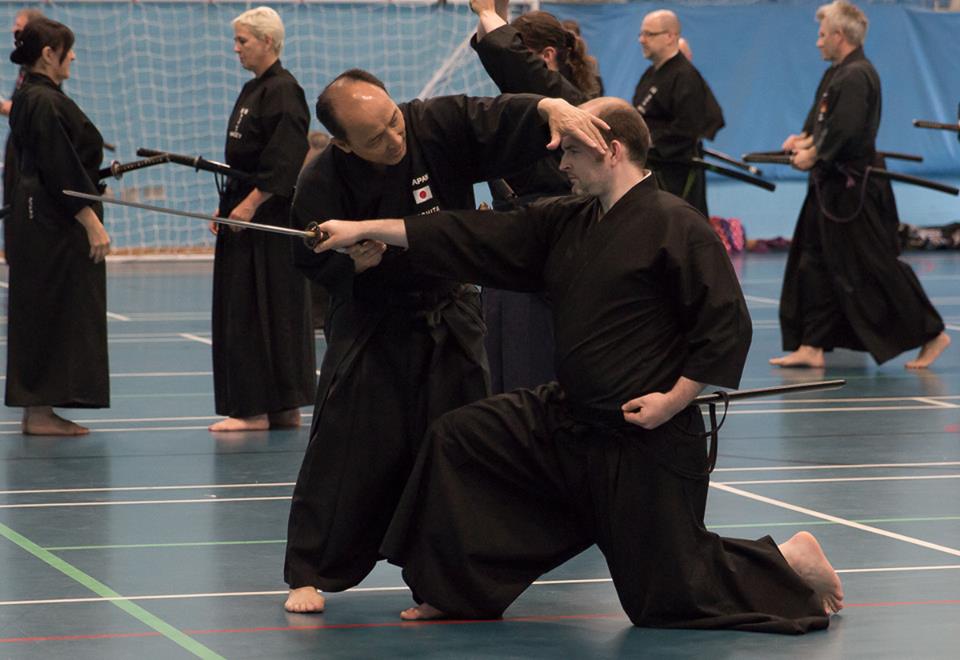
Koryū are living traditions that transmit a highly specific way of organising the body. Through this physical organisation, they cultivate and reinforce a corresponding psychological disposition and philosophical worldview unique to each ryū. The movements, postures, and methods of a classical school are not merely technical exercises; they are vehicles for transmitting a particular way of perceiving, thinking, and acting.
In this sense, training in a koryū allows practitioners to temporarily embody the mindset of generations of warriors who preserved and refined these teachings. This is not to suggest any literal spiritual possession or mystical intervention. Rather, koryū function as systems designed to preserve and transmit the personality, philosophy, strategic insights, physical methods, and psychological orientation of their founders and successive generations of exponents.
The techniques of a koryū are therefore not always concerned solely with winning a fight. Many - perhaps most - exist to shape how practitioners think, feel, and respond under pressure. Through the repeated performance of specific movements, students internalise particular habits of mind.
Physical organisation becomes psychological organisation
The body is used as a tool to condition consciousness.
In my own teaching, the change in a student rarely comes from a lecture, though I have given many over the years. It comes from a hundred small moments. The first time they bow without being prompted. The first time, they accept a correction without flinching. The first time they tie their hakama properly, they take their own preparation seriously. None of this gets announced. It just settles into them.
Samurai philosophy is encoded and transmitted in the kata.
Kata as behavioural education
Kata are set patterns of movement practised again and again. To an outsider, they can look like dance or shadow-fighting. To a practitioner, they are a slow education in:
- Attention - every angle, every breath, every grip matters.
- Timing - when to move, when to wait, when to commit.
- Order - one thing must finish before the next begins.
- Consequence - every motion has a result you can feel and see.
A kata done sloppily produces a sloppy person. A kata done with care produces a more careful person. Over the years, this shapes character more deeply than any motivational quote could. The physical techniques often conceal deeper layers of meaning and purpose.
Within Musō Jikiden Eishin-ryū, the school of iaijutsu that I study, this principle appears repeatedly. One example can be found in Yaegaki, the fifth kata of the Omori-ryū series. Historically, this form was known as In'yō Shintai, referring to the principles of Yin (In) and Yang (Yō). The kata embodies concepts of duality, balance, and the relationship between omote (the visible or outward) and ura (the hidden or inward).
Yet, as is often the case in koryū, there is another layer of interpretation. Embedded within the kata are elements derived from Esoteric Buddhism. While the movements can be understood as practical responses to attacks from multiple directions, the form may also be viewed as a mudrā - a ritualised arrangement of physical gestures. When combined with appropriate visualisation and recitation practices, such gestures were traditionally believed to create spiritual protection or "divine armour."
Viewed from this perspective, the kata serves a purpose beyond combative instruction. It becomes a method for cultivating spiritual power, mental composure, and divine protection. Nor is this an isolated example. Throughout the classical traditions, there are techniques that appear martial on the surface yet serve entirely different functions. Some forms operate as ritual acts of purification or exorcism. Others encode strategic principles for battlefield manoeuvre and troop movement. Some are, in essence, embodied prayers expressed through movement rather than words.
This intersection of martial training and samurai philosophy is particularly evident in Musō Jikiden Eishin-ryū. The most significant transmission document of the tradition - the scroll that grants teaching authority and is said to contain the innermost teachings of the school - is itself a Buddhist text.
Defeating the poisons of the soul
Known historically as the Tetsugi no Maki (手次之巻, Scroll of Transmission), it is among the oldest surviving documents associated with the iaijutsu tradition founded by Hayashizaki Jinsuke Shigenobu (1542?–1621?). Today, the document continues to be transmitted within Musō Jikiden Eishin-ryū under the title Kongen no Maki (根元之巻, Scroll of the Source), reflecting the profound integration of Buddhist thought and martial practice that lies at the heart of the tradition.
This text explains that iai was intended as a means of overcoming the Three Poisons (sandoku 三毒) - greed, anger, and ignorance - which Buddhist tradition identifies as the primary obstacles to awakening. Within the framework of Esoteric Buddhism, these mental afflictions are regarded as the root causes of suffering and the principal barriers to spiritual realisation. The practice of iai, therefore, was understood not merely as martial training, but also as a samurai philosophy of self-cultivation aimed at transforming the practitioner's mind and character.
All of this serves as a reminder that the movements found within a koryū cannot always be interpreted at face value. What appears to be a cut, block, or parry may not be solely—or even primarily—a combative action. A movement may function simultaneously as a mudrā, a prayer, a ritual gesture, a mnemonic device for tactical principles, a method of psychological conditioning, or even a means of addressing the emotional and mental burdens associated with conflict and trauma.
In the classical traditions, martial movement frequently serves as a language through which samurai philosophy - physical, psychological, tactical, and spiritual - are transmitted.
Continue reading:
Reigi as ethical training
Reigi means etiquette, but that English word is too thin. It includes how you bow, how you enter and leave the training space, how you address your seniors, how you handle weapons, how you fold your uniform, how you treat your partner - how you treat yourself.
I am low-key obsessed with reigi. To the point, I recorded an entire podcast episode about it.
It is not politeness for politeness's sake. Reigi trains your perception. It teaches you to notice your surroundings, respect the people in them, and act with awareness of consequence. A student who learns reigi properly carries that awareness into the world. They notice things others miss. They treat people, tools, and spaces with more care.
For example, in iaido, at the start and end of every practice is a form of reigi called tōrei (a respectful bow to the sword). The late Shimabukuro Sensei states the significance of this bow to the sword beautifully. He says the depth of our bow is not measured by the monetary value of the sword. The sword we bow to may be inexpensive. It may be old. It may be flawed. None of that matters. What matters is this: "It is the sword with which you train. It is the sword you are using to reshape your mind, your values, and your character — the sword that is creating the person you are striving to become."
But there is a deeper samurai philosophy here.
Even in modern ZNKR Iaido, there are deep remnants of samurai philosophy hidden in the movements.
The opening bow to sword is taken from Musō Shinden-ryū. Placing the sword with its cutting edge outward-facing and hilt to the right-hand side, positions the sword for practical readiness. The sword can be easily drawn and used, but more significantly, it presents its cutting edge toward potential opponents. Even before being placed at the waist, the sword is already fulfilling its protective function.
The positioning makes a philosophical statement: "You cannot pass here; you cannot defeat me." This embodies one of the highest principles in Japanese swordsmanship - thinking not of winning, but of not losing, expressed as "saya no uchi no kachi" (victory while the sword remains in the scabbard).
Traditional instruction enhances this concept through subtle eye movements during the opening bow - keeping the eyes slightly raised, maintaining visual awareness while bowing, and lifting the gaze before fully raising the head. These elements demonstrate vigilance and the absence of openings (suki) that an opponent might exploit.
Conversely, the closing bow from Musō Jikiden Eishin-ryū places the sword with the hilt to the left and the cutting edge facing inward. This arrangement makes the sword difficult to draw quickly, signifying that practice has concluded and conflict has ended. There are no more opponents or enemies, so the sword no longer needs to present a threat to anyone. Those seated before the practitioner are no longer perceived as potential adversaries - peace has been restored.
During this final bow, the eyes move naturally with the body without the assertive quality shown during the opening bow, further emphasising the transition from readiness to peaceful conclusion.
Continue reading:
- The Historical and Cultural Roots of Reiho (coming soon)
- The Deeper Meaning of Etiquette in Iaido (coming soon)
- The History of ZNKR Iaido
Dojo culture as pressure regulation
The dojo is a confluence of samurai philosophies made manifest, but more than that, a good dojo is a controlled pressure environment. You will be:
- Tired and asked to continue.
- Wrong and corrected in front of others.
- Slower than the person opposite you, and unable to hide it.
- Frustrated and expected to behave anyway.
This is not cruelty. It is a workshop for self-command. You learn to stay composed when things are not going your way. You learn to hear criticism without collapsing. You learn that your ego is not the centre of the room. These habits do not stay in the dojo. They come home with you.
Why practice often teaches more than slogans
Form reveals character under repetition. A person's true patience, honesty, and self-control come out over hundreds of training hours, in ways they cannot fake. This is why a few months of practice will teach you more about samurai philosophy than a library of summary books. The body cannot pretend the way the mind can.
Continue reading:
- Iaido philosophy: the sword and the self
- The Hidden Benefits of Jodo. A philosophy of the short staff
- What is the No Mind State of Mushin and How to Achieve It
- Are You Secretly Practising Samurai Magic?
- Entering the Dojo: Life Lessons From the Martial Arts #1
- Naming and Knowing: Life Lessons From the Martial Arts #2
- Kiryoku - Direct Unwavering Focus: Life Lessons From the Martial Arts #3
- How koryū schools transmit "samurai values" through practice (coming soon)
- Training ethics and humility (coming soon)
- Spiritual claims in dojos: what to take seriously and what to leave (coming soon)
The qualities you can actually train from these traditions
You do not need to live in feudal Japan, or even own a sword, to take real value from this material. Four qualities translate directly to daily life. Each one can be trained and tested in ordinary situations.
The reason these matter is simple. You do not get to choose when life will pressure you. You only get to choose how much work you have put in before that moment arrives.
Self-regulation over performance
The samurai tradition values control of the self before control of others. This is the opposite of how most modern advice works. Modern culture rewards performance and visibility. The warrior tradition rewards inner steadiness, even when nobody is watching.
You can train this. Notice your reactions. Slow them down. Choose your response instead of being chosen by it. Do this enough times, and it becomes a habit. This is a core teaching in the physical practice of Budo.
Clarity over fantasy
Romanticised thinking is comforting but useless under pressure. The samurai tradition, at its best, asks you to see clearly: your skill, your limits, the situation, the consequences. Not better than they are. Not worse. Just as they are.
This is harder than it sounds. Most people argue with reality rather than work with it. Training in martial arts puts you in front of honest feedback that you cannot dispute. You either landed the strike or you did not. You either kept your composure or you did not. The mirror is unflattering, but it is fair.
Dignity over ego
There is a difference between ego and dignity. Ego is loud, fragile, and demands attention. Dignity is quiet, stable, and does not need approval. The samurai ideal, when it works, points towards dignity.
This is called Kigurai (気位).
Kigurai is the dignity of spirit that appears under pressure.
It is not confidence in the ordinary sense, and it is certainly not arrogance. It is the feeling that a person possesses an unshakeable inner standard and refuses to be diminished by circumstances. When facing difficulty, threat, competition, or confrontation, they do not become smaller, frantic, or desperate. They remain themselves.
A person with kigurai doesn't need to prove they are strong. They don't seek validation. They don't beg for respect. Their self-respect is already settled.
In martial arts, kigurai is felt most strongly in the moment before action. Two people face each other, and one seems psychologically larger than the situation. Not because of physical power, but because they are completely at ease with themselves. Their spirit occupies the space.
In practice, this looks like accepting correction without sulking, congratulating the person who beat you in sparring, doing the unglamorous task because it needs doing, and refusing to inflate yourself when others are watching. None of this is exciting. All of it shows.
Steadiness under correction, uncertainty, and pressure
Most failures in life are not failures of skill. They are failures of composure. You knew what to do. You just lost your head when it mattered.
Trained steadiness is the antidote. It is built in small doses. Every time you handle a hard conversation without raising your voice, every time you stay calm when something goes wrong, every time you accept a hard truth without lashing out, you are training the same muscle the warrior tradition aims at. The ultimate outcome of this is called Fūkaku (風格).
Fūkaku is what remains when a person's character, experience, and practice have become visible in their very presence. If kigurai is the dignity of spirit in a moment of challenge, fūkaku is the atmosphere created by an entire life of refinement.
This is what I call "The Discipline of Presence": A process of transforming composure into character and character into presence.
Continue reading:
- Mushin and zanshin: basic mental states explained (coming soon)
- Warrior mindset versus ego (coming soon)
How to study samurai philosophy without deceiving yourself
This is a difficult subject to study honestly, because so much of the popular material is unreliable. Here is the method I recommend to my students that protects you from the worst mistakes.

Years ago, I spent a long period reading every English-language book I could find on Japanese warrior culture. Some of it was excellent. Much of it repeated the same errors. The change in my understanding only came when I started training in real Japanese martial arts under qualified teachers. Many of the ideas I had absorbed from books quietly dissolved. Others took on a meaning I had not seen on the page. The difference between reading about discipline and being held to it for years is enormous.
Start with practice, not identity
Do not begin by asking "How can I be like a samurai?" That question leads to costume thinking. Begin by asking, "What discipline can I actually take on?" That question leads somewhere real.
Even a simple practice, done daily, will teach you more than years of admiring the idea. If you're looking for a guide to applying these ideas to your daily life, I have a whole podcast on it called 2nd Dojo. You can find the episodes and worksheets here.
Distinguish text, tradition, and modern commentary
When you read anything about samurai philosophy, sort it into one of three categories:
- Primary text - written by someone who lived inside the tradition.
- Traditional commentary - explanation from within a continuing school or lineage.
- Modern interpretation - written by someone outside, often for a non-specialist audience, often lacking context.
Each has value. Each also has limits. Mixing them up is how confusion spreads.
Ask what a claim demands of conduct
A real principle has consequences. If a quote says "Always tell the truth," ask what that means tomorrow at work. If a claim says "Live with awareness," ask what you would have to change.
If the answer is "nothing in particular," you are dealing with decoration, not philosophy.
Prefer what can be tested in training and life
Trust the ideas you can actually try. Distrust the ones that only sound good. The samurai tradition, at its core, was practical. It described what worked in real situations. Modern romantic versions describe what sounds impressive. Stay close to the practical, and you will stay close to the truth.
Use this hub as your reading path
This page is a starting point. The pages linked below go deeper into specific areas. Read them in the order that matches your honest question, not the order that flatters your existing assumptions.
Where to go next

Here are the natural next steps depending on what you want to understand better.
If you want the big picture
- Samurai philosophy: an honest overview (coming soon)
If you want historical clarity
- What did Nitobe Inazō actually mean by "Bushidō"? (coming soon)
- Bushido myths and modern fiction (coming soon)
- Confucian duty and samurai ethics in the Edo period (coming soon)
If you want text-level interpretation
- What is the Hagakure, and what context is required to read it well? (coming soon)
- What is the best translation of the Hagakure?
- What does The Book of Five Rings actually argue? (coming soon)
- Secrets of the Ryū in Koryu Literature
- Fake Musashi quotes explained
If you want practice-grounded understanding
- Iaido philosophy: the sword and the self
- The Hidden Benefits of Jodo. A philosophy of the short staff
- What is the No Mind State of Mushin and How to Achieve It
- Are You Secretly Practising Samurai Magic?
- Entering the Dojo: Life Lessons From the Martial Arts #1
- Naming and Knowing: Life Lessons From the Martial Arts #2
- Kiryoku - Direct Unwavering Focus: Life Lessons From the Martial Arts #3
- How koryū schools transmit "samurai values" through practice (coming soon)
- Training ethics and humility (coming soon)
- Spiritual claims in dojos: what to take seriously and what to leave (coming soon)
- Mushin and zanshin: basic mental states explained (coming soon)
- Training ethics and humility (coming soon)
- Warrior mindset versus ego (coming soon)
- The Historical and Cultural Roots of Reiho (coming soon)
- The Deeper Meaning of Etiquette in Iaido (coming soon)
- The History of ZNKR Iaido
- The Mental Dimension of Iaidō: Cultivating Focus and Presence (coming soon)
- Understanding Riai in ZNKR Iaido (coming soon)
- The Importance of Kasso Teki (coming soon)
- The Three Sen in Japanese Swordsmanship (coming soon)
- The Philosophy Behind Jodo: Walking the Warrior's Path in Modern Times(coming soon)
- The Sacred Dimensions of Jodo: Spiritual Elements in Training (coming soon)
- Jodo Etiquette: Navigating Traditional Dojo Culture with Confidence (coming soon)
- The Role and Types of Kiai in Jōdo (coming soon)
- The Purpose and Meaning of Jōdo (coming soon)
- Beyond Physical Technique: The Deeper Meaning (coming soon)
- Modern Applications of the Principles Learned from Jō Training (coming soon)
- Hidden in Plain Sight: The Philosophical Principles in Jōdo Techniques (coming soon)
- How Seigan ("Right in the Eyes") Demonstrates Psychological Control (coming soon)
- The Concept of Seme (Pressure) and Its Life Applications (coming soon)
- Ran Ai ("Harmony in Chaos") as a Metaphor for Handling Life's Challenges (coming soon)
- How Physical Technique Becomes a Path to Character Development (coming soon)
- The Philosophy of Embodied Wisdom (coming soon)
If you want myth correction
- Zen and the Samurai: What's supported by sources, and what's romantic myth? (coming soon)
- Bushido myths and modern fiction (coming soon)
- Spiritual claims in dojos: what to take seriously and what to leave (coming soon)
- A beginner-proof method for checking sources (coming soon)
- Fake Musashi quotes explained
- The Gunpo Jiyoshu and the Ninja Myth
- The Shoninki - Lies, Legend and Lunacy
- The Bansenshukai - A Period Fantasy Document
- The Ninpiden - As Legitimate as a Kill Bill Hattori Hanzo Blade
- Miyamoto Musashi: A Life in Arms -The Facts Behind the Legend.
- A Review - Musashi Miyamoto - The Origin of the Legend
Samurai philosophy, taken seriously, is not a costume. It is not a list of quotes. It is not a feeling you can borrow. It is a discipline you can practise. It shows up in how you train, how you treat people, and how you hold yourself when things are hard.
If you take that seriously, the tradition has a great deal to offer.
If you only want the image, it will give you nothing real, and you will eventually notice the gap.
The choice, as it has always been, is yours to make through the way you live.
If you'd like to train in authentic Japanese Martial Arts, those same warrior skills developed by the samurai, check out my dojo at DublinKendo.com
- - - -
If you want to get in great physical, mental and emotional shape using the same principles and techniques inspired by the feudal warriors and healers of Japan, check out my Samurai Strength Programs.
About the Author

Paul Batman O’Brien is passionate about sharing the wisdom of martial arts to help solve our daily problems. He teaches both gendai (modern) and koryu (classical) Japanese martial traditions for Dublin Kendo Kobukai, holding 5th Dan in Iaido, 4th Dan in Jodo, and serving as dojo leader for Hyōhō Niten Ichi Ryū in Ireland.
With over 40 years in martial arts and 20+ teaching, he is a multi-time international medalist, and has represented Ireland at the European Championships for both Iaido and Jodo many times.
He was a lead writer for Irish Fighter Magazine for over 15 years, with over 100 published articles and is the author of multiple books on martial arts, strength and fitness, eastern medicine, and philosophy.
When not teaching martial arts, he owns and operates the Meridian Acupuncture Clinic.


Free Samurai E-books
Get Free Exclusive Samurai Guides and E-books
Subscribe Now
My Best Selling Samurai Fitness Program
Top Viewed Pages