- Home
- Samurai Philosophy
- The No Mind State of Mushin
The No Mind State of Mushin and How to Achieve It
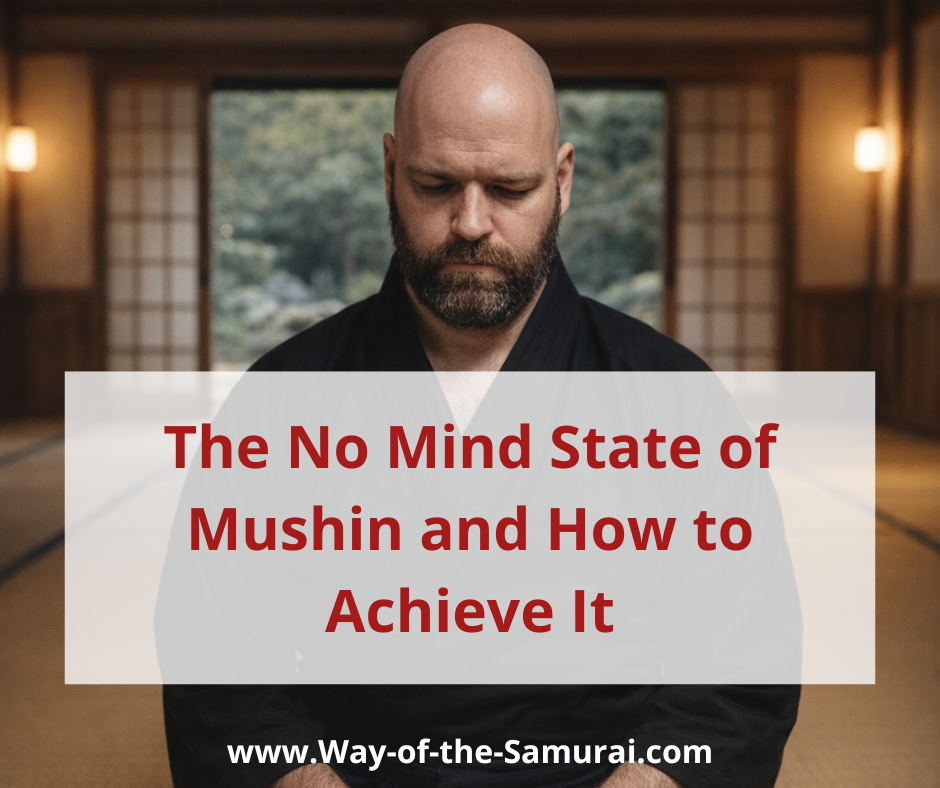
What is the no mind state of mushin (無心)? This state of mind is central to the Japanese martial arts and refers to a state of mind free from distracting thoughts. Unlike the literal translation suggests, this is not the absence of thought but rather a heightened awareness unclouded by mental chatter, fear, or anticipation.
Think back to Tom Cruise’s character, Nathan Algren, in “The Last Samurai”,
“Nobutada: Please forgive; too many mind.
Algren: [puzzled] "Too many mind?"
Nobutada: Hai, mind the sword, mind the people watch, mind enemy - too many mind.
Nobutada: [seriously] No mind.
Algren: [pretending getting it] No mind.” (1)
In the practice of Iaido, Jodo or Kenjutsu, the no mind state of mushin emerges naturally through years of diligent training. As techniques become deeply ingrained in body memory, the mind can release conscious control and allow movements to unfold naturally. This state of flowing awareness represents the highest level of performance.
The most obvious example of this in class is usually when a student asks, “How did you do that? Did you move the left foot first or the right?”, and I can’t answer. I don’t know how I did it. I wasn’t thinking about it. I just did it. Natural. In Western Sports performance, we might term this “unconscious competence”.
While the no mind state of mushin might seem esoteric, we've all experienced glimpses of this state - moments of complete absorption when we perform at our best without self-consciousness. Budō offers a systematic path to cultivating this quality intentionally rather than accidentally, but let me come back to that.
Yagyū Munenori, who was the official sword instructor to the Tokugawa shoguns, wrote in the “Life-Giving Sword” that the ideal state of mind, mushin, was like that of a clear mirror that reflects everything without holding onto any image.
“Because a mirror is always clear and has no form within it at all, the form of whatever stands before it will be clearly reflected. The breast of a Man of the Way is like a mirror: it does nothing and is perfectly clear. Thus, he has No-Mind, and in all things lacks nothing. This is the ordinary mind. A man who accomplishes everything with this ordinary mind is said to be a master” (2)
That might be a little hard to grasp, but really, the idea of Mushin/No-mind as the Ordinary Mind is something that you’ve experienced. When I am with my students and patients, I demonstrate it by gently tossing a pen or some little item towards them and saying, “Catch!”
Without thinking, their hands shoot up and catch it. They didn't plan this. They didn't analyse the trajectory or calculate the speed. Their body simply responded. In that brief moment, they experienced something, with an ordinary mind, that Japanese martial artists have studied and cultivated for centuries: Mushin, the state of No-mind.
The no mind state of mushin is one of the most important concepts in traditional Japanese martial arts. Mushin doesn't mean having a blank brain or being unconscious. Instead, it describes a state where your mind is so free and flexible that it can respond to anything without hesitation. It's the difference between thinking about what to do and simply doing it. For martial artists, this difference could mean life or death. For the rest of us, understanding mushin can transform how we approach challenges, learn new skills, and handle pressure.
Where The No Mind State of Mushin Mushin Comes From
The concept of mushin has its roots in Chan/Zen Buddhism, which arrived in Japan from China during the medieval period. Buddhist monks discovered that meditation could produce a particular quality of mind - one that was alert yet relaxed, focused yet free. When Japanese warriors began studying with these monks, they realised that this mental state was exactly what they needed in combat.
The most famous exploration of this connection comes from Takuan Sōhō, a Zen master who lived in the early 1600s. Though not a swordsman, Takuan’s influence on martial thought is profound as he wrote a series of letters to Yagyū Munenori, who was the official sword instructor to the Tokugawa shoguns. These letters were later collected into a book called The Unfettered Mind. In this remarkable text, Takuan explains how the Zen principle of No-Mind...
“The No-Mind is the same as the Right Mind. It neither congeals nor fixes itself in one place. It is called No-Mind when the mind has neither discrimination nor thought but wanders about the entire body and extends throughout the entire self. The No-Mind is placed nowhere. Yet it is not like wood or stone. Where there is no stopping place, it is called No-Mind. When it stops, there is something in the mind. When there is nothing in the mind, it is called the mind of No-Mind. It is also called No-Mind-No-Thought.” (3)
“The function of the intellect disappears, and one ends in a state of No-Mind-No-Thought. If one reaches the deepest point, arms, legs and body remember what to do, but the mind does not enter into this at all…While hands, feet and body may move, the mind does not stop any place at all, and one does not know where it is. Being in a state of No-Thought No-Mind” (4)
In his writings to Munenori, Takuan focuses on a single danger: the mind that stops.
According to Takuan, the moment the mind stops on anything - an opponent’s sword, a plan, a technique, a fear - it loses its freedom. A stopped mind cannot respond fully to changing circumstances. Even if one has excellent technique, fixation creates delay, hesitation, or inappropriate action.
“If ten men, each with a sword, come at you… and go from one to the next, you will not be lacking in a proper action for every one of the ten… But if the mind stops before one of these men, the right action will have slipped away.” (5)
Takuan explains the no mind state of mushin as a mind that “abides nowhere.” This does not mean the mind disappears. Instead, it moves continuously, like water flowing around obstacles. Because it does not settle in one place, it is available everywhere. When action is needed, it appears immediately and naturally.
“When this No-Mind has been well developed, the mind does not stop with one thing nor does it lack any one thing. It is like water overflowing and exists within itself. It appears appropriately when facing a time of need” (6)
An important point Takuan makes is that mushin cannot be forced. Trying to “empty the mind” only adds another thought to cling to. Even telling oneself “do not think” becomes a form of thinking. Mushin develops gradually as a result of correct training and understanding. When the mind is no longer obsessed with controlling itself, it begins to function freely.
“An old poem says:
To think, "I will not think"-
This, too, is something in one's thoughts.
Simply do not think
About not thinking at all.” (7)
For Takuan, this principle is universal. It applies not only to swordsmanship, but to any activity that requires timing, sensitivity, and clarity. The unfettered mind is simply the mind working as it should.
However, Takuan was expounding on these ideas to a swordsman and strategist, Yagyū Munenori, and in his correspondence, Takuan related it in those terms:
“No matter what secret tradition you receive, no matter what technique you use, if your mind is detained by that technique, you will suffer defeat. Your mind should not be detained - whether by the actions of your opponent, by your own actions, or by cutting and thrusting. This is essential.” (8)

Yagyū Munenori further developed these ideas and applied them to swordsmanship and military strategy.
Yagyū Munenori: The No-Mind State of Mushin as Strategy and Responsibility
As mentioned, Yagyū Munenori was a master swordsman and the martial instructor to the Tokugawa shoguns. He was the founder of the Edo branch of Yagyū Shinkage-ryū and author of the Heihō kadensho (兵法家伝書) (A Hereditary Book on the Art of War, now commonly referred to by the title of one of its three scrolls, The Life-Giving Sword).
Munenori had to bridge the gap between Zen philosophy and practical combat, and he did so brilliantly. Munenori presents mushin in language shaped by his real-world responsibilities. While he draws deeply from Zen thought - especially from Takuan -his concern is application.
Munenori often describes the no mind state of mushin as “the mind that does not stop.” Like Takuan, he warns that when the mind stops on the opponent, on fear, or on the desire to strike, defeat follows. But Munenori adds a strategic layer. A stopped mind narrows awareness. It sees only one option and misses the larger situation.
“...if the mind stops with the sword with which a man is going to strike you, there will be an interval, and your own action will be lost. But if the interval between your opponent’s striking sword and your own action is narrower than the breadth of a hair, your opponent’s sword should become your own” (9)
He also introduces the idea of immovable wisdom (fudōchi). This may sound like rigidity, but Munenori explains it carefully. An immovable mind is not fixed. It is immovable because it does not cling. Since it is not pulled around by emotion or ego, it remains stable even in chaos. At the same time, it can move freely and respond instantly.
“The mind that releases the mind is one that is let go and does not stop. If you maintain such a released mind, your movements will be free.” (10)
One of Munenori’s most important teachings is the distinction between the killing sword and the life-giving sword. The killing sword comes from a mind fixed on the self, on winning, dominating, or destroying. The life-giving sword comes from mushin. Because the mind is clear and unbiased, action is precise and minimal. Often, conflict is resolved before violence is necessary.
When we fix our attention too firmly on one thing, we become vulnerable to everything else. If a swordsman focuses entirely on his opponent's blade, they might miss the subtle shift in footwork that signals an attack from a different angle. If they focus on winning, their anxiety might slow their reactions. The solution, then, is to let the mind flow freely without attachment to any particular thing.
“If your mind stops at something and does not return to its original quality, your skill in the martial arts will be truncated. For this reason, it is not only in the martial arts that you do not stop the mind in one place. This principle extends to all things.” (11)
For Munenori, the no mind state of mushin is not only a martial skill. It is a moral one. The same no-mind required to wield a sword correctly is required to govern people fairly and make wise decisions.
Be Water, My Friend
One of the best ways I ever heard the no mind state of mushin being described was in a 1971 episode of “Longstreet”. Specifically in the episode titled "The Way of The Intercepting Fist", featuring Bruce Lee, a great martial arts philosopher in his own right (and one of the reasons I went on to go to college and get a degree majoring in Philosophy and Classical Civilisations).
"If you try to remember, you will lose. Empty your mind. Be formless, shapeless, like water. Now, you put water into a cup; it becomes the cup; put it into a teapot, it becomes the teapot. Now, water can flow, or creep, or drip or crash. Be water, my friend” (12)
He repeated this again in a famous interview with Pierre Berton in 1971, as this concept of Mushin, this emptiness of the mind, was fundamental to Bruce’s development of Jeet Kune Do. Like water, a mind in mushin adapts instantly to whatever situation arises.
This doesn't mean being passive or limp. Water can also be incredibly powerful. Think of a river carving through rock over time, or a wave crashing against the shore. The power comes precisely because water doesn't resist its own nature. It flows where it needs to flow with complete commitment. A martial artist in mushin responds with this same quality - adapting to each moment with full presence and power.
How to Cultivate The No Mind State of Mushin
So how do you actually develop the no mind state of mushin? The traditional martial arts texts suggest several approaches that remain valuable today.
- First and most importantly, there is no substitute for practice.
Mushin is not a trick or a technique that you can simply decide to use. It emerges naturally when your skills become so deeply ingrained that they no longer require conscious direction. Munenori emphasises this point, reminding students that "the mind that has reached mastery of an art leaves the art behind" (Munenori, 2003, p. 89). This mastery only comes through dedicated, repetitive training. Whether you're learning a martial art, an instrument, a sport, or any other skill, the path is the same: practice until your body knows what to do without your mind having to direct it.
- Second, meditation helps.
This isn't surprising, given Mushin's Zen roots. Regular meditation practice trains your mind to settle into stillness and to release thoughts rather than grasping them. You don't need to become a monk or sit for hours. Even ten or fifteen minutes of daily meditation can make a difference. The goal is to become familiar with that quiet, spacious quality of mind so that you can access it more easily in active situations.
- Third, learn to notice when your mind "stops" or becomes fixated.
This is where self-awareness becomes crucial. During practice or performance, pay attention to moments when you feel stuck, tense, or overthinking. What is your mind attaching to? Is it fear of failure? Desire for approval? Frustration with yourself? Simply noticing these patterns begins to loosen their hold. As Takuan advised, "Even if the mind is moved, if it does not stop at the thing toward which it moved, it will be able to go on freely to an infinity of things" (Takuan, 1986, p. 24).
- Fourth, trust yourself.
This might be the hardest part for many people. Mushin requires a willingness to let go of conscious control and trust that your training will carry you through. This feels risky because we like to feel in control. But as these texts consistently teach, the grasping for control is itself the problem. True mastery looks like letting go.
As Always, The Journey Continues
Mushin is not a destination that you reach once and then possess forever. Even master martial artists describe it as something that comes and goes, something that requires constant cultivation. Some days, everything flows. Other days, the mind is restless and the old patterns of grasping and stopping return. This is normal and should not discourage you.
What matters is the direction of your practice. Each time you catch yourself overthinking and gently return to presence, you strengthen the habit of mushin. Each hour of dedicated practice makes your skills more automatic, more available without thought. Each meditation session familiarises you with that calm, spacious awareness.
The Japanese martial artists who developed these teachings were practical people. They faced life-and-death situations and needed methods that actually worked. The fact that their insights have survived for over four hundred years tells us something important. Mushin isn't just an abstract philosophical idea. It's a description of how human minds work at their best - free, flexible, fully engaged, and unburdened by excessive thinking.
Whether you're stepping onto a sports field, walking into an exam, or simply trying to navigate the challenges of daily life, the wisdom of mushin remains relevant. Let your mind be like water. Practice until your skills become second nature. And when the moment of action arrives, trust yourself and let go.
If you're interested in learning more about Mushin and Japanese Philosophy, including the extended edition of this article, check out my books on Samurai Philosophy.
Samurai Strength Vols 11&12: Living the Warriors Way.
Footnotes
- he Last Samurai. Directed by Edward Zwick. Released 2003; Santa Monica, CA: Warner Bros. Pictures, 2003, Blu-ray/DVD.
- Yagyū, Munenori. The Life-Giving Sword: Secret Teachings from the House of the Shogun. Translated by William Scott Wilson. Boston, MA: Shambhala, 2012. ISBN 9781590309902.
- Takuan Sōhō. The Unfettered Mind: Writings from a Zen Master to a Master Swordsman. Translated by William Scott Wilson. Boston: Shambhala Publications, 2012. ISBN 9781590309865.
- Ibid
- Ibid
- Ibid
- Ibid
- Yagyū, Munenori. The Life-Giving Sword: Secret Teachings from the House of the Shogun. Translated by William Scott Wilson. Boston, MA: Shambhala, 2012. ISBN 9781590309902.
- Ibid
- Ibid
- Ibid
- Bruce Lee in “Longstreet”, "The Way of the Intercepting Fist", 1971
If you'd like to train in authentic Japanese Martial Arts, those same warrior skills developed by the samurai, check out my dojo at DublinKendo.com
- - - -
If you want to get in great physical, mental and emotional shape using the same principles and techniques inspired by the feudal warriors and healers of Japan, check out my Samurai Strength Programs.
You've been reading about the no mind state of mushin. Read more Samurai Philosophy Here
Click here to return to the Way of the Samurai Home Page.
You might like these
How to Tie a Sageo and It's Importance for Iaido
How to Tie a Sageo and It's Importance for Iaido
What is Koryu Bujutsu
What is Koryu Bujutsu - Defining a Life Through the Arts of War
Are You Secretly Practicing Samurai Magic?
Are You Secretly Practicing Samurai Magic?


About the Author

Paul Batman O’Brien is passionate about sharing the wisdom of martial arts to help solve our daily problems. He teaches both gendai (modern) and koryu (classical) Japanese martial traditions for Dublin Kendo Kobukai, holding 5th Dan in Iaido, 4th Dan in Jodo, and serving as dojo leader for Hyōhō Niten Ichi Ryū in Ireland.
With over 40 years in martial arts and 20+ teaching, he is a multi-time international medalist, and has represented Ireland at the European Championships for both Iaido and Jodo many times.
He was a lead writer for Irish Fighter Magazine for over 15 years, with over 100 published articles and is the author of multiple books on martial arts, strength and fitness, eastern medicine, and philosophy.
When not teaching martial arts, he owns and operates the Meridian Acupuncture Clinic.


Free Samurai E-books

Get Free Exclusive Samurai Guides and E-books
Subscribe Now
My Best Selling Samurai Fitness Program
Top Viewed Pages