The Hidden Benefits of Jodo
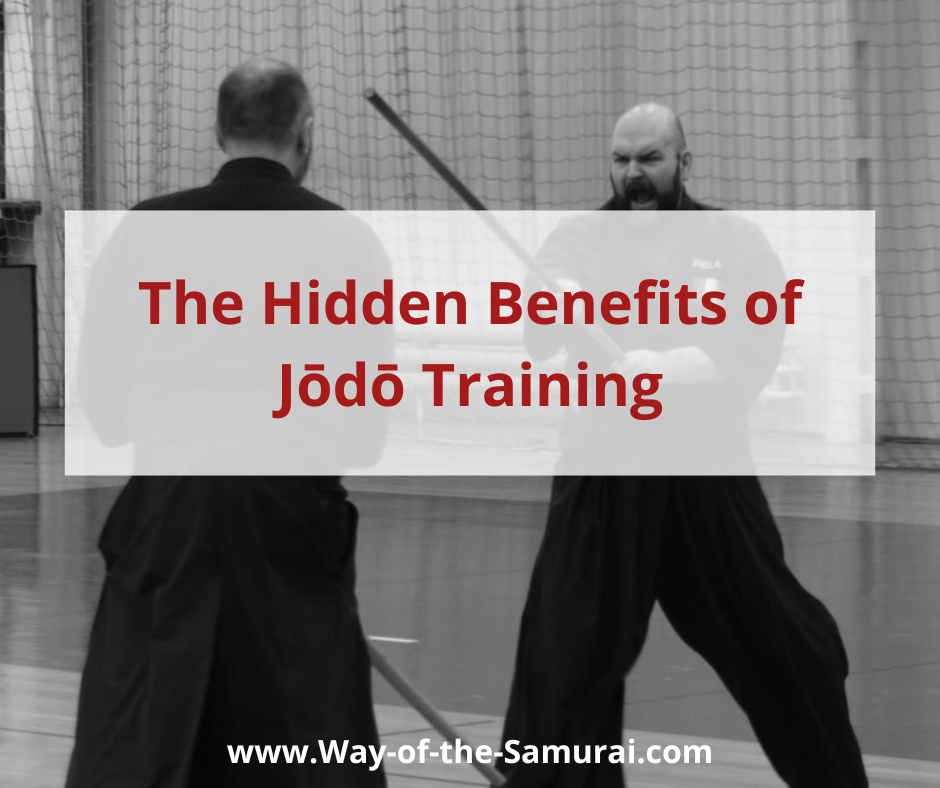
The Hidden Benefits of Jodo are profound. When most people think about martial arts training today, their minds immediately jump to self-defence applications or competitive sporting aspects. While these elements certainly exist in many disciplines, traditional Japanese martial arts like jōdō offer a far richer tapestry of benefits that extend well beyond fighting capability (despite jōdō being one of the most practical self-defence arts, and I say this as a specialist reality-based personal protection instructor of 20 years). These "hidden benefits of Jodo" often become the most treasured aspects of training for long-term practitioners, transforming what might begin as a practical pursuit into a lifelong journey of self-improvement.
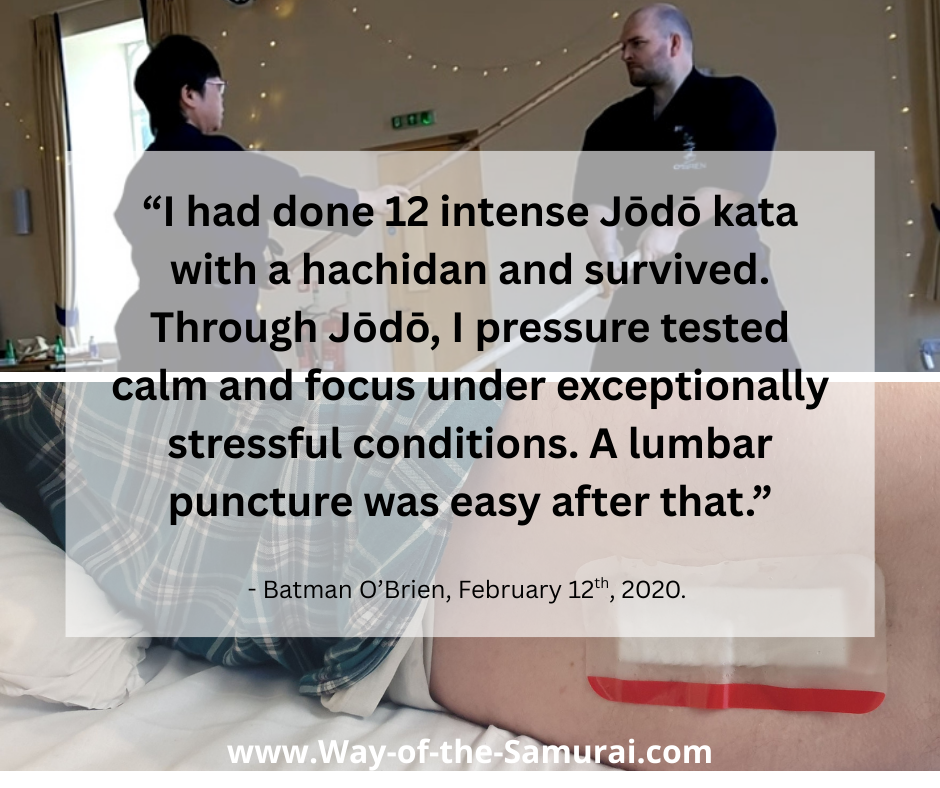
"The reason for this is that there has never been an era more in need of both the principles and techniques of Shintō Musō-ryū Jōdō than today. In our current society, dominated by materialism, the imbalance between spirit and matter is worsening rapidly, and surely no one is free from concern about the consequences. The final destination of a disharmonized humanity is a barren society overwhelmed by mistrust among people.
The core philosophy of Shintō Musō-ryū Jōdō is for people to seek inner depth as human beings while striving to create harmony between body and spirit.”
- Shimizu Takaji, Shintō Musō-ryū Jōdō Shihan (1)
I’m going to break these hidden benefits of Jodo into a number of distinct categories: Physical, Mental, Character, Emotional and Spiritual. Some of this comes from my own reflection of teaching Jōdō for a few years now, and my reflections on the texts of the luminaries of the art, others come directly from instruction from senior sensei, and some will be straight out quotations. It is my hope that reflecting on these ideas will allow the Jōdō student to see the wider implications of simply swinging a stick around
The Physical Hidden Benefits of Jodo: A Holistic Approach to Fitness
One of the most impactful hidden benefits of Jodo training (certainly for me) provides a remarkably balanced form of physical exercise that develops the entire body in ways that many modern fitness programs fail to address. Unlike specialised sports that might overdevelop certain muscle groups while neglecting others, jōdō cultivates strength, flexibility, and coordination throughout the body. It does this by developing the muscles, the cardiovascular system and nervous system in a method unique to Japanese weapons arts.
“From the perspective of medicine, the bones, muscles and nerves on the right and left sides are equally useful, and this is a great thing” (2)
Perfect Posture and Alignment
Perhaps the most immediately noticeable physical hidden benefit of jodo training is improved posture. The body speaks volumes in a silent language through posture. This language, understood by practitioners across various disciplines, reveals combative psychology, spiritual intentions, readiness, and even character. At the centre of this physical vocabulary is the concept of kamae - formal stances that are far more than mere body positions.
“Kamae is not just how you stand," explained the late Jōdō master instructor Tsunemori Kaminoda. "It is how you prepare your body, mind, and weapon to respond to any situation. It is the physical manifestation of your martial readiness." (3)
The word kamae (構え) combines the ideas of "structure" and "readiness." Unlike casual postures we adopt in daily life, kamae in martial arts are deliberate positions designed to maximise both defensive protection and offensive potential. They represent the distilled wisdom of centuries of combat experience.
The fundamental stances in jōdō require proper skeletal alignment, with the back straight, shoulders relaxed, and weight distributed correctly between the feet. This attention to posture carries over into everyday life, helping practitioners counteract the slouching habits that often develop from desk work, driving, and screen time.
Balance and Stability
The dynamic movements in jōdō require exceptional balance. When performing techniques such as hiki otoshi uchi (pulling down strike), the practitioner must maintain stability while rotating the hips and stepping forward. This constant attention to balance develops the core muscles and proprioception (your body's awareness of its position in space).
Advanced practitioners can execute complex movements while maintaining perfect balance, even when shifting weight or changing direction. This improved balance translates directly to everyday life, reducing the risk of falls and injuries, particularly as we age.
This is something I am particularly sensitive to and have greatly benefited from. In February of 2020, while I was meant to be attending a Jōdō seminar with Ueda Sensei, Hachidan Hanshi, I was instead lying in a hospital bed unable to walk, balance, stand or move my left leg. Despite this severe inconvenience, I still tried my best to participate, arranging my feet into the different stances, photographing them and sending them to my teachers at the seminar!
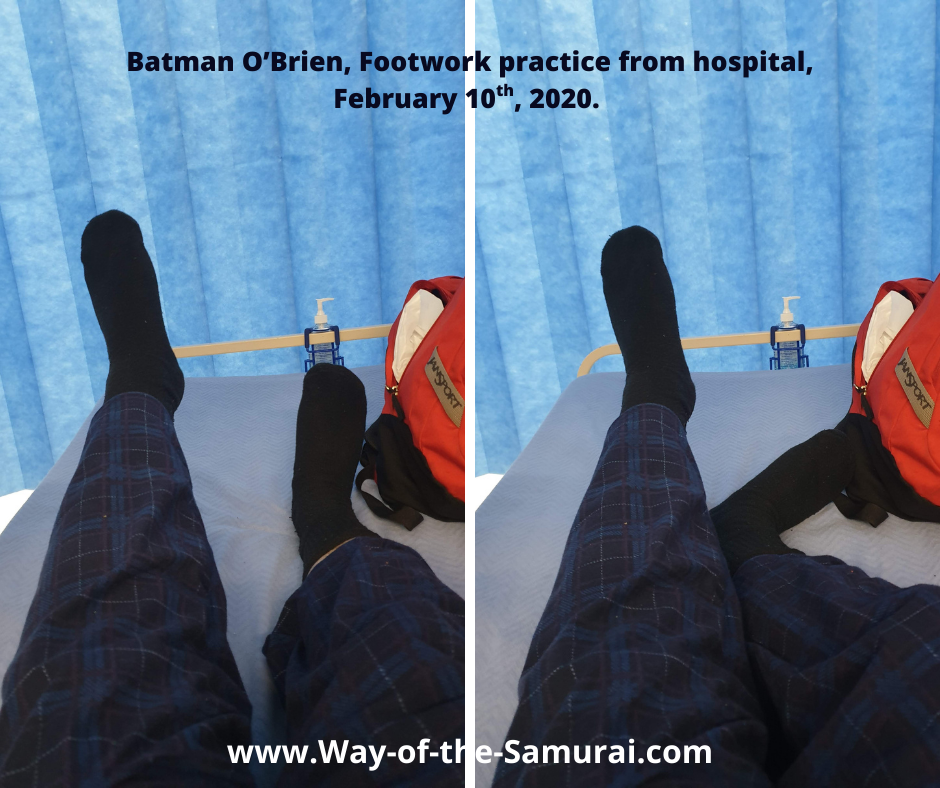
After many tests, I was diagnosed with Multiple Sclerosis. This is an incurable, progressive neurological disease. It impairs the ability to balance and coordinate your muscles, often resulting in disorganised spasticity, along with fatigue, cognitive problems, intense pain and a whole host of other terrible symptoms.
Jōdō has been instrumental in my rehabilitation and the redevelopment of my near-perfect balance. So much so, I can now stand on my left leg, while performing alternating front and side kicks with the right leg, while simultaneously touching my nose with my index finger alternating between my outstretched arms, while my eyes are closed. I can also rapidly spin 180 degrees, trap an opponent’s hands with my jō, rapidly spin in the opposite direction 180 degrees, controlling my opponent, entering into their space and disrupting their balance, while maintaining my own.
Coordination and Ambidexterity
Jōdō demands coordination between the hands, feet, and eyes. The jō is manipulated with both hands, often requiring different actions from each hand simultaneously. For example, during gyakute uchi (reverse-hand strike), one hand pulls while the other pushes, coordinating with footwork and maintaining proper distance from the partner.
This bilateral training develops ambidexterity and neural pathways between the hemispheres of the brain. Unlike sports that favour dominant-side development, jōdō cultivates balanced coordination throughout the body.
Research suggests that this type of bilateral training can improve cognitive function and may even help prevent certain neurological conditions.
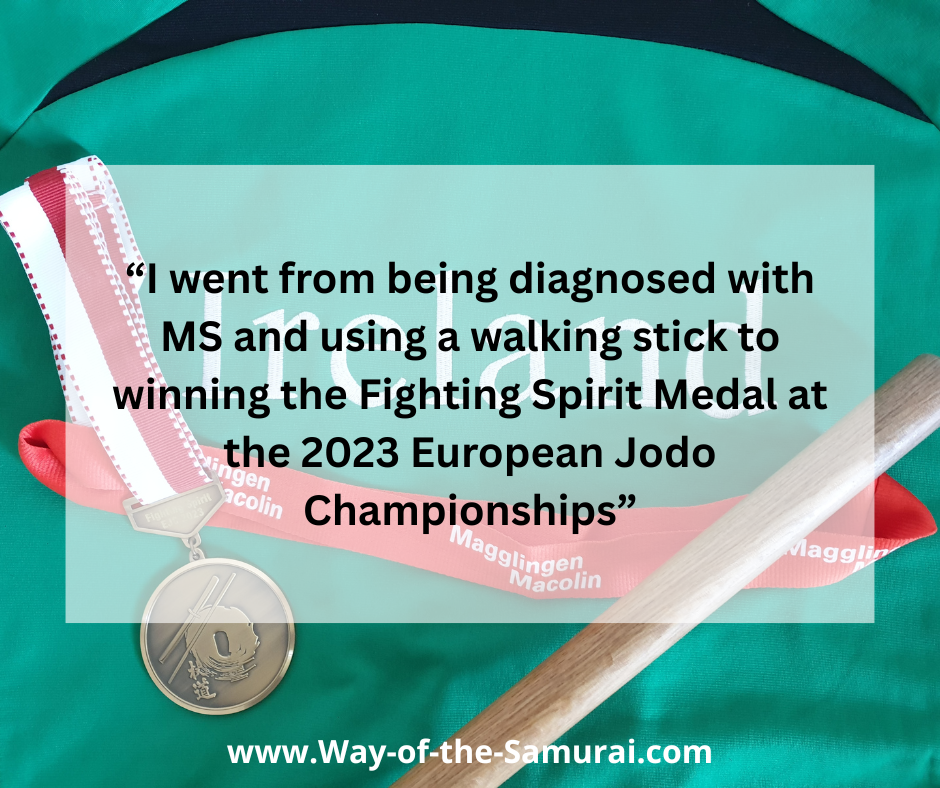
I have certainly used it to rehab and recover from my own incurable neurological condition. Did I mention that I went from being diagnosed with MS and using a walking stick to winning the Fighting Spirit Medal at the 2023 European Jodo Championships!
Full-Body Integration
Perhaps the most distinctive physical benefit of jōdō is how it integrates the entire body into each technique. Power generation comes not from isolated muscle groups but from the coordinated action of the legs, hips, torso, and arms. I often repeat to my students:
"The power of Jōdo techniques comes from the floor. "Your feet grip the floor, your legs transfer force to your hips, your hips direct it through your centre, and only then does it travel through your arms to the Jō."
This integration develops what martial artists call "connected body" movement, where force is transmitted efficiently through aligned joints. Over time, practitioners develop a physical awareness that allows them to perform daily activities with greater efficiency and less strain.
The Hidden Benefit of Jodo: Mental - Cultivating a Focused Mind
While the physical hidden benefits of jodo are significant, many long-term practitioners find the mental aspects even more valuable. Jōdō training creates a unique environment for developing focus, concentration, and mindfulness.
Focus and Concentration
“In our current society, dominated by materialism, the imbalance between spirit and matter is worsening rapidly, and surely no one is free from concern about the consequences. The final destination of a disharmonized humanity is a barren society overwhelmed by mistrust among people.”
- Shimizu Takaji, Shintō Musō-ryū Jōdō Shihan (4)
Shimizu Sensei wrote these prophetic words in 1976. He passed away in June 1978. He never saw the rise of the internet, social media and the age of constant digital distraction, where the ability to focus deeply on a single task has become increasingly rare. Despite this, Shimizu Sensei was right about the antidote to this parasitical attention disease.
Jōdō practice provides a structured environment for developing the skill of maintaining focus and concentration. During training, practitioners must maintain complete attention on their technique, their partner, and the subtle interactions between the jo and the sword.
This focused attention is particularly evident during kata practice, where predefined sequences must be executed with precision while maintaining awareness of timing, distance, and technique. The consequence of a lapse in concentration is immediate and obvious; the technique fails or becomes awkward. This direct feedback loop trains the mind to sustain attention.
Mindfulness and Present-Moment Awareness
Jōdō practice cultivates a state that closely resembles what modern psychology calls "mindfulness", complete attention to the present moment without judgment. When practising jōdō, you cannot afford to dwell on past mistakes or worry about future techniques; you must be completely present.
This mindfulness state, called "mushin" (no-mind) in Japanese martial arts, represents a condition of heightened awareness (“zanshin”) without distraction. In this state, the practitioner responds appropriately to changing circumstances without conscious deliberation, having internalised the principles of the art so thoroughly that responses become natural.
The hidden benefits of jodo mindfulness extend far beyond the dojo. Research has linked mindfulness practice to reduced stress, improved emotional regulation, and greater resilience in the face of challenges - all valuable skills in our high-pressure modern world.
I often tell my patients that you can bypass years of training in meditation and mindfulness with jōdō. You are instantly in the present moment if you have someone armed with a sword coming at you, intent on killing you. :-)
Stress Reduction
The structured nature of jōdō practice provides an effective stress-reduction mechanism. The combination of physical exertion, focused attention, and rhythmic breathing creates a meditative state that many practitioners describe as deeply refreshing.
Unlike activities that simply distract from stress, jōdō training teaches techniques for actively managing it. The controlled breathing practised during techniques helps activate the parasympathetic nervous system (the "rest and digest" response), counteracting the effects of chronic stress.
As a certified master coach in stress relief and a TCM physician, I am continually impressed by the stress management techniques encoded in jōdō.
Character Development: The Philosophical Hidden Benefits of Jodo
Beyond the physical and mental hidden benefits of jodo, it offers something increasingly rare in modern society: a structured framework for character development. The philosophical principles embedded in traditional martial arts guide ethical behaviour and personal growth.
The Three Virtues of Jo
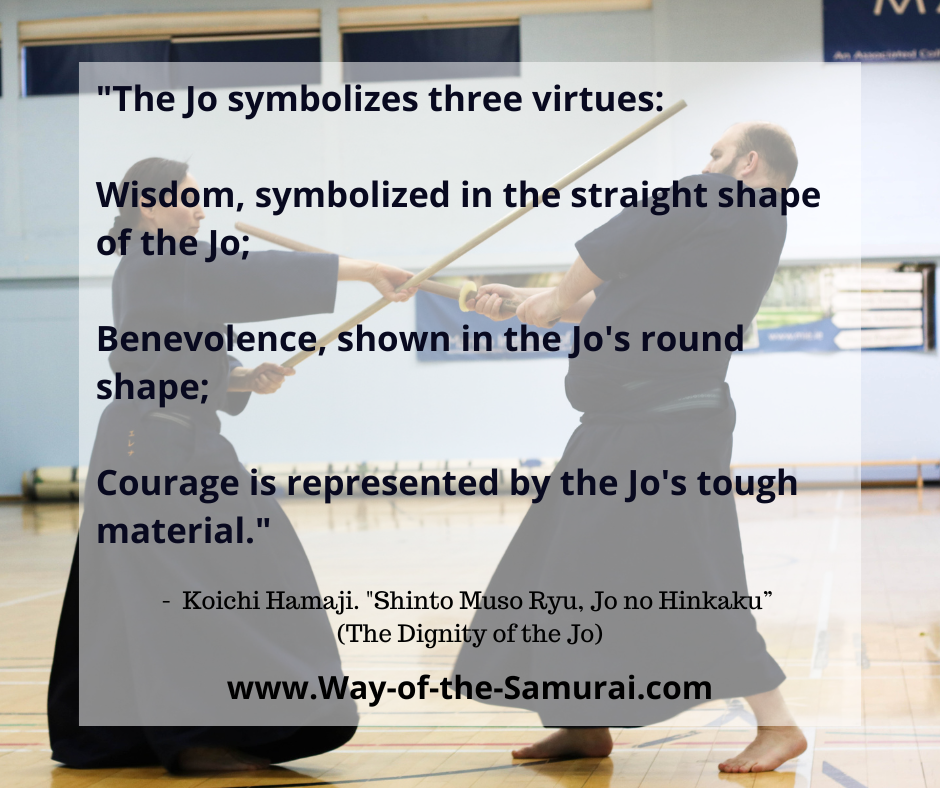
In "Jo no Hinkaku" (The Dignity of the Jo), Koichi Hamaji Sensei explains that the jo embodies three essential virtues (5):
- Wisdom - symbolised by the straightness of the jo, representing clear understanding and direct perception.
- Benevolence - represented by the jo's round shape, symbolising completeness and compassion without sharp edges.
- Courage - represented by the tough material of the jo, symbolising resilience and strength of character.
These virtues aren't merely abstract concepts but qualities actively cultivated through training. The precision required in techniques develops wisdom; the cooperative nature of partner practice fosters benevolence; and the persistence needed to master difficult movements builds courage.
Etiquette and Respect
Jōdō training begins and ends with formal bowing procedures that acknowledge the training space, the teacher, and fellow students. These ceremonies aren't empty formalities but physical expressions of gratitude and respect that set the tone for training.
The relationship between partners in jōdō practice embodies mutual respect. The roles of uchi (striking/attacking side - sword) and shi (doing/receiving side - jō) create a reciprocal learning environment where both participants contribute to each other's growth. This cooperative rather than competitive structure fosters an atmosphere of mutual support.
The handling of training weapons further reinforces respectful attitudes. Students learn precise methods for carrying the jō and sword, placing them down, and passing them to others. These seemingly small details cultivate mindfulness and consideration that extend to all interactions.
Perseverance and Self-Discipline
Progress in jōdō requires consistent practice over years rather than weeks or months. This long-term commitment develops perseverance (nintai) and self-discipline (jishin). Students learn to value gradual improvement and to persist through plateaus when progress seems slow.
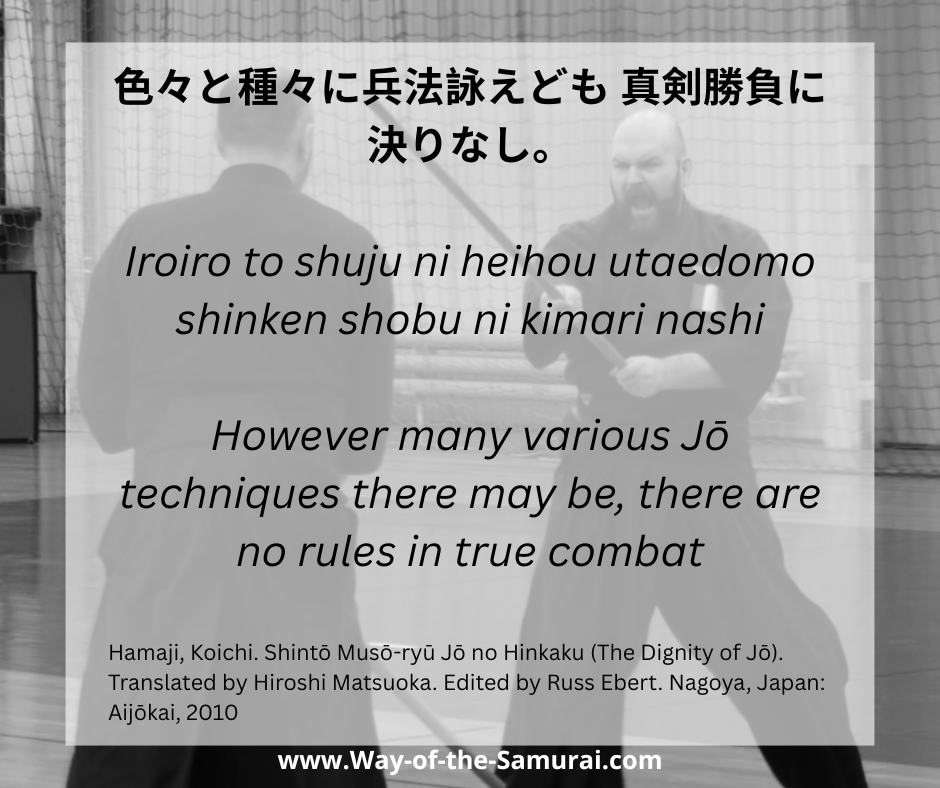
The twelfth Golden Rule of Jo states:
“色々と種々に兵法詠えども 真剣勝負に決りなし。
Iroiro to shuju ni heihou utaedomo shinken shobu ni kimari nashi
However many various Jō techniques there may be, there are no rules in true combat.”
- Koichi Hamaji Sensei (6)
This principle reminds practitioners that mastery isn't about accumulating techniques but developing the judgment to apply principles appropriately in changing circumstances - a lesson applicable far beyond martial arts.
The Meditative Hidden Benefit of Jodo Kata Practice
The heart of jōdō training lies in kata practice - predetermined sequences performed with a partner. While beginners often focus on the external aspects of kata, experienced practitioners discover their meditative dimension.
Moving Meditation
Kata practice becomes a form of moving meditation as practitioners advance. The precise, repeated movements create a rhythmic flow that calms the mind while maintaining heightened awareness. This state resembles what psychologist Mihály Csíkszentmihályi termed "flow" - complete absorption in an activity where challenge and skill are balanced.
The eighth Golden Rule of Jō advises:
“古き形少しもたがわずくり返せ 自然に身につく氣杖体
Furuki kata sukoshi mo tagawazu kurikaese shizen ni minituku ki jo tai
Practice the time-honored techniques repeatedly. Imitate them exactly as your teacher shows. Aim at attaining a perfect unity of body and spirit with the Jo.”
- Koichi Hamaji Sensei (7)
This unity represents a meditative ideal where the distinction between practitioner and practice dissolves.
Kata as Philosophical Texts
I often refer to kata as “physical philosophy”. Each kata contains encoded principles that reveal themselves gradually through practice. What begins as physical movement evolves into philosophical insight as practitioners discover the underlying principles of timing, distance, and interaction.
For example, the kata "Tsukizue" (Arriving Stick) teaches not only technical skills but principles of yielding to superior force before countering - a lesson I think applicable to many of life's challenges. Similarly, "Midare Dome" (Turbulence Control) embodies principles of maintaining composure amid chaos.
These kata weren't created arbitrarily but emerged from profound understanding. These original techniques have undergone the test of time and have developed into 64 kata/forms today. The ninth form of Okuden is Aun, which is just a single hidari-honte-uchi. The simplicity of this near-final technique - returning to a fundamental movement after mastering complexity - I think reflects the concept of returning to beginnings with a deeper understanding.
The Hidden Benefit of Jodo: Jodo Training Transfers to Everyday Life
The hidden benefits of jodo extend well beyond the training hall, influencing how practitioners navigate daily challenges and relationships.
Enhanced Awareness and Perception
Jōdō training heightens sensory awareness, particularly kinesthetic and visual perception. Practitioners become more attuned to their surroundings, noticing details others might miss. This enhanced awareness improves safety in everyday situations and enriches experience by bringing attention to details often overlooked.
The concept of "enzan no metsuke" (gazing at distant mountains) taught in jōdō - looking at the whole scene rather than fixating on a single point - develops peripheral awareness that proves valuable in everything from driving to navigating crowded spaces. This also teaches us to develop a “God’s Eye View” to problems in our lives, removing ourselves from the immediacy of crisis and giving us the perspective to navigate a solution. Conflict Resolution Skills
Though jōdō teaches techniques for addressing physical conflict, its principles apply equally well to verbal and social conflicts. The concepts of ma-ai (proper distance), timing, and appropriate response transfer directly to interpersonal interactions.
Jōdō teaches that the most effective response isn't always direct confrontation. Sometimes, yielding before countering (as in hiki otoshi techniques) or redirecting energy (as in maki otoshi) provides better results than head-on opposition. These strategic principles apply equally well to workplace disagreements or family disputes.
The First Golden Rule of Jō, according to Hamaji Sensei, states: "As the jo helps a man, it is also the path of the samurai."
“身をもって人を助ける杖のごと この姿こそ士の道
Mi o motte hito o tasukeru tsue no goto kono sugata koso mononofu no michi
As the jō helps a man, it is also the path of the samurai.”
- Koichi Hamaji Sensei (8)
This rule reminds practitioners that the ultimate goal is not to defeat others but to support and guide - a principle that transforms potential conflicts into opportunities for mutual benefit.
Mental Resilience
Perhaps the most valuable everyday benefit of jōdō training is increased mental resilience. The practice of maintaining focus and composure under pressure develops the ability to stay calm in stressful situations.
When facing life's inevitable challenges, jōdō practitioners draw on their training to maintain balance - literally and figuratively. The physical stability cultivated through stance training becomes a metaphor for emotional stability in difficult circumstances. Submitting to intense kata practice against experienced, lightning-fast, and deadly precise partners prepares you to face the worst stress with grace, confidence and dignity. I’m speaking again from personal experience.
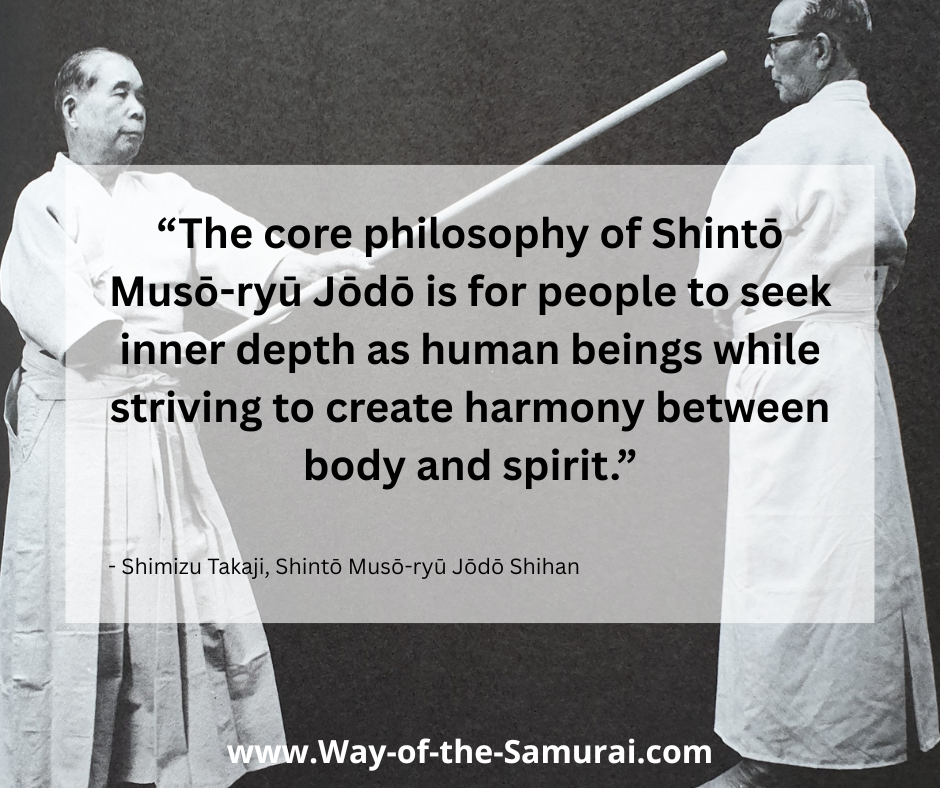
On February 12th, 2020, my wife sat terrified watching me live through one of the worst experiences of her life - a lumbar puncture. The colloquial “spinal tap”. Having a large, thick needle inserted into your back and extracting cerebral spinal fluid is not, at the best of times, a pleasant experience. The junior doctor performing the procedure, under the supervision of a more senior doctor, of course, was having a hard time differentiating between my spine and my muscle tissue.
I took my phone, used the selfie setting as a mirror and provided direction. I never flinched, never jumped. My wife asked me how I had remained so completely calm during the procedure. I replied that I had done 12 intense Jōdō kata with a hachidan and survived. Through Jōdō, I pressure tested calm and focus under exceptionally stressful conditions. A lumbar puncture was easy after that.
Transformations Through Jōdō
Obviously, I’m not the first to receive the hidden benefits of jodo. The impact of jōdō training is perhaps best illustrated through the experiences of practitioners who have discovered these hidden benefits firsthand.
Consider the case of the great kenshi (sword saint) Nakayama Hakudō (Hiromichi), who became a master in three martial ways - kendō, iaidō, and jōdō. Regarding Shindo Musō Ryū jōdō, he stated:
“In my youth, I was taught by Shindō Musō Ryū jōdō shihan, Uchida Ryōgorō sensei, and for the first time I understood the other side of kendo. I learned the special way of handling the jō, the manipulation of the feet, the carriage of the body, and so forth. Even in kendo practice I cultivated jōdō techniques. Thanks to that I learned a great deal. There are no other kata as well developed as those of Shindō Musō Ryû jōjutsu. So I understood that Shindō Musō Ryû jōjutsu was like a national treasure budō.”
- Nakayama Hakudō Sensei (9)
This cross-fertilisation between the arts demonstrates how jōdō's principles enhance other disciplines and activities. The body awareness, timing, and distance perception developed through jōdō benefit everything, from other martial arts to dance, sports, and everyday movement.
Modern practitioners often report unexpected benefits from their training. Many discover that improved posture alleviates back pain that had troubled them for years. Others find that the focused attention cultivated in the dojo helps them perform better at work or in academic pursuits. Some notice enhanced interpersonal skills as they apply the principles of timing and appropriate response to conversations and relationships.
One particularly valuable benefit in our digital age is the "digital detox" that jōdō practice provides. For two hours in the dojo, practitioners must be completely present, free from the notifications, alerts, and distractions that fragment attention in daily life. Many report that this regular period of focused presence becomes essential to their mental well-being.
The Lifelong Journey of Improvement
Unlike achievements that can be completed and set aside, jōdō offers a path of continuous growth and discovery. The thirteenth Golden Rule of Jo states:
“"杖により武徳をつみしその力 我にとどめず末永く傳えよ。
Jo ni yori butoku o tsumishi sono chikara ware ni todomezu suenagaku
Do not confine the virtue and power attained through practising Jo. Hand them down from generation to generation.”
- Koichi Hamaji Sensei (10)
This perspective transforms jōdō from a mere skill to be acquired into a lifelong journey of improvement - not just for oneself but for others. Many practitioners discover that teaching becomes an important part of their practice, offering new insights and a deeper understanding of techniques they thought they had mastered.
The joy of this continuous discovery keeps practitioners engaged decade after decade. Unlike activities that become routine or boring with repetition, jōdō reveals new layers of meaning and challenge as practitioners advance. What begins as a physical challenge evolves into technical refinement, then philosophical insight, and finally becomes a vehicle for personal expression.
Conclusion: The Wholeness of Jōdō Practice
The hidden benefits of jod0 training reveal why this classical martial art has survived for over four centuries despite the radical changes in Japanese society and warfare. Its value lies not primarily in combat effectiveness but in its comprehensive approach to human development - physical, mental, and spiritual.
Through consistent practice, jōdō develops not just fighting skills but the qualities needed to live well: awareness, balance, focus, resilience, and respect. These qualities serve practitioners in all aspects of life, from professional challenges to personal relationships.
If you're considering beginning jōdō training, recognise that you're embarking on more than just learning techniques with a wooden staff. You're entering a rich tradition that offers a structured path for holistic self-improvement. The visible benefits - improved fitness, coordination, and self-defence skills - are just the beginning. The hidden benefits of Jodo - enhanced mental focus, emotional balance, calmness under pressure, and character development - reveal themselves gradually through dedicated practice.
As with any worthwhile pursuit, the benefits of jōdō correlate directly with the sincerity and consistency of your practice. The path is available to anyone willing to step onto it with an open mind and a willing spirit. The journey may begin with learning to hold the jō correctly, but it can lead to profound personal transformation for those who persist.
If you'd like to train with me, and explore the hidden benefits of Jodo, check out the details below.
If you'd like to train in authentic Japanese Martial Arts, those same warrior skills developed by the samurai, check out my dojo at DublinKendo.com
- - - -
If you want to get in great physical, mental and emotional shape using the same principles and techniques inspired by the feudal warriors and healers of Japan, check out my Samurai Strength Programs.
References
- Asakichi Nakajima & Tsunemori Kaminoda. Jōdō Kyohan. Japan Publications Inc. 1976, ISBN4-8170-6415-3 C007. My translation.
- Yoneno Kotaro and Hiroi Tsunetsugu. “Jodo Kyoten”. Airyudo. 2005.
- Asakichi Nakajima & Tsunemori Kaminoda. Jōdō Kyohan. Japan Publications Inc. 1976, ISBN4-8170-6415-3 C007. My translation.
- Ibid.
- Hamaji, Koichi. Shintō Musō-ryū Jō no Hinkaku (The Dignity of Jō). Translated by Hiroshi Matsuoka. Edited by Russ Ebert. Nagoya, Japan: Aijōkai, 2010.
- Ibid
- Ibid
- Ibid
- Kenji, M. “The History of Shindo Musō Ryū Jojutsu”. Trans. Armstrong, H.B. International Hoplology Society, Inc. 2019
- Hamaji, Koichi. Shintō Musō-ryū Jō no Hinkaku (The Dignity of Jō). Translated by Hiroshi Matsuoka. Edited by Russ Ebert. Nagoya, Japan: Aijōkai, 2010.
You've been reading about the hidden benefits of Jodo. Check out the History of Jodo here.
Click here to return to the Way of the Samurai Home Page.
You might like these
Jodo The Way of the Staff: A Basic Introduction
Jodo The Way of the Staff: A Basic Introduction
Jodo Shodan Grading: Sticking it to Irish Martial Arts History
Jodo Shodan Grading: Sticking it to Irish Martial Arts History
The Fascinating History of Jodo: How a Defeat Led to Enlightenment
The Fascinating History of Jodo: How a Defeat Led to Enlightenment

About the Author

Paul Batman O’Brien is passionate about sharing the wisdom of martial arts to help solve our daily problems. He teaches both gendai (modern) and koryu (classical) Japanese martial traditions for Dublin Kendo Kobukai, holding 5th Dan in Iaido, 4th Dan in Jodo, and serving as dojo leader for Hyōhō Niten Ichi Ryū in Ireland.
With over 40 years in martial arts and 20+ teaching, he is a multi-time international medalist, and has represented Ireland at the European Championships for both Iaido and Jodo many times.
He was a lead writer for Irish Fighter Magazine for over 15 years, with over 100 published articles and is the author of multiple books on martial arts, strength and fitness, eastern medicine, and philosophy.
When not teaching martial arts, he owns and operates the Meridian Acupuncture Clinic.
What are your thoughts on the Hidden Benefits of Jodo? Let me know, below.


Free Samurai E-books

Get Free Exclusive Samurai Guides and E-books
Subscribe Now
My Best Selling Samurai Fitness Program
Top Viewed Pages