- Home
- Samurai Philosophy
- The Philosophy Behind Iaido
The Philosophy Behind Iaido
More Than Just Sword Drawing
The philosophy behind Iaido was so profound for me that I’ve based every aspect of my life on it. That’s not an exaggeration - my choice of profession, how I run my businesses, how I conduct myself in my friendships and relationships, how I manage chronic illness, my strength training, my nutrition, how I manage stress and achieve emotional equilibrium - are all based on the philosophical concepts found in Iaido and would later expand to the philosophy found in the other Budo I practice.
When you first see Iaido, the art of Japanese Swordsmanship practised, you might think it's simply about drawing a sword quickly and making precise cuts. However, beneath these elegant movements lies a profound philosophy that has evolved over centuries. Understanding this deeper dimension can transform Iaido from a set of physical techniques into a meaningful path for personal growth and self-discovery.
I have an honours degree in Arts, majoring in Philosophy and Classical Studies. I have worked in Taoist-based Classical Medicine, the same practised by the samurai, for 20 years. I have gone on to write 2 books on the philosophy behind Iaido and Budo - and have over 10 more mini-guides written and ready to go alongside dedicated podcasts - Fighting Tengu and 2nd Dojo, delving deep into these mysteries. For now, I’d like to just give you a brief glimpse into the philosophy behind Iaido. Rest assured, each one of these concepts will have its own separate article too...
From Satsujin-ken to Katsujin-ken: The Sword's Transformation in the Philosophy Behind Iaido.
One of the most important philosophical transitions in Japanese swordsmanship occurred during the peaceful Edo period (1603-1868). With large-scale battles becoming rare, the purpose of sword training shifted dramatically.
Originally, swordsmanship was primarily about satsujin-ken (殺人剣) - "the sword that takes life." The primary goal was effectiveness in combat. However, as Japan entered a long period of peace, a new concept emerged: katsujin-ken (活人剣) - "the sword that gives life."
This shift represents a profound change in perspective. Rather than focusing on defeating enemies, swordsmen began to see their practice as a way to defeat their own weaknesses, overcome ego, and develop a mindful, compassionate character.
As expressed by master swordsman Yagyu Munenori in his classic text "Heiho Kadensho" (The Life-Giving Sword):
“the heart of this work is the idea that the sword that kills people can, on the contrary, become a sword that gives them life. In a chaotic society, many people are killed for no reason. The Death-Dealing Sword is used to bring a chaotic society under control; but once this has been done, cannot that same sword become a Life-Giving Sword?”
“It is missing the point to think that the martial art is solely in cutting a man down. It is not in cutting people down; it is in killing evil. It is the stratagem of killing the evil of one man and giving life to ten thousand”
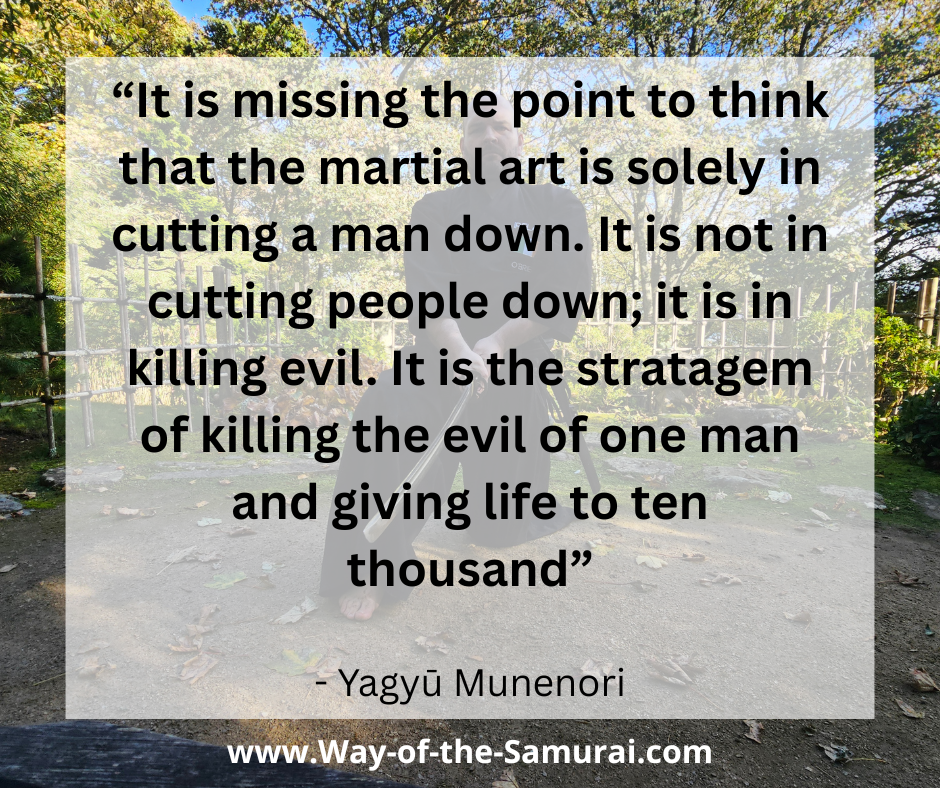
In modern times, this philosophy behind iaido remains central. We practice not to learn how to harm others, but to cultivate awareness, self-control, and positive qualities that benefit ourselves and society.
Zanshin: Continued Awareness
Perhaps the most important philosophy behind Iaido is zanshin (残心), which literally means "remaining mind" or "lingering heart." This term refers to a state of relaxed alertness that continues even after completing a technique.
In practical terms, zanshin is visible at the end of each Iaidō kata, when the practitioner maintains awareness even after resheathing the sword. The body remains poised and the mind alert, ready to respond to any new threat. It also weighs the gravity of the action that has just been committed.
In Iaido, the martial art of Japanese Swordsmanship, we are trained to maintain and show constant zanshin. This is not simply a matter of being aware of our bodies and the physical position we are in, our surroundings or our opponents. In Iaido, defeating and metaphorically “killing” an opponent is a matter of microseconds. The cuts happen fast, yet the performance of a complete technique takes 45-60 seconds on average. In a typical 45-second technique, I’ll spend perhaps at most 1-2 seconds on the action of cutting. The rest, the vast bulk of 43 seconds or so, is spent demonstrating Zanshin.
Awareness. Aware of what I have just done, that I have metaphorically taken a life. Aware of the weight of that. Aware that they may not be dead and could launch a counter-attack. Aware they may have friends…aware of everything. Where I am, who I am, what I am, what I have done, what I am doing, what I will do and the world's reaction to that. My reaction to that.
On a deeper level, zanshin represents a way of moving through life with full awareness. It teaches us to be present not just during dramatic moments but in the quiet spaces between actions. This quality of attention helps us notice small details, avoid careless mistakes, and appreciate each moment.
Developing zanshin in Iaidō practice helps create a habit of mindfulness that extends beyond the dojo. Practitioners often find themselves becoming more attentive in conversations, more careful in their work, and more appreciative of everyday experiences.
This state of awareness is extended to all things. What you eat, how you eat, how you sit, how you walk. Everything is done from a state of zanshin. Zanshin reflects a broader philosophical stance on life. It encourages practitioners to be ever-present, to live fully in each moment, and to carry this heightened state of awareness beyond the dojo into everyday activities. This constant vigilance fosters a sense of calm and readiness, enabling individuals to respond effectively to challenges and opportunities as they arise.
As you can imagine, that takes work and practice, but here's the thing in both Eastern and Western thought on productivity, success and self-management: the most important and most powerful state we can be in is the state of awareness.
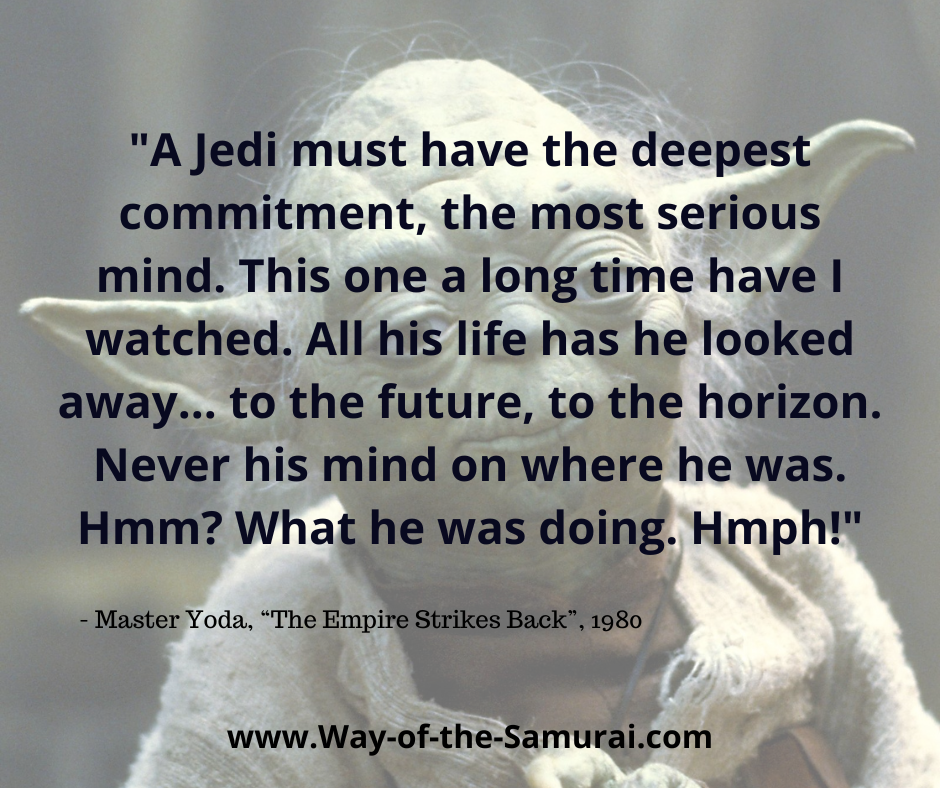 Yoda, calling out the exact opposite of Zanshin.Yoda, calling out the exact opposite of Zanshin.
And while Zanshin has its origins in martial arts, its principles can be applied to various aspects of modern life, enhancing both personal and professional experiences. Here are three practical examples of Zanshin in daily life:
- Driving
Driving is an activity that requires constant attention and quick reflexes. Applying Zanshin while driving means maintaining a high level of awareness of the road, the vehicle, and other drivers. This involves being attentive to potential hazards, anticipating the actions of other drivers, and remaining calm and composed in stressful situations. By practising Zanshin, drivers can improve their safety and the safety of others on the road.
- Professional Environment
In a professional setting, Zanshin can enhance productivity and effectiveness. For instance, during meetings, Zanshin involves being fully present, actively listening, and anticipating potential issues or questions. This heightened state of awareness can lead to better decision-making, more effective communication, and a greater ability to handle unexpected challenges. Moreover, in creative professions, Zanshin can help maintain focus and flow, allowing for deeper engagement with tasks and projects.
- Personal Relationships
Zanshin can also improve personal relationships by fostering better communication and understanding. In conversations, practising Zanshin means truly listening to the other person, being aware of their emotions and non-verbal cues, and responding thoughtfully. This level of attentiveness can strengthen connections, resolve conflicts more effectively, and create a more supportive and empathetic environment.
Awareness, fundamentally, is remembering that you're alive and here. Many of our actions, particularly those that limit and damage us, are taken from a point where we forget, where we are unaware, mindless. Think about popcorn and junk food in front of a cinema screen. You're focused on the on-screen action. Not on what you are eating, how it tastes, if you want it, if you're full, or if you're even enjoying it.
I would encourage you to expand your awareness and see yourself as the witness to your own life. When you can do this and see the bigger picture, you can see the next step on the path to your success much more easily.
Seme: Projection of Intent
Another key concept in the philosophy behind Iaido is seme (攻め), which can be translated as "pressure" or "initiative." In practical terms, seme refers to the projection of focused intent toward an opponent, controlling the psychological space between you.
There's a fairly modern myth about this involving Musashi and the Zen priest Takuan. The two never met, but the lesson contained in this fictional account highlights Musashi's strong seme and the dangers of it. I read this account as a young boy, and the lesson stuck with me.
“Once upon a time the legendary swordsman Miyamoto Musashi was practising zazen beside a stream with his life-long friend and mentor, Zen Master Takuan Soho .
Suddenly, he became aware of another presence nearby. From the corner of his eye, he saw a deadly viper slithering into the clearing toward Takuan.
Knowing that the slightest movement might frighten the venomous snake into attacking his friend, Musashi kept watching the serpent in utter stillness. When Takuan himself became aware of the snake's presence, a faint smile appeared on his face. The snake came toward him and peacefully crawled across his thighs.
The serpent continued on its course toward Musashi. Several feet away, sensing Musashi's presence, he recoiled, preparing to attack, but suddenly scurried away into the bushes. Musashi had not moved. His fierce spirit, undisturbed by the threat of the viper, was so palpable that the snake had speedily moved away in fright.
Most men would be proud to possess such an intimidating aura, but Musashi felt only shame as he suddenly understood his own greatest shortcoming.
“What’s troubling you?” asked Takuan.
"All my life, I have trained myself to develop such skill that no man would ever dare attack me. Now that I have reached my goal, all sentient beings instinctively fear me. You saw how the snake fled from me!"
“I saw it,” the priest said. "Since it dared not attack you, you defeated it without striking a blow, and because of that, both the snake and you are alive now. Why does that sadden you?"
“Because I am so strong that no one can ever grow closer to me. I can never have true peace.” Musashi pointed a finger at the priest. “Not like you”, he said with admiration. "You did not fear the snake, nor did the snake fear you. Your spirit is so calm, so natural, that the snake treated you no differently than the rocks, the trees, or the wind. People accept you that way, too."
Takuan smiled and resumed his Zazen.”
In solo Iaidō kata, although no physical opponent is present, the practitioner must generate real seme, creating a palpable sense of focused energy, just as the story tells us Muashi did with the snake. This mental projection gives life and meaning to the movements, transforming them from empty choreography into vital expressions of intent.
Learning to generate seme requires developing a strong connection between mind and body. Your intention must flow through your posture, breathing, and movement to create a unified presence. This integration of thought and action has applications far beyond martial arts - it's a skill that enhances performance in many areas of life.
Practically speaking, as an acupuncturist (did you know that early acupuncture was often performed with the tip of a sword?), I find that seme and intent through needling substantially increase the efficacy of treatment. In fact, most acupuncturists are utterly unaware that the application of seme was a key component of acupuncture as a medical discipline in classical Chinese and Japanese Acupuncture.
For instance, Volume 9 of The Great Compendium of Acupuncture and Moxibustion by Yáng Jìzhōu discusses this concept of seme/intent (called ‘Yi’ in Chinese Medicine). Contained in the following passage on "Proper Countenance and Praying to the Gods", one finds:
“When holding the needle, do not look to the sides. Your heart has no outside thoughts. It is as if your hand is holding a tiger with the power to capture a dragon.
[This passage describes the concentrated focus and intent within the heart, manifesting in the movement of the hand]
“When you are about to insert the needle, close your eyes and focus your mind for a moment on your needling method. Your heart should contemplate Shénnóng, Huángdi, and True Persons Sūn and Wéi standing solemnly in front of you. Silently say, ‘After my acupuncture treatment, the disease will not relapse.’
Then use the Incantation for Extracting Diseases through the Points, saying:
Great is Qiányuán, the mighty gathering of the gods in the heavens.
The ten-thousand disease will be plucked out when my gold needle reaches the site.
I serve the Most High Lord Lăo. Quickly, quickly, this is a lawful order.”
This is followed by the “Incantation of Acupuncture” and sometimes additional invocations, all to generate a specific intent towards the treatment.
Of course, there are many practical applications of seme in everyday life. For example, in a professional setting, entering a meeting with a prepared presence, maintaining initiative in discussions/negotiations and reading and responding to team dynamics are all examples of seme. In personal development, seme can also be applied to build psychological resilience, develop situational awareness, and create and maintain momentum. Seme is also seen in many of our relationships, when we look at understanding emotional distance, reading subtle social cues and maintaining positive pressure.
Maai: Understanding Space and Timing
Another key philosophy behind Iaido is Maai (間合). This refers to the proper distance and timing in relation to an opponent. Although Iaidō is often practised solo, a deep understanding of maai is essential for techniques to make practical sense. In its most basic form, maai concerns whether techniques can physically reach their targets - whether you're close enough to strike but far enough to avoid being struck, for example. But even this seemingly simple concept contains subtle gradations that traditional arts carefully distinguished.
Japanese swordsmanship identified several critical distances, each creating different tactical possibilities. "To-ma" (遠間) or "long distance" placed opponents at the edge of striking range, where techniques required full commitment to reach their targets. "Chika-ma" (近間) or "close distance" positioned fighters where even small movements could strike effectively, requiring exquisite control and timing. Between these extremes lay "issoku itto no maai" (一足一刀の間合) - "one-step, one-sword distance" - considered the ideal fighting position where a single step could bring one within striking range.
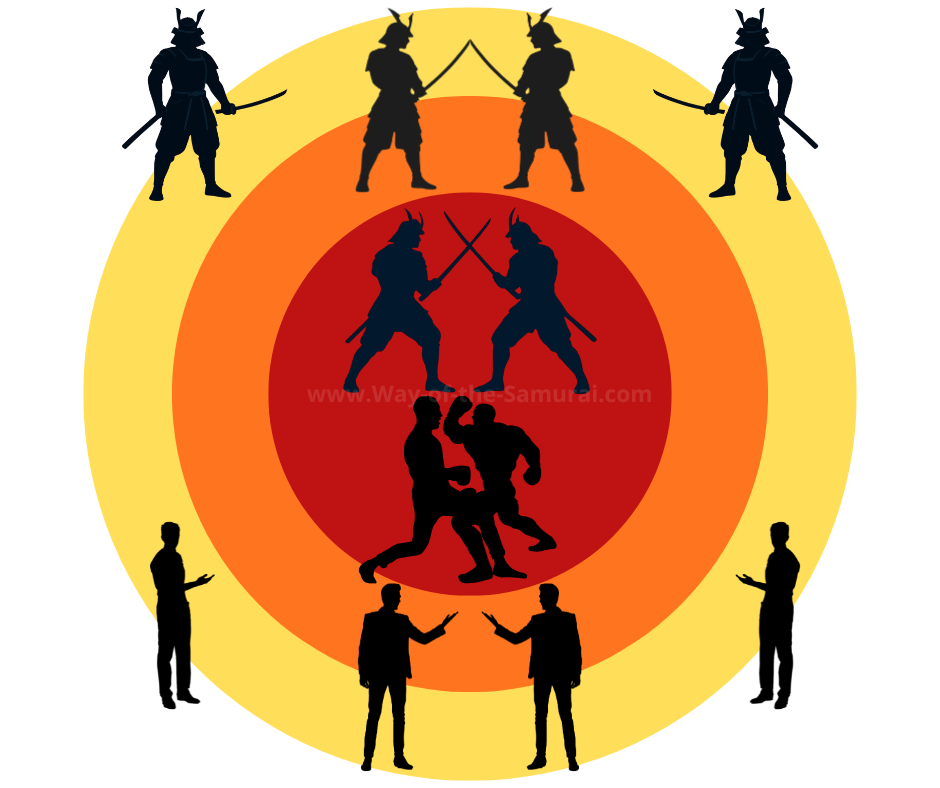
I teach similar concepts when instructing reality-based martial arts. In this instance, it is called the conflict circle.
- Red: The smallest circle in the centre is the red zone. This is touching distance, handshake distance. This is reserved for trusted friends and family members.
- Orange: Outside of the red circle is an orange circle. This is within arm's reach. This could be a professional distance needed for someone to pass you a document or item.
- Yellow: The final circle outside of this is the yellow zone. This circle represents everything outside of one step with an outstretched arm. This is the distance to keep strangers at. In order for any contact to be made, they literally have to step closer.
Of course, this understanding of distance, a key philosophy behind Iaido, is vital for personal safety in today's world. You can see how classical maai and reality-based principles for the modern day align below.
What makes maai more complex than simple measurement is how it changes according to the weapons involved, the physical attributes of the practitioners, and the tactical context. A tall person with long arms has a different effective range than a shorter individual. A sword creates different maai than a spear or an empty hand. The angle of approach, elevation differences, and environmental factors all modify the effective distance for technique application.
This concept teaches sensitivity to spatial relationships and timing - knowing exactly when to act and how much distance to maintain for optimal effectiveness. It requires developing what some teachers call "the eye that sees all distances," an intuitive grasp of spatial relationships.
As always, however, maai is a layered concept. It's not just physical space and timing, the interval... but your mental, emotional space. How emotionally invested are you? How much do you care? Too trusting, too suspicious?
In today's world, maai offers a philosophical lesson about finding appropriate boundaries in relationships and timing in life decisions. Sometimes we need to maintain distance; other times we need to close the gap - understanding when to do which is a vital skill both in Iaidō and in daily interactions.
Just as combat success depends on appropriate maai, as a coach, as an acupuncturist, I find meaningful dialogue requires finding the right interval between speaking and listening, assertion and receptivity, statement and silence. This conversational maai creates the conditions for genuine exchange rather than parallel monologues that fail to connect despite occupying the same physical space.
In professional contexts, this timing sensitivity can transform meetings from inefficient information dumps to productive exchanges. By recognising when to speak and when to remain silent, when to present complete thoughts and when to offer space for others' contributions, individuals can significantly enhance group communication effectiveness. This awareness extends beyond mere politeness to strategic timing that creates optimal conditions for idea development and decision-making.
In my work as an acupuncturist and health coach, along with my work teaching martial arts, I have found an application of maai involves managing psychological space in professional and personal relationships, too. Just as combat effectiveness requires finding an appropriate distance - neither too close nor too far - healthy relationships depend on psychological spacing that respects boundaries while maintaining connection. The relational philosophy behind Iaido, that is maai, creates the conditions for mutual growth rather than either enmeshment that prevents independence or disconnection that precludes intimacy.
There are so many more examples of the application of maai in daily life:
- Psychological spacing in relationships, both professional and personal. (Healthy connections require neither suffocating closeness nor cold distance, but rather a dynamic balance that respects boundaries while maintaining intimacy — much like the tactical distancing required in combat).
- The importance of proper intervals between activities. (Sustainable productivity and wellbeing emerge not from relentless effort but from recognising natural rhythms of focus and recovery, with adequate transition time between engagements).
- Stress management and boundary-setting. (Maintaining appropriate psychological distance from demands allows for sustainable engagement rather than cycles of overextension and burnout).
I cover these and more in a dedicated podcast episode on 2nd Dojo on this topic, along with a mini-guide, worksheets and more.
But this is long enough...time to set a boundary. :-)
In the next part of this article, I'll briefly explore more of the philosophy behind iaido, including:
- Fudoshin!
- Fushin!
- Mushin!
- Rei!
- Do!
and so much more.
Join me for the next part - The Philosophy Behind Iaido Part 2 - Here.
References
- Yagyū, Munenori. The Life-Giving Sword: Secret Teachings from the House of the Shogun. Translated by William Scott Wilson. Boston, MA: Shambhala, 2012. ISBN 9781590309902.
- Wilcox, Lorraine, translator. The Great Compendium of Acupuncture and Moxibustion Volume IX. Portland, OR: Chinese Medicine Database, 2011. ISBN 9780979955266
- Takuan Sōhō. The Unfettered Mind: Writings from a Zen Master to a Master Swordsman. Translated by William Scott Wilson. Boston: Shambhala Publications, 2012. ISBN 9781590309865.
If you'd like to train in authentic Japanese Martial Arts, those same warrior skills developed by the samurai, check out my dojo at DublinKendo.com
- - - -
If you want to get in great physical, mental and emotional shape using the same principles and techniques inspired by the feudal warriors and healers of Japan, check out my Samurai Strength Programs.
You've been reading about the Philosophy Behind Iaido. Learn more here.
Click here to return to the Way of the Samurai Home Page.
You might like these
How to Tie a Sageo and It's Importance for Iaido
How to Tie a Sageo and It's Importance for Iaido
What is Koryu Bujutsu
What is Koryu Bujutsu - Defining a Life Through the Arts of War
Are You Secretly Practicing Samurai Magic?
Are You Secretly Practicing Samurai Magic?
About the Author

Paul Batman O’Brien is passionate about sharing the wisdom of martial arts to help solve our daily problems. He teaches both gendai (modern) and koryu (classical) Japanese martial traditions for Dublin Kendo Kobukai, holding 5th Dan in Iaido, 4th Dan in Jodo, and serving as dojo leader for Hyōhō Niten Ichi Ryū in Ireland.
With over 40 years in martial arts and 20+ teaching, he is a multi-time international medalist, and has represented Ireland at the European Championships for both Iaido and Jodo many times.
He was a lead writer for Irish Fighter Magazine for over 15 years, with over 100 published articles and is the author of multiple books on martial arts, strength and fitness, eastern medicine, and philosophy.
When not teaching martial arts, he owns and operates the Meridian Acupuncture Clinic.


Free Samurai E-books
Get Free Exclusive Samurai Guides and E-books
Subscribe Now
My Best Selling Samurai Fitness Program
Top Viewed Pages