The Ueda Sensei Spring Jodo Seminar 2026 Review
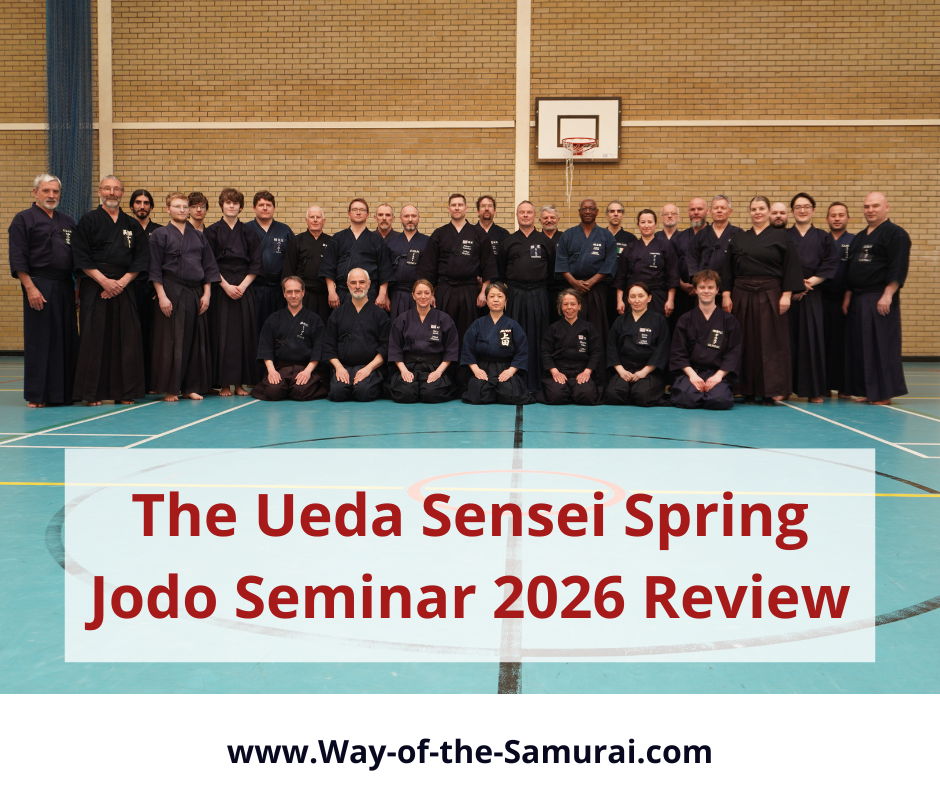
What an incredible week of Budo! The Ueda Sensei Spring Jodo Seminar was a huge amount of work and effort from so many people to make it happen - chiefly our great friend Jim Toman and his dojo Ojika NI Kendo Dojo, Andy Watson Sensei for his magnificent translation, the support of so many of our friends in the United Kingdom to serve on the grading panel, and, of course my long suffering Jodo partner, John Kennedy Sensei. But make it work they did!
Kayako Ueda Sensei, Hachidan Hanshi and Elena West-Vatolina Sensei, Nanadan Renshi came over for nearly a full week to share the best Jodo on the island of Ireland.
It was a spectacular week, kicking off with an amazing Thursday evening Jodo session in Dublin Kendo Kobukai on the 16th April 2026. I have never seen so many Jodoka fit in that hall! We had a record-breaking 16 participants, all crammed into a small church hall in Blackrock. All practising a martial art that originated in Japan over 400 years ago.
Not to speak for Sensei, but I feel this observation (a 400-year-old martial art has somehow found its way to a small hall on an island halfway around the world) may have been in her mind as well, as she opened the class with a brief lecture on the meaning and significance of lineage.
Ueda Sensei Spring Jodo Seminar Day 1 - Thurs 16th April, 2026
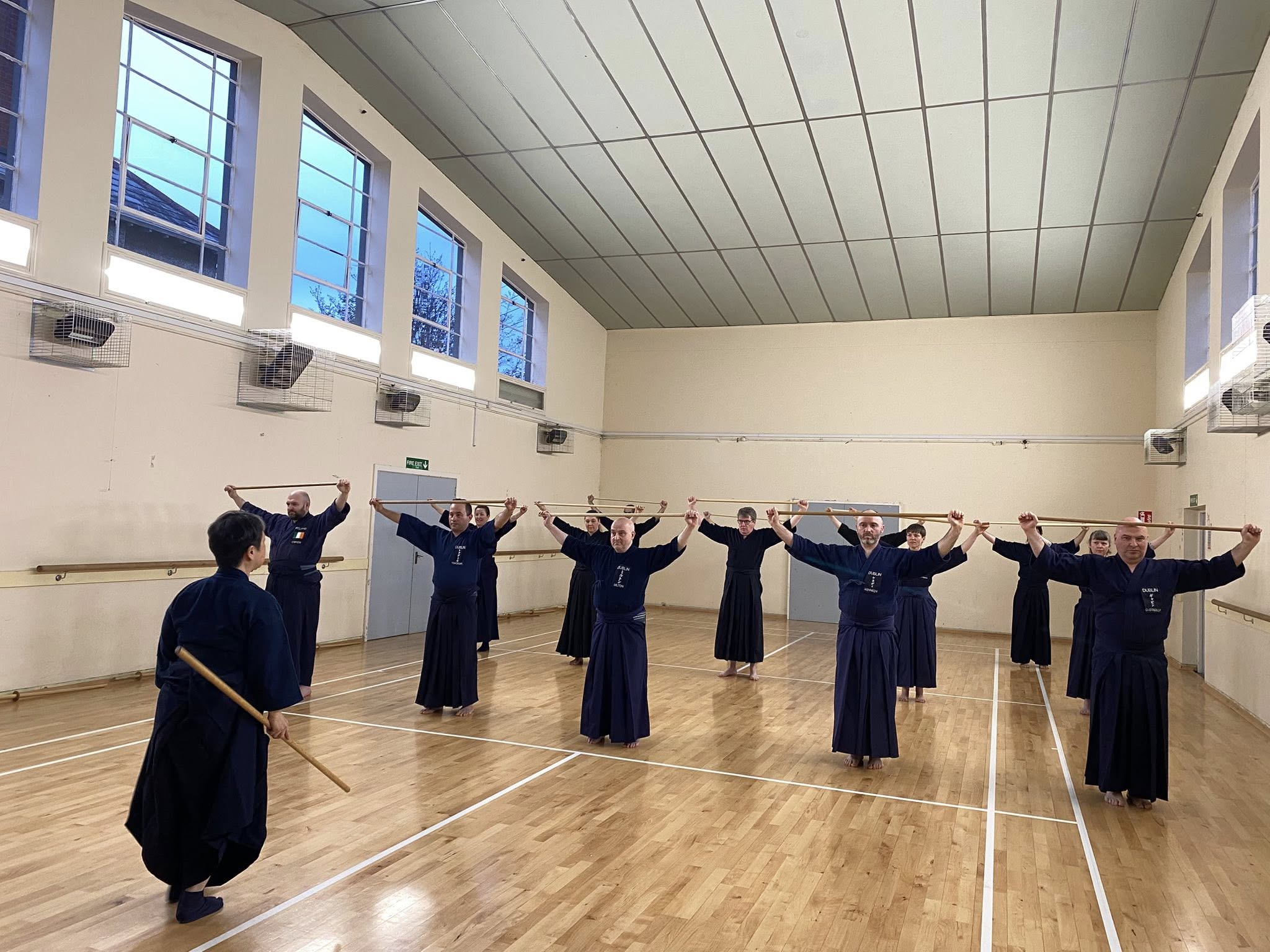
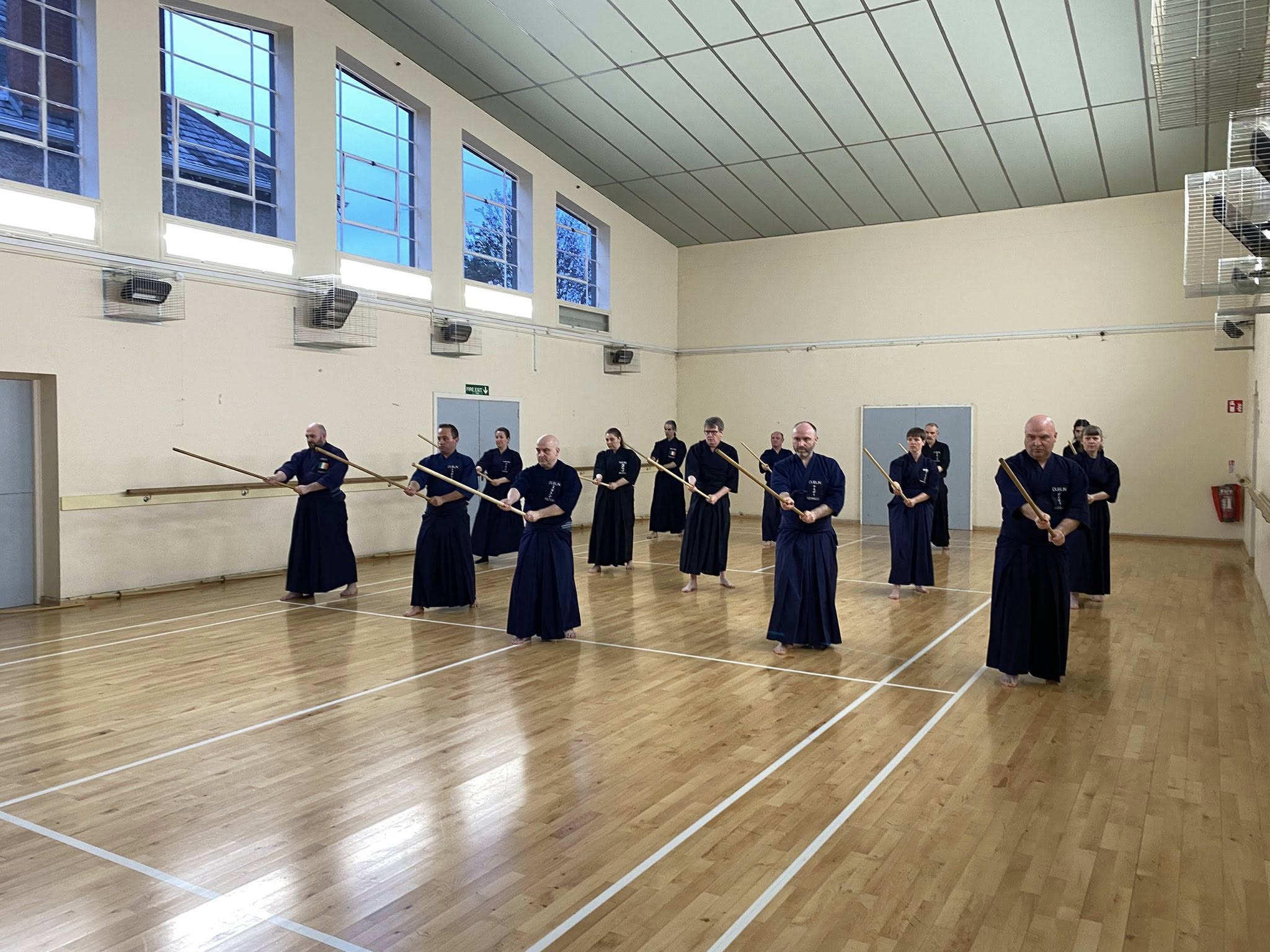
Ueda Sensei then positioned everyone perfectly and held an absolute clinic on the Tandoka Dosa (the solo forms) of Jodo.
The tandoku dosa were developed by the last headmaster of Shinto Muso Ryu Jojutsu, Shimizu Takaji (1876-1978), between 1964-1968 and adopted by the ZNKR (Zen Nihon Kendō Renmei 全日本剣道連盟 - All Japan Kendo Federation) in 1969. Taken from the classical koryu (old school) of Shinto Muso ryu, Shimizu Sensei isolated what he felt were the key techniques that were the building blocks of Jodo.
The tandoka dosa act as a solo practice teaching 12 basic movements of the jo, including a variety of strikes, thrusts, blocks, pins, parries, disarms and counters. From this, the student learns the primary methods of handling the jo in the later kata. The Sotai Dosa (paired practice), meanwhile, teaches the student distance, timing and subtle movements of the jo, along with swordsmanship skills as the student uses the staff against an attacking sword.
The techniques used in both are as follows:
- Honte uchi (本手打 main strike)
- Gyakute uchi (逆手打 reverse-grip strike)
- Hiki Otoshi uchi (引落打 downward-pulling strike)
- Kaeshi tsuki (返突 counter thrust)
- Gyakute tsuki (逆手突 reverse-grip thrust)
- Maki otoshi (巻落 downward twist)
- Kuri tsuke (繰付 spin and attach)
- Kuri hanashi (繰放 spin and release)
- Tai atari (体当 body strike)
- Tsuki hazushi uchi (突外打 thrust, release, strike)
- Dō barai uchi (胴払打 body-reaping strike)
- Tai hazushi uchi migi (体外打右 body-releasing strike, right side); tai hazushi uchi hidari (体外打左 body-releasing strike, left side)
I had never seen so clearly the differences in the levels of understanding and ability of the various dan grades of Jodo until that session. We often speak of "depth of practice" as a consideration of judges, but I had never seen before the stark differences and contrast between different dan ranks expressed so clearly. Truly mind-blowing stuff.
After a highly detailed examination of the finer points of these techniques, Ueda Sensei had us apply what we had hopefully learned and absorbed in the first three of the twelve ZNKR Jodo kata developed by Shimizu Sensei:
- Tsukizue (着杖, Walking/Arriving Stick)
- Suigetsu (Solar Plexus)
- Hissage (引提, Pull)
It was a phenomenal practice and hinted at the transformation that awaited our students, following concentrated practice with such high-level teachers...
Ueda Sensei Spring Jodo Seminar Day 2 - Fri 17th April, 2026
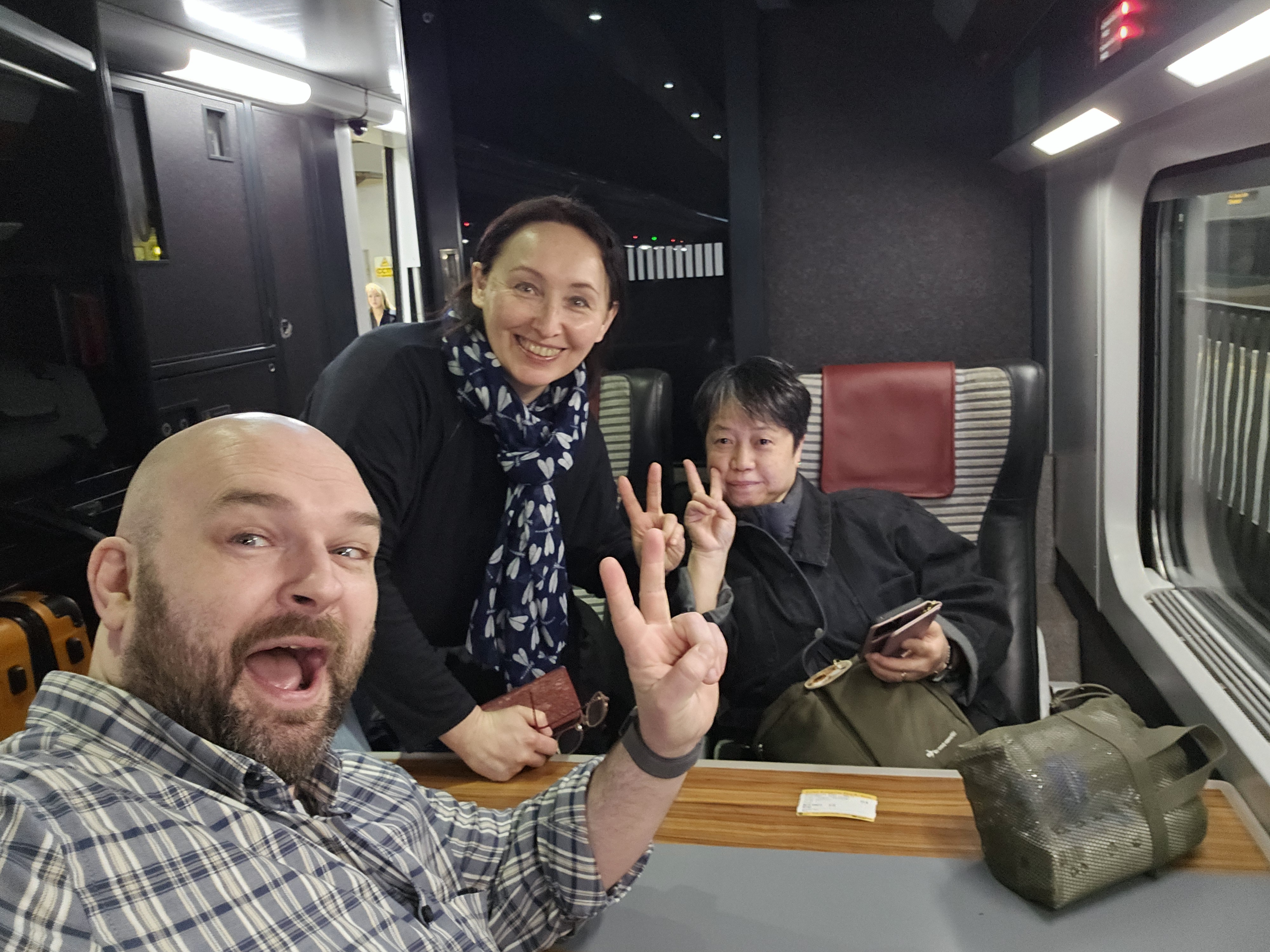
The second day of our Jodo journey began with a scenic train ride to Belfast. This train journey was fabulous. It was my first time riding first class and was well worth the upgrade. Great space, lots of leg room, table service food and drinks, complimentary chocolates and best of all - a hot towel towards the end. Nothing beats the refreshment of a warm towel.
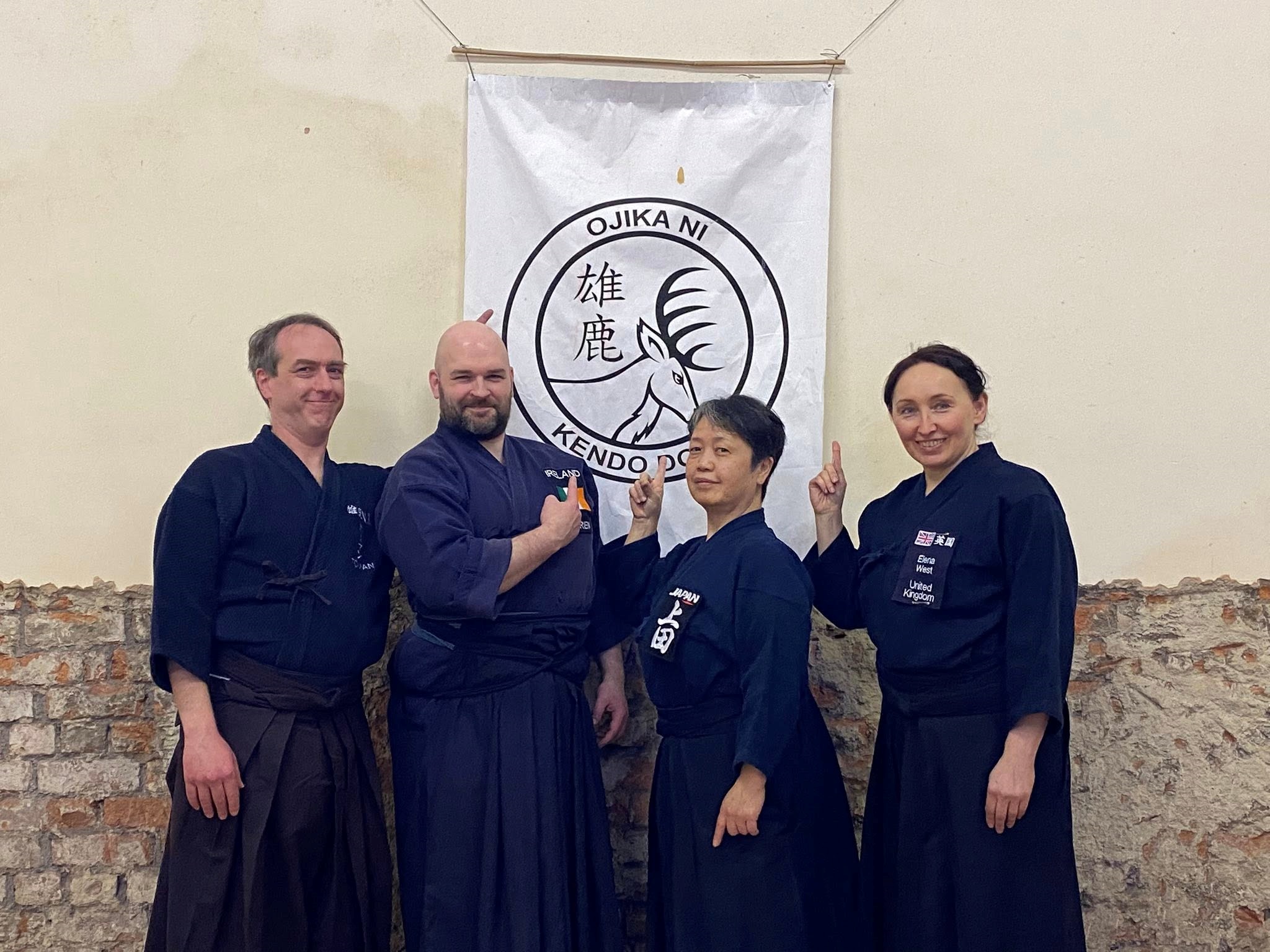
Disembarking, we were met by the always reliable Jim Toman, head of our sister dojo Ojika NI Kendo Dojo and the man behind this epic seminar. After a short car ride and taking in some of the beautifully designed architecture of Belfast city, we arrived at the excellent accommodation Jim had arranged for the Sensei, myself and John, and a few more of our UK friends.
After getting settled in, we headed off for the official start of the Ueda Sensei Spring Jodo Seminar with a Friday evening session in Ojika NI Kendo Dojo and with some of the attendees of the seminar who had flown over from the UK for the event.
This was another amazing session, and I was very glad to represent Dublin Kendo at it.
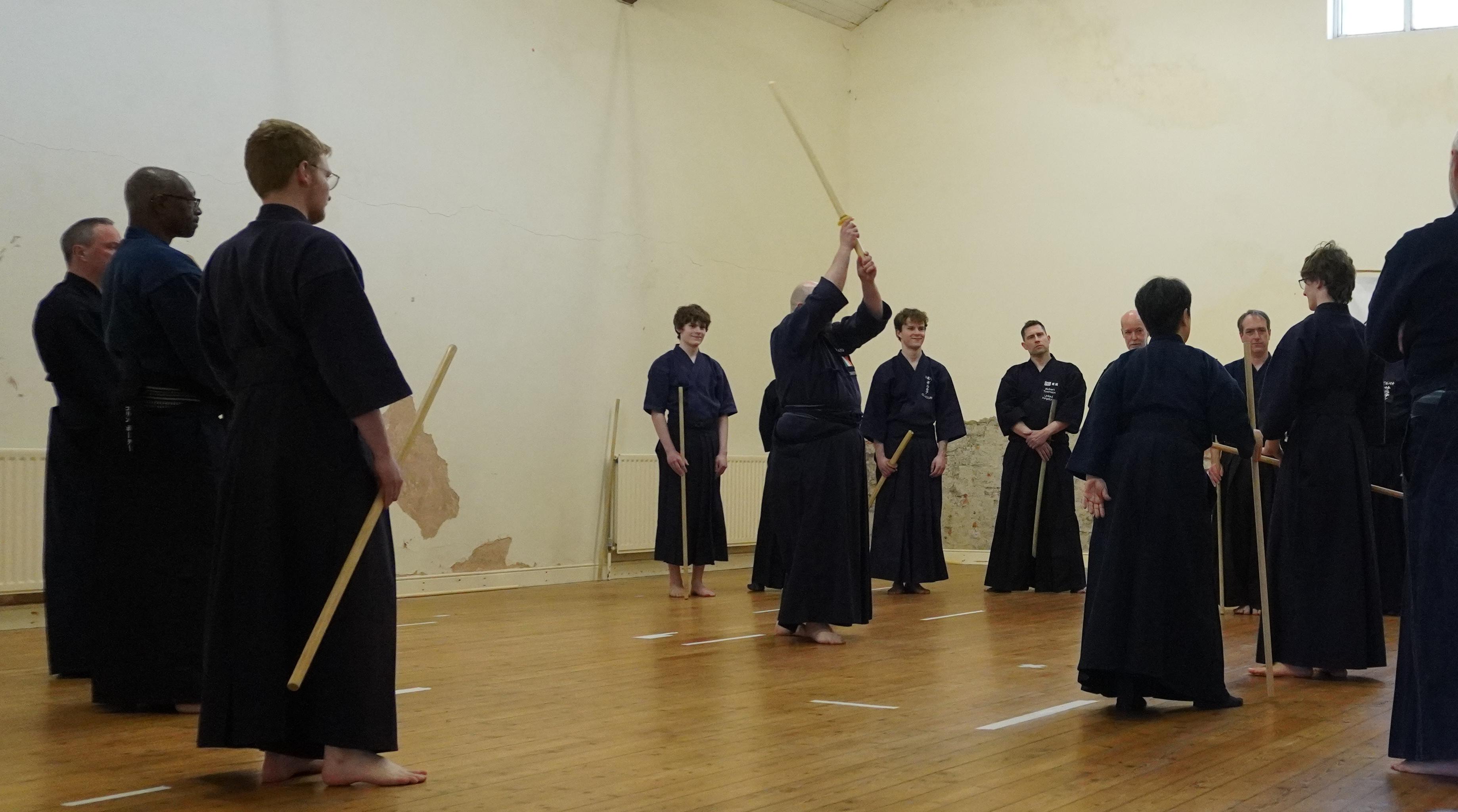
Ueda Sensei worked again on the kihon, the foundational exercises needed to develop solid Jodo. This time, there was an intense focus on delivering a good hikiotoshi.
Ueda Sensei Spring Jodo Seminar - The Hidden Depths of Hikiotoshi
Hikiotoshi means to Pull Down and Strike and is one of the most important techniques in all of Jodo. There are several variations, some where you transition into a strike, some where you sweep the sword aside and step into the space you create, and then thrust the jo at the opponent's face - and there are variations between schools and different areas of Japan in just that!
When the command, “Hikiotoshi ni Kamae” (Pull Down Strike Stance) is given, the side holding the sword (Uchidachi) takes Chudan no Kamae (middle stance) at the same time as the jo-side moves to take Hikiotoshi ni Kamae. Jo does so by starting from Tsune no Kamae (a position, with the feet parallel, where they hold the centre of the Jo, with the right hand at the right side of the body, the arm extended naturally on the right side of the body with a slightly bent elbow), and they slide the left foot forward. As they do so, they grip the tip of the jo with the left hand. The fingers of the left hand point downwards with the knuckle and back of the hand facing to the right. They then rotate the left hand upwards and close to the left breast, the knuckles of the left hand facing, and close to the left breast, making contact with the jo at the base of the thumb, with the left-hand fingers pointing upwards.
As they raise the left hand the jo in this manner, the upper body, hips, and shoulders rotate 90 degrees so that the navel points to the right-hand side. They keep looking to the front, however. This is called Ma Hanmi (full side facing). The right hand, meanwhile, holds the middle area of the jo in a forward grip (i. e., palm facing outwards, thumb pointing downwards) with the right arm naturally straightened.
The sword side takes Chudan no Kamae, approximately one arm's length from Jo, holding the kissaki at roughly shoulder level. (Ueda Sensei was quick to address that manually checking this distance by sticking out your arm has fallen out of favour in Japan and is being discouraged).
The command “Hajime” (Bgein!) is given, and the Jo raises the jo high directly overhead, and in a large circular manner, makes contact with the monouchi (upper third) of the partner's sword. Using a twisting of the hips to the left, rotating on the ball of the left foot so that it now points roughly 45 degrees to the left front corner, jo slides along the bokken in a forward diagonal manner, forcing their partner's bokken to their right rear. The jo's goal is to move both Uchi’s sword and centre using a large jo movement, strong Kiai, stable posture and hip movement.
As Uchi’s sword is struck, they move back with their right foot, receiving the strike with the whole body but maintaining their posture and zanshin (lingering awareness) so they may cut if the opening presents itself. This is a subtle and natural movement.
The jo now flows into bringing the joseki (tip of the jo) upwards to threaten Uchi’s face, demonstrating their own zanshin, pursuing this with a forward step of the right foot.
As we practised, this Ueda Sensei was quick to help us understand the common mistakes in Hikiotoshi -
Including insufficient Ma Hanmi (not turning the body fully sideways)
- The left hand turned too far away from body
- The rear foot pointing past 90 degrees
- Using too much power in the upper body and "slapping" the sword away
- And so much more.
The sound of Sensei's strikes was a thing of beauty.
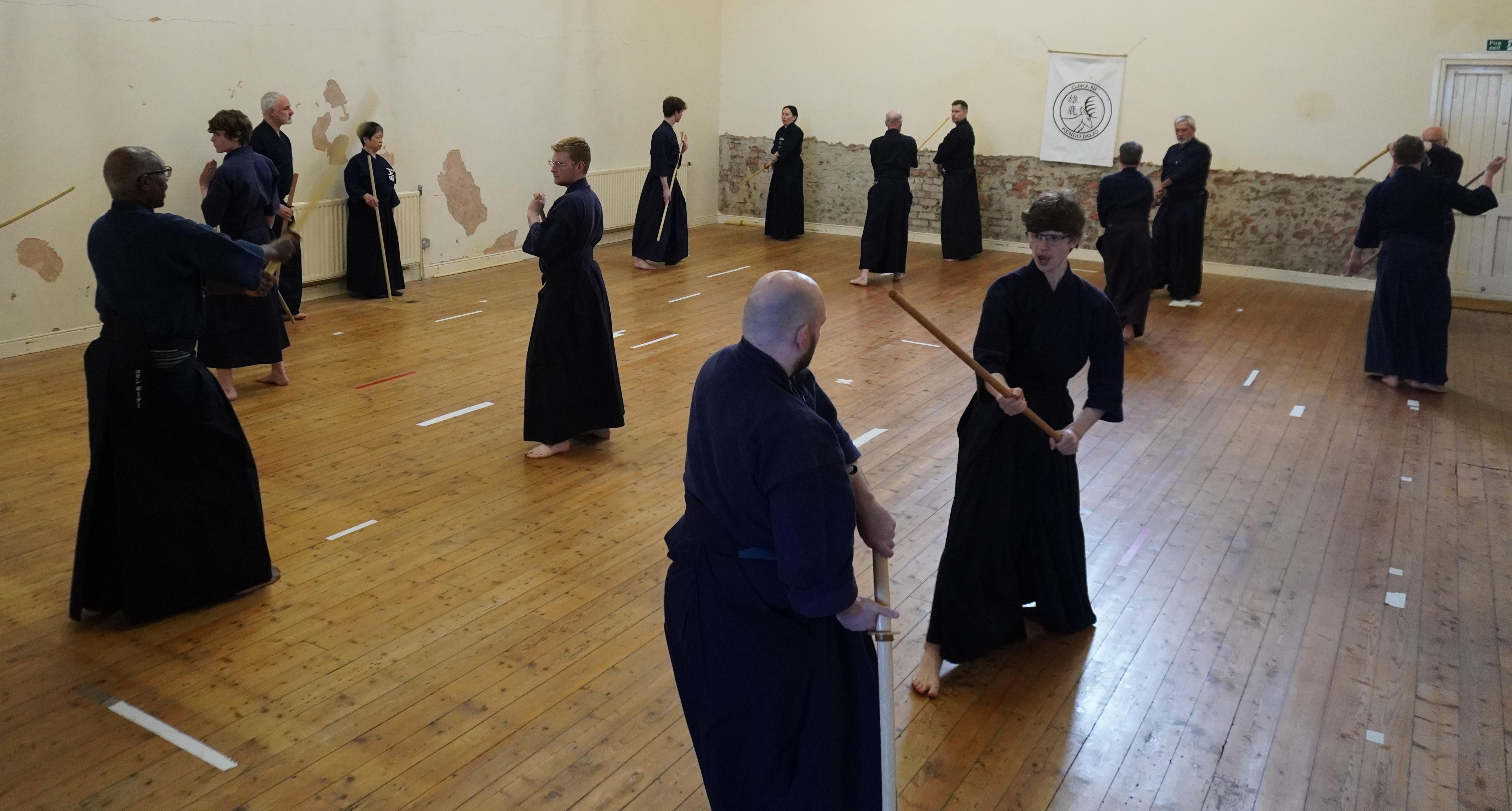
I had the opportunity and good fortune to work with one of Ojika NI Dojo's youngest members, Dean.
Dean was then chosen by Ueda Sensei to develop his hikiotoshi further. A great honour and wonderful learning experience, I was honoured to be tachi and deliver the best cuts I could so that Dean could implement the advice Ueda Sensei was imparting. And this was great advice for everyone, me included. I also got to receive several hikiotoshi from Ueda Sensei directly during this, which really helped me understand the problems in my own technique. Dean, doing a tremendous job, picked up the points and really improved his technique.
We then moved on to kata, and I was lucky enough to be able to work with my teacher Elena West-Vatolina Sensei on the first 5 kata, while Ueda Sensei and Andy Watson Sensei watched on. I got some fantastic points - particularly regarding opening my chest more and articulating the shoulders and hara. This was amazing. Such a simple and small change dramatically improved my power generation (not muscle strength) and appearance. The kata were feeling great.
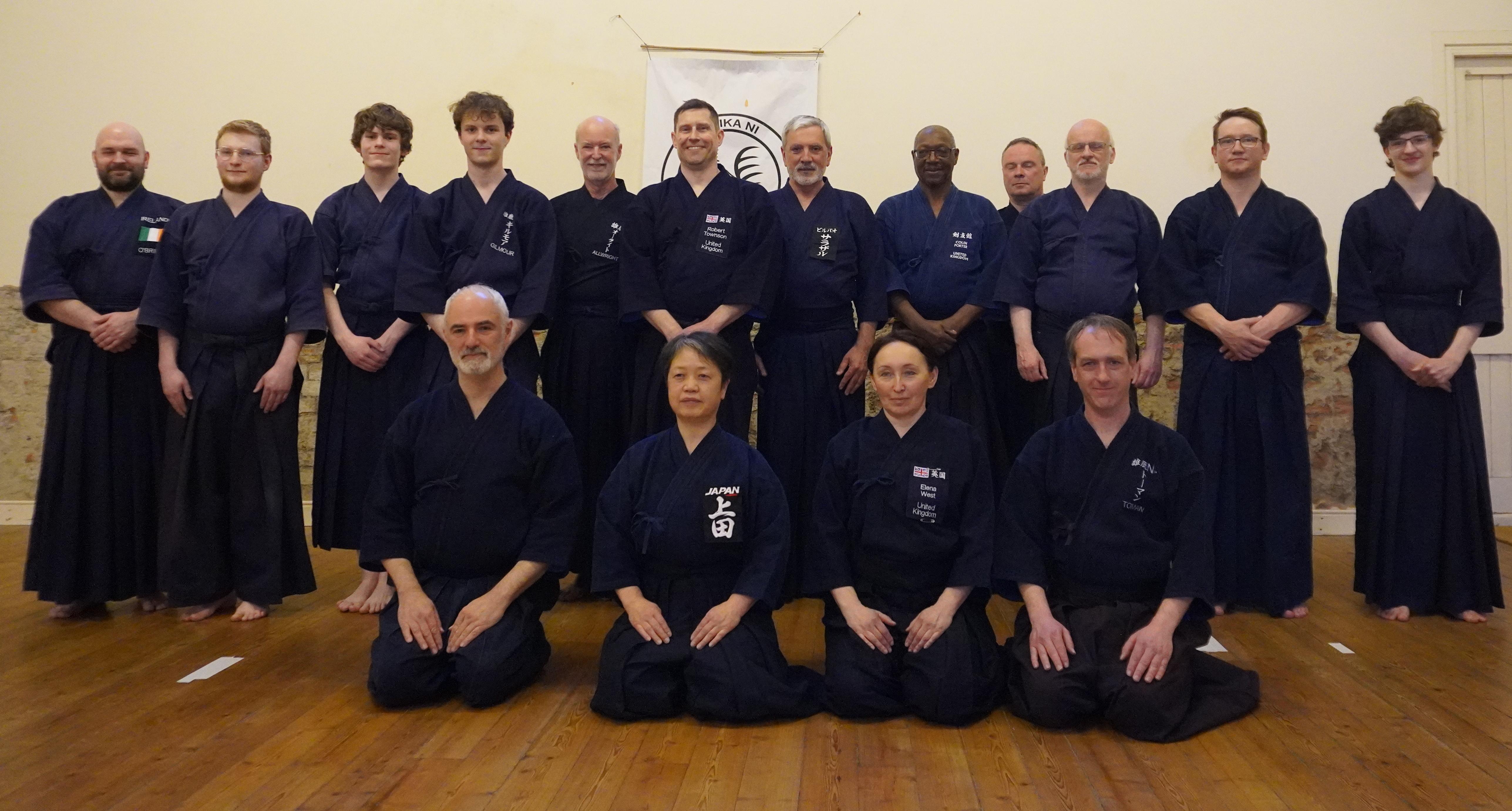
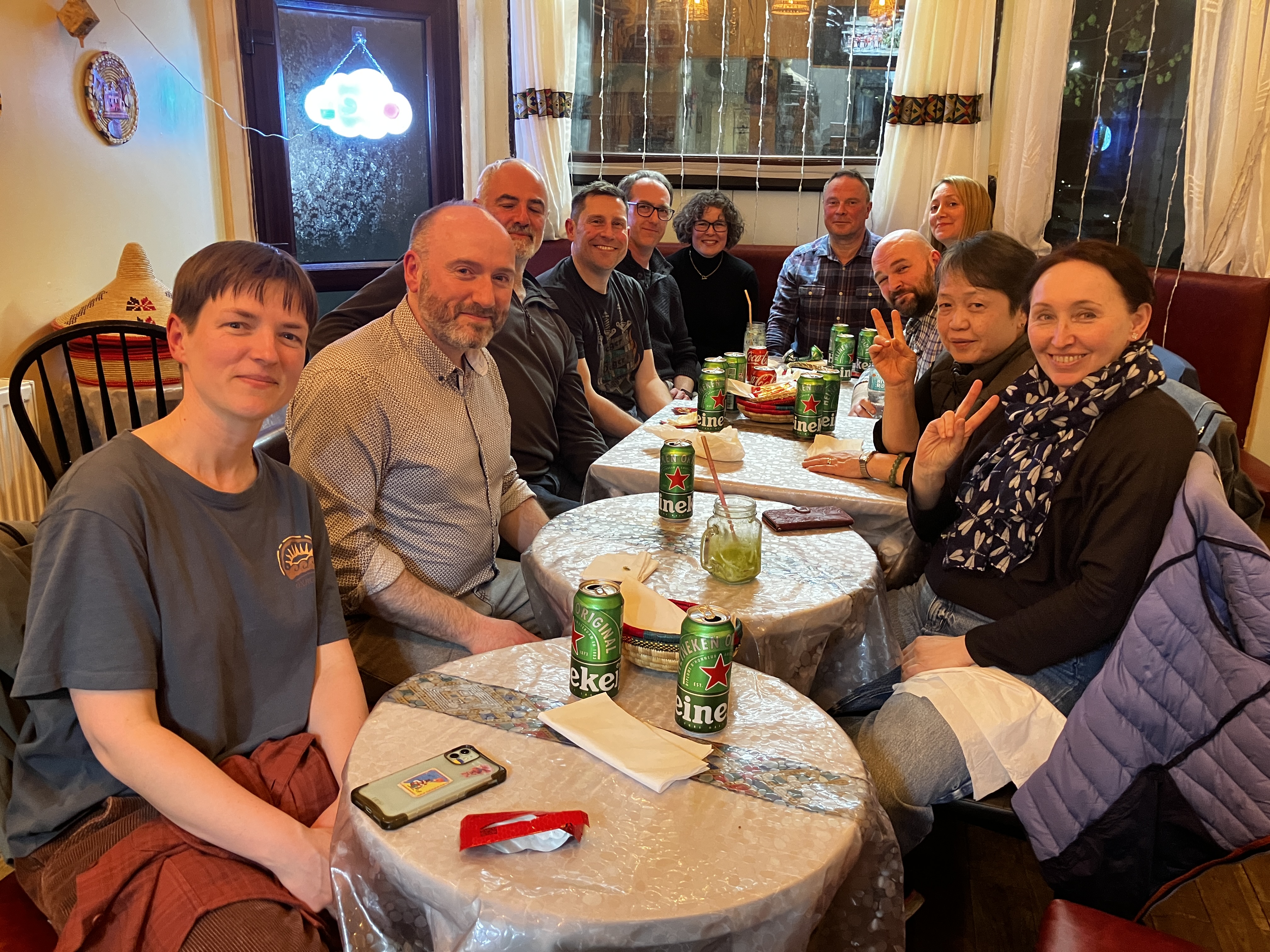
Then, it was off to dinner and a delicious Ethiopian meal in a restaurant discovered by our own Anastasia. After stuffing ourselves and having many great laughs catching up with my friends from the UK, it was back to the house...where everyone took their beds, eager for the first day of the seminar.
Ueda Sensei Spring Jodo Seminar Day 3 - Sat 18th April, 2026
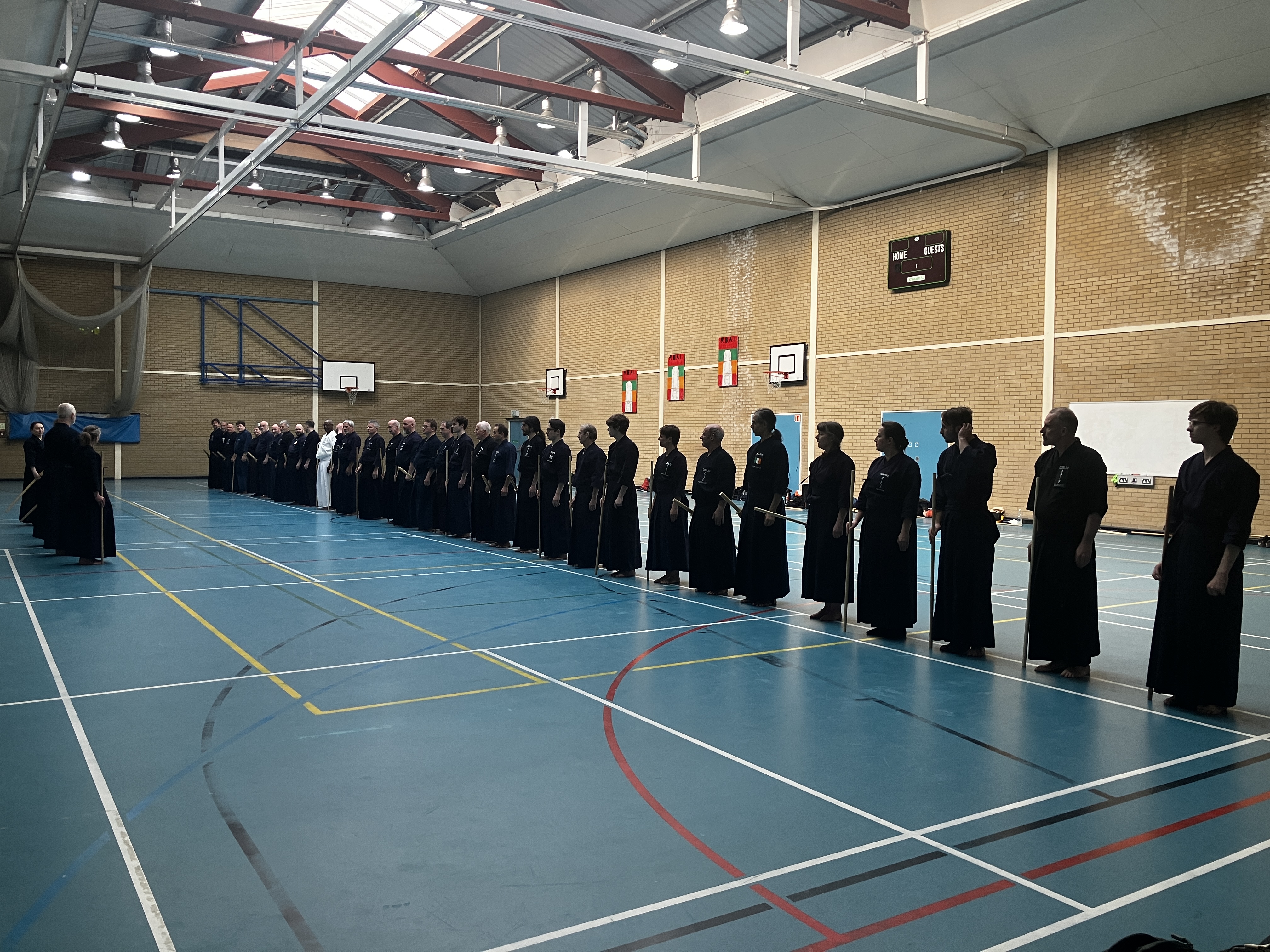
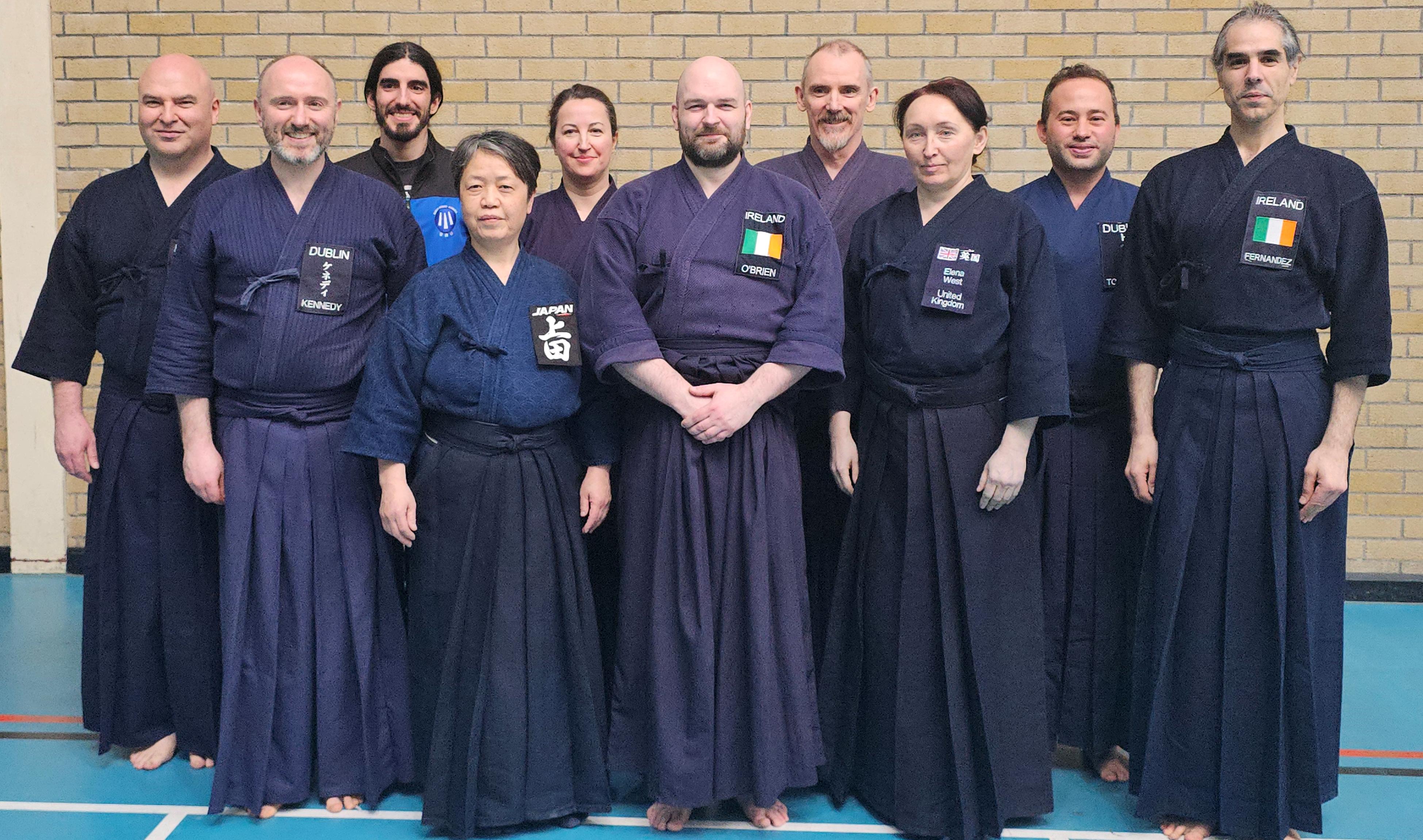
The first day of the official seminar was met by a wonderful turnout and well-justified enthusiasm. 12 members of Dublin Kendo Kobukai Jodo division had travelled up to attend the seminar.
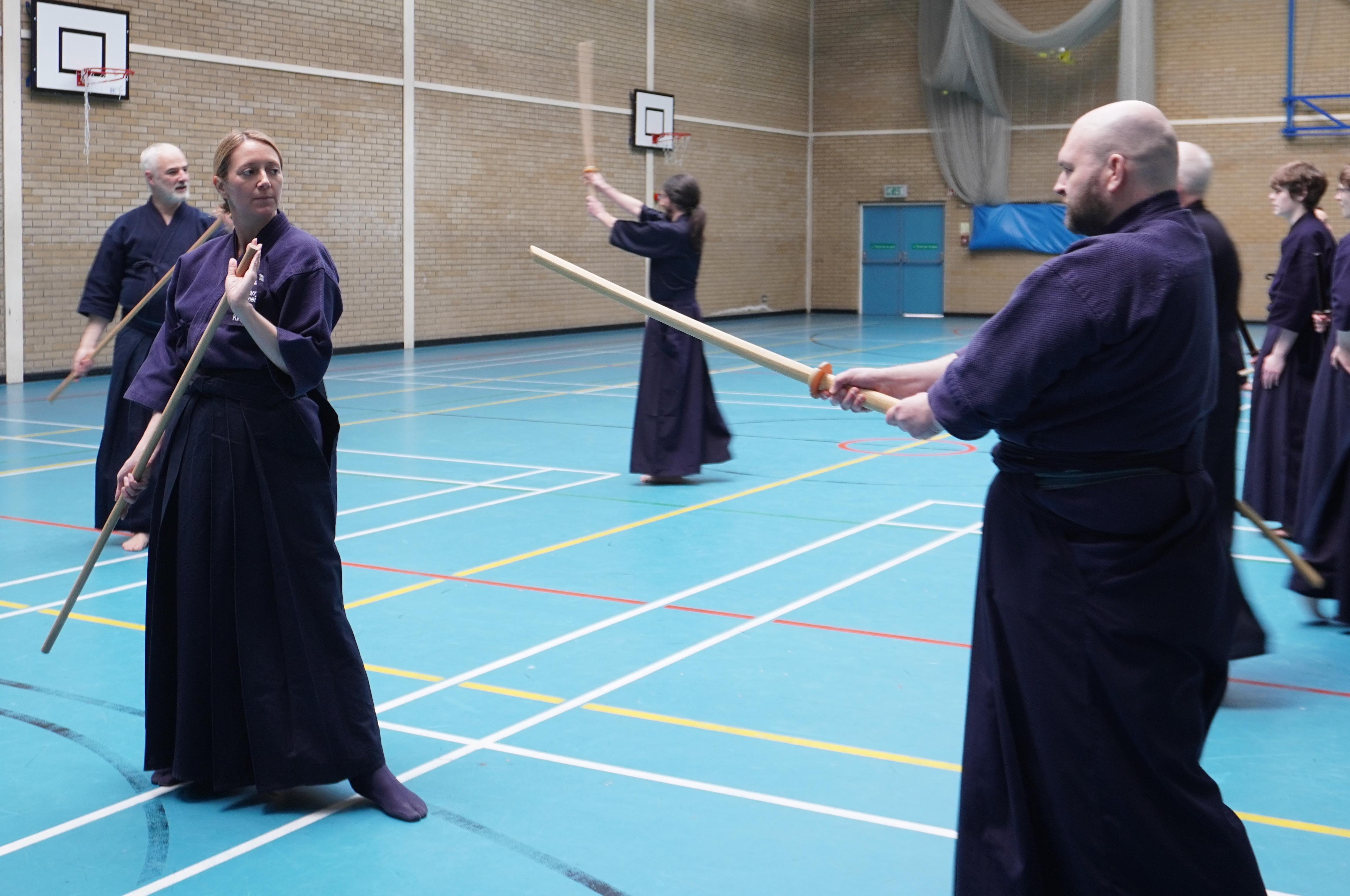
Ueda Sensei led us in careful cleaning and inspection of our equipment, and then treated us to a phenomenal lecture that helped clarify everyone's understanding of Jodo and then led everyone through an intense kihon practice building on the lessons of the previous two sessions she had led in our respective home dojo.
One super cool highlight was getting to tighten the angle of our hikiotoshi and gyakute uchi through a 4-person practice, where one person takes tachi, and the other three jo. Two people stand parallel, holding the jo vertically in front of them. This tight jo wall is placed in front of the tachi. As a result, the jo is forced to keep a narrow angle and strike from above. I can't describe how fun this one was, and then Ueda Sensei, ever resourceful, showed us how to set up a solo version of this practice.
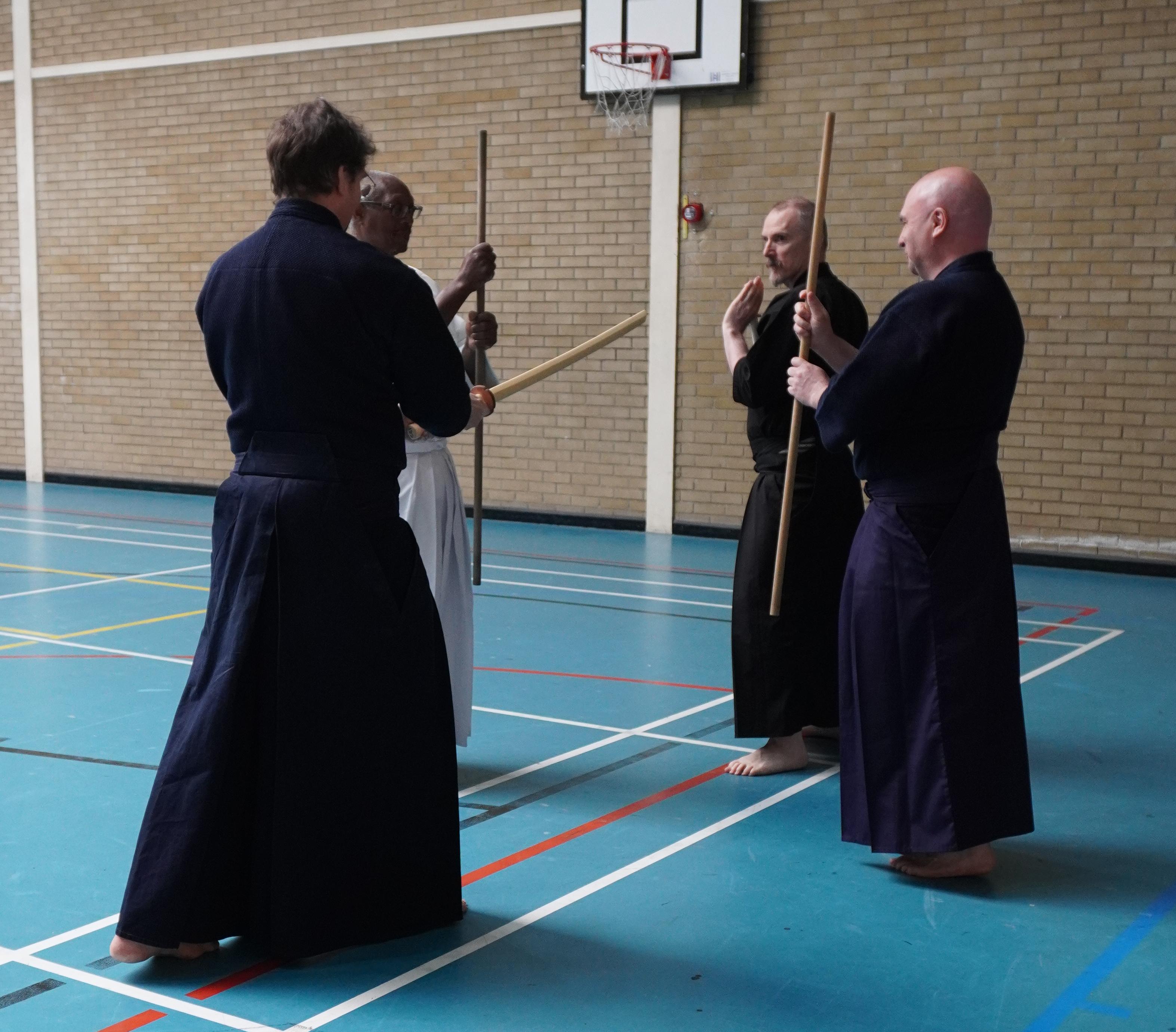
Ueda Sensei then had the Nanadan Sensei all line up with a Jo each and had the rest of the participants take a tachi. Ueda Sensei then instructed the Nanadan Sesnsei to give us a good hikiotoshi, and once that was done, let the next student feel it.
This was an invaluable experience. Not only did it allow participants to hear, see and feel what a good hikiotoshi is meant to be, it allowed them to see different nuances and variations between the different teaching styles and lineages of jodo.
This was an info-heavy day, resulting in page after page of notes being taken.
We concluded the day with another unique drill, observing and judging jodo, and learning how to prioritise a variety of categories across dan levels. There were some thrills, surprises, and plenty of action for the observers along the way, not to mention for the brave demonstrators.
It is really rare and a wonderful opportunity for instruction of this kind, and I thought it was just fabulous. Importantly, at several points during this, I got to reflect deeply on what and how I teach jodo...and wondered what results the next day would bring as several of our students would be grading...
Ueda Sensei Spring Jodo Seminar Day 4 - Sun 19th April, 2026
Sunday 19th was the last day of the official seminar (but not the end of our training with Ueda Sensei!) While the day before had been info-heavy, now was the day we got to apply it. After a solid warm-up, the gradings began!
And this, this was stressful.
Sure, those going for the grading, of course, would have nerves, but for John and me, this was dire!!! Would our teachings hold up? Would our students be able to demonstrate what they had learned? We felt this was a judgment on us as much as it was on our students.
I was particularly invested as I had put forward two of the beginners from my most recent Jodo beginners course for Ikkyu. I felt confident putting them forward. I'd seen the work they'd put in, but exams are high-stress situations. You've never at your best. We all make mistakes under pressure, drop a kissaki, take the wrong kamae, drop a jo, forget a kata or part of one.
In addition to that, we had a student seeking Shodan, another Nidan, and my good friend Colin, challenging for Yondan.
Each challenger stepped out onto the floor amid a row of stern, unmoving judges. Each looked confident.
They gave it their all.
And all passed.
Please join me in congratulating Dublin Kendo's new:
- Ikkyu - Emmanuel Clarke and Markuss Zakss
- Shodan - David Leonard
- Nidan - Ilias Vrachnis
Well done all. I am extraordinarily proud.
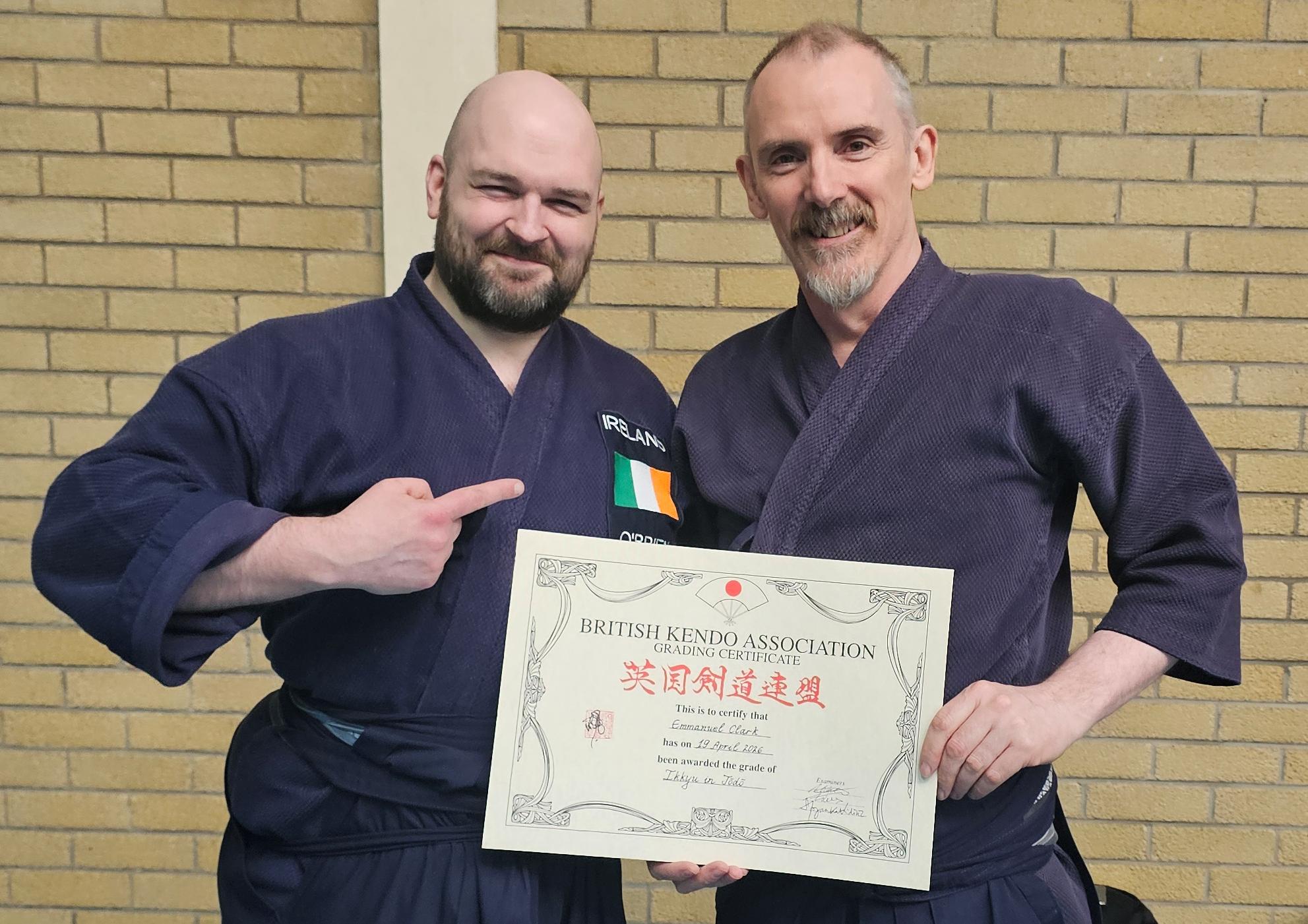
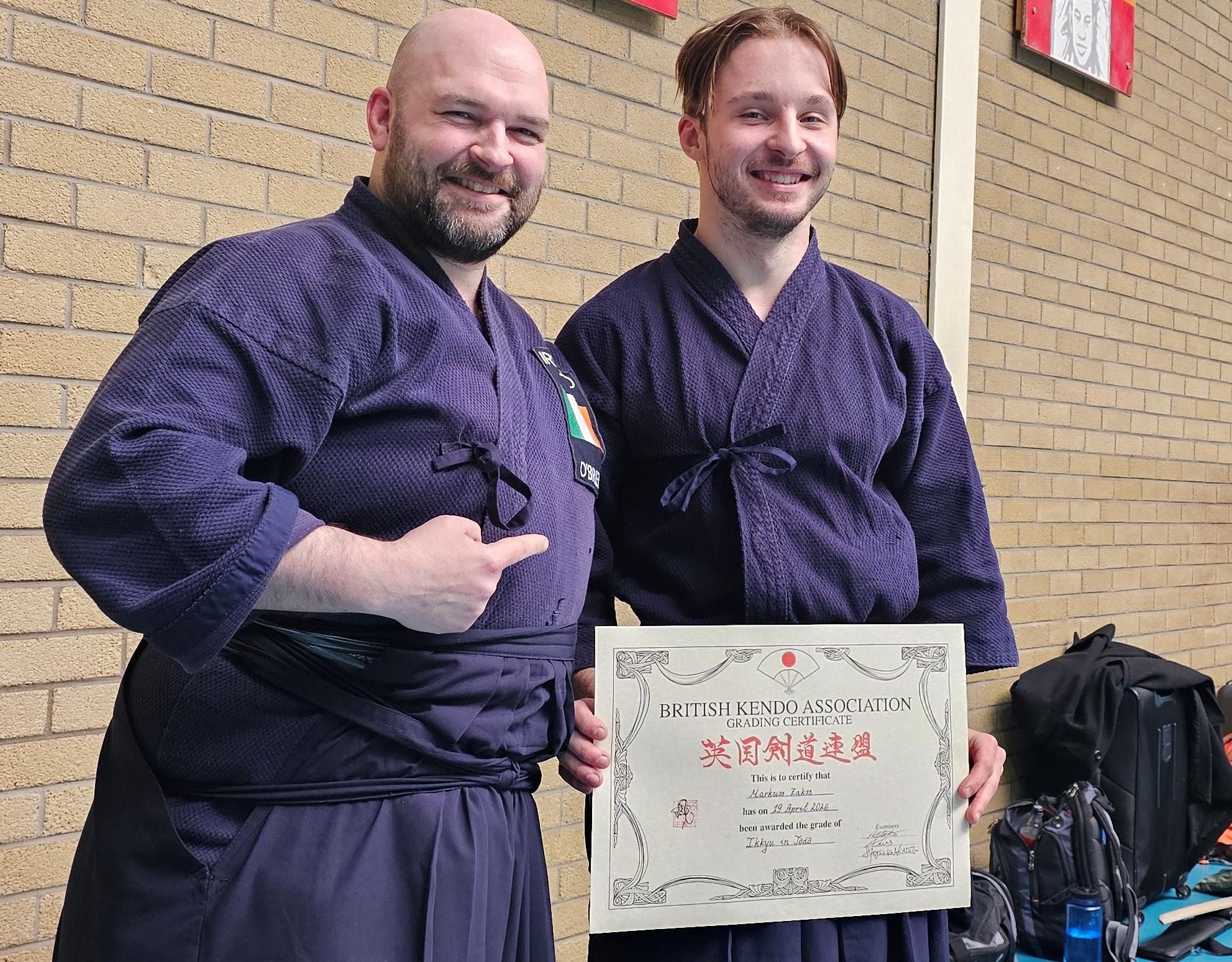
After the gradings, we had lunch and celebrated, before getting back to work implementing all the knowledge and changes through a very intense keiko. I was very lucky in that I got to work closely with Elena Sensei on the latter ZNKR kata and some koryu ahead of my 5th Dan examination later this year.
Then, John, Gavin and myself hoped on a train back to Dublin, to make preparations for the final training day...
Ueda Sensei Spring Jodo Seminar Day 5 - Mon 20th April, 2026
The final day of the Ueda Sensei Spring Jodo Seminar had arrived. And Sensei had saved the best session for last.
Opening with an acknowledgement of our newly graded students, celebrating their success and highlighting their progress over a few short days, Ueda Sensei began with a review of the key points from the last 4 days of training.
Meanwhile, Elena Sensei spent some time personally coaching two of our beginners, which was an excellent experience for them.
The main group then progressed to working its way through the first 6 kata. Ueda Sensei's keen eyes picked up small mistakes and gently guided us to our best Jodo. Of particular interest was a small foot movement in kata number 6, Monomi, and a wonderful moment of shared laughter was brought about with some unexpected comic relief in the act of simply turning around during shi/uchi kotai.
Things were going great until one of our new Ikkyu reached the limit of their knowledge of the kata. This became an unexpected blessing, as Ueda Sensei excitedly decided to teach us a masterclass on Kata 7, Kasumi. This was invaluable, and our Ikkyu students were thrilled to be taught these important kata by Ueda Sensei.
Personally, I learned a ton - particularly key aspects of timing and subtle shifts in initiation and action that I had missed previously. All of this leading to a very different feeling and life in the kata.
Ueda Sensei decided to reward the hard-working students with a masterclass on Kata 8, Tachi Otoshi.
Sensei began by explaining the personal importance of this kata to her and encouraged us to try our best. After practising the basic jo-side movements, she had the seniors pair up as the tachi and help the newer students through the kata.
Finally, as a parting gift and to leave the correct impression and heart of the kata, she provided an embu of Tachi Otoshi, and I was honoured to serve as tachi. This was a very special moment for me, and I did my best to be a tachi that Ueda could demonstrate the highest level of Jodo with.
And then, we were done.
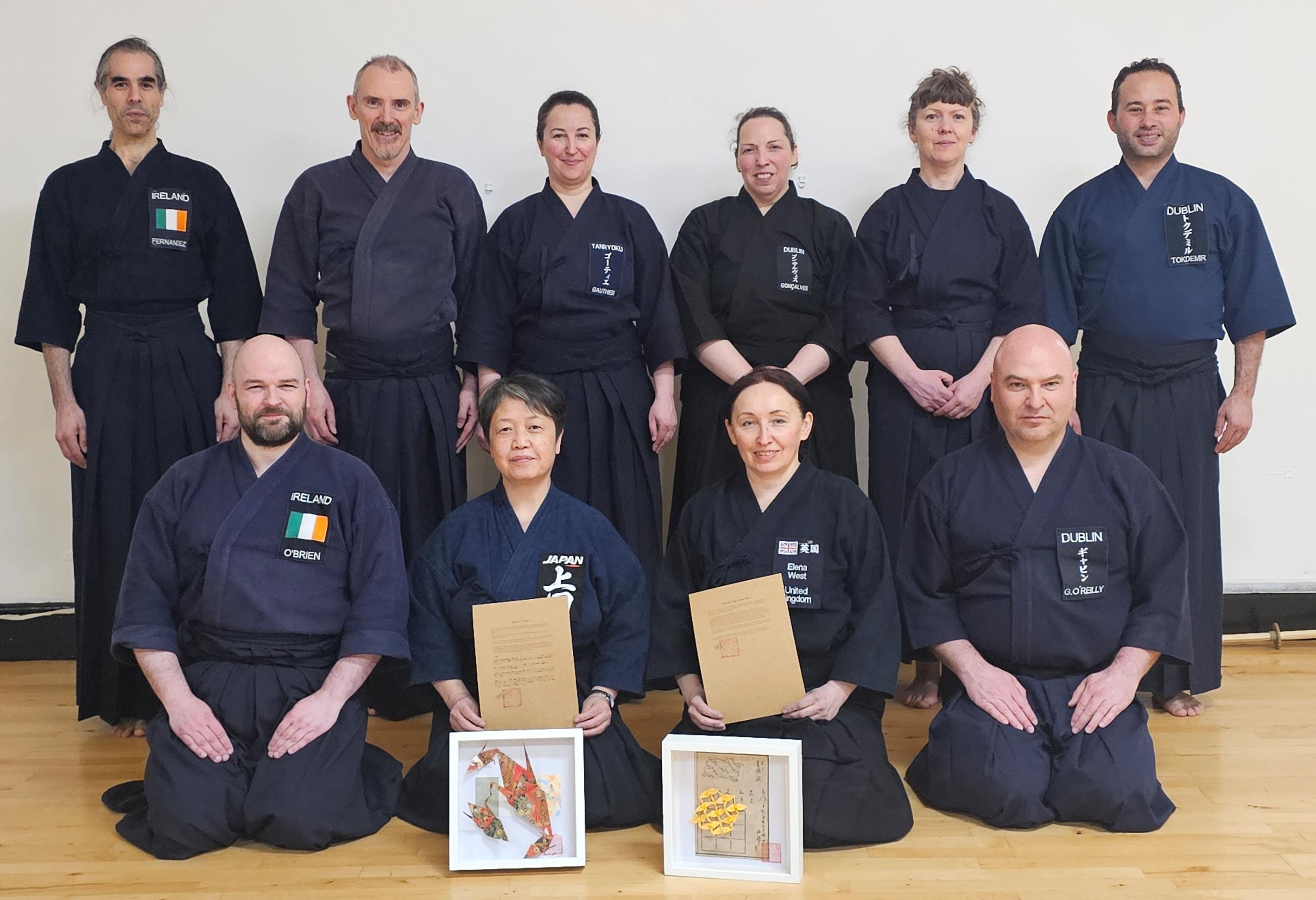
After the session ended, I took the opportunity to thank Ueda Sensei for all she had done, for sharing so much of her heart and love of Jodo with us. The depth of her knowledge and generosity in her teaching is profound.
Ueda Sensei Spring Jodo Seminar Day 5 - A Parting Gift
After the final session of the Ueda Sensei Spring Jodo Seminar, I presented the Sensei with two gifts from my new Samurai Art Studio. Both of these were hand-made by me, with very specific selections regarding the artwork, paper and history, reflecting my relationship with both teachers, and I thought I'd share a little of the meaning behind both here.
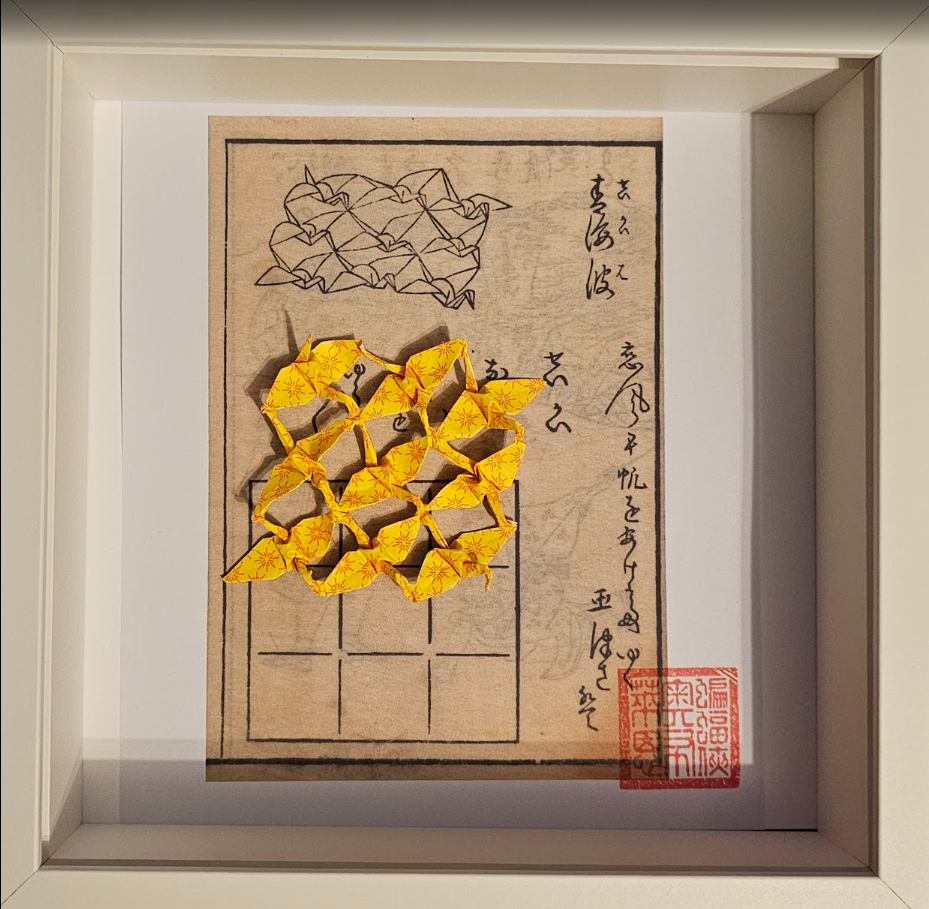
The first piece made for Elena Sensei is titled “Seikaiha”, meaning Blue Ocean Wave.
This model first appears in the very earliest technical manual of Japanese Origami, the “Hiden Senbazuru Orikata” (Secret of Folding 1000 Cranes), published in Kyoto, Japan in 1797. The original instruction for the model is reproduced in the background.
The gently spreading waves symbolise enduring peace and harmony, and continuous progress. The overlapping arcs of the Seigaiha design evoke the vast expanse of the ocean, both tranquil and powerful, suggesting that the path of life and Jodo continues endlessly.
The piece was folded from a single sheet of traditional Japanese chiyogami paper, meaning “thousand generations paper”. I chose this as I hope the spirit of the Jodo we have been taught will continue for a thousand generations.
That single sheet is folded into 9, interconnected cranes.
The origami crane has long been considered a symbol of longevity and good fortune, and its form, overlapping with the flow of the Seigaiha, conveys the meaning that individual journeys harmonise within a larger current and are passed down through generations. This work can be said to express tradition, inheritance, and strength found in tranquillity.
I chose to make this model for Elena Sensei because it is one of the most difficult and complex of the traditional forms, where great attention must be paid to every fold, just as great attention must be placed on every instruction Sensei gives us.
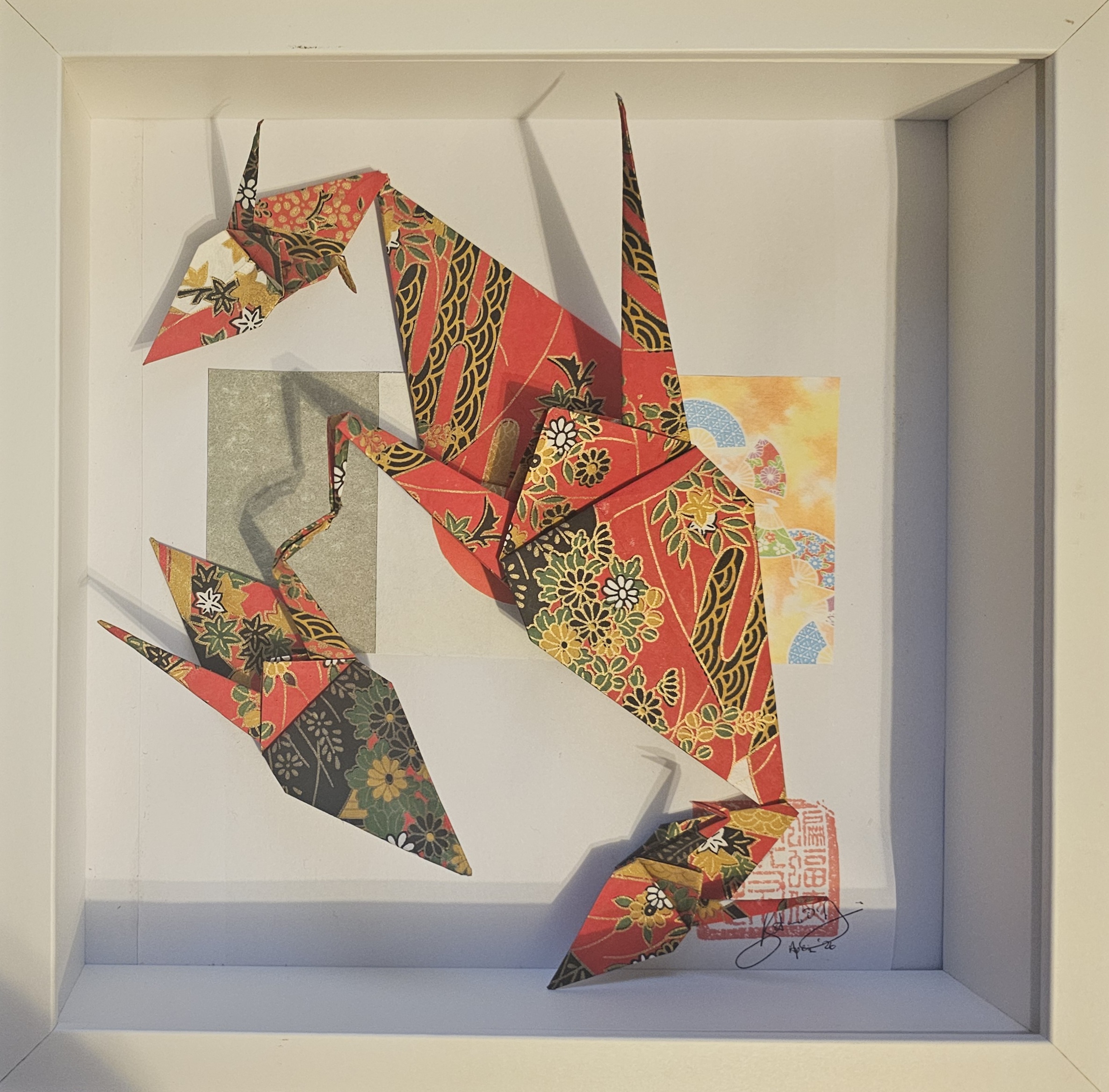
The piece I made for Ueda Sensei is an original work I designed, that I have titled “Sensei” (Teacher).
This model represents Ueda Sensei as the central crane, with Elena Sensei receiving direct instruction, as Batman and John, the small cranes, follow on Ueda Sensei's wings.
I folded the model from a single sheet of traditional Japanese washi, with gold thread. Just as Sensei weaves our thread into the history of Jodo, the thread and paper connect all the cranes.
The background is made from a green panel of Irish handmade mulberry paper and traditional Japanese chiyogami paper, meaning “thousand generations paper”, as I hope that Sensei Ueda's Jodo will be passed down for a thousand generations. The background is designed to represent the Irish flag, with the Japanese flag in the middle, representing the coming together of our traditions.
Ueda Sensei Spring Jodo Seminar - Thank You
As I reflect on everything that I learned at the Ueda Sensei Spring Jodo Seminar, I want to offer my thanks to all involved.
My deepest and sincerest thanks to Ueda Sensei for all the travel and work she put in to share with us her Jodo. We were absolutely ecstatic to learn that she had received the honour of being awarded the title of HANSHI, only a few days after her return from Ireland.
This is the highest of the Shogo (称号) titles that can be awarded, and it is the first time in history that a woman has received this distinction in Jodo.
I also want to extend my thanks to Elena Sensei for her repeated instruction and for looking after my health. I'd also like to thank Andy Watson Sensei for his excellent translations and for letting me experience his hikiotoshi (sorry about the tsuba!), equally, my thanks to Harry Jones Sensei, and Stoyanka Vidinic Sensei.
And of course, to my good friend and fellow Irishman, Jim Toman, who went above and beyond organising the venue, accommodation and transport in the North, and whose hospitality, friendship and care were faultless. These things are incredibly hard work, and you made it look easy mate.
Finally, I am, as always, deeply grateful to my long-suffering training partner John Kennedy Sensei, who took time out from perhaps one of the most significant weeks of his professional life to support the Sensei when I could not. Simply put, Jodo in Ireland would not exist without John.
And speaking of Jodo in Ireland, Ueda Sensei's last command at the Monday session of the Ueda Sensei Spring Jodo Seminar was that every person in the dojo should bring one friend to the next session so that we grow Jodo in Ireland.
As such, I am opening the Jodo sessions on Monday to the public. If you'd like to try Jodo, the art of the Samurai Stick, contact me and I'll arrange a free trial session.
If you'd like to train in authentic Japanese Martial Arts, those same warrior skills developed by the samurai, check out my dojo at DublinKendo.com
- - - -
If you want to get in great physical, mental and emotional shape using the same principles and techniques inspired by the feudal warriors and healers of Japan, check out my Samurai Strength Programs.
Click here to return to the Way of the Samurai Home Page.
You might like these
Jodo The Way of the Staff: A Basic Introduction
Jodo The Way of the Staff: A Basic Introduction
Jodo Shodan Grading: Sticking it to Irish Martial Arts History
Jodo Shodan Grading: Sticking it to Irish Martial Arts History
The Fascinating History of Jodo: How a Defeat Led to Enlightenment
The Fascinating History of Jodo: How a Defeat Led to Enlightenment
About the Author

Paul Batman O’Brien is passionate about sharing the wisdom of martial arts to help solve our daily problems. He teaches both gendai (modern) and koryu (classical) Japanese martial traditions for Dublin Kendo Kobukai, holding 5th Dan in Iaido, 4th Dan in Jodo, and serving as dojo leader for Hyōhō Niten Ichi Ryū in Ireland.
With over 40 years in martial arts and 20+ teaching, he is a multi-time international medalist, and has represented Ireland at the European Championships for both Iaido and Jodo many times.
He was a lead writer for Irish Fighter Magazine for over 15 years, with over 100 published articles and is the author of multiple books on martial arts, strength and fitness, eastern medicine, and philosophy.
When not teaching martial arts, he owns and operates the Meridian Acupuncture Clinic.


Free Samurai E-books

Get Free Exclusive Samurai Guides and E-books
Subscribe Now
My Best Selling Samurai Fitness Program
Top Viewed Pages