The Fascinating History of Jodo: How a Defeat Led to Enlightenment
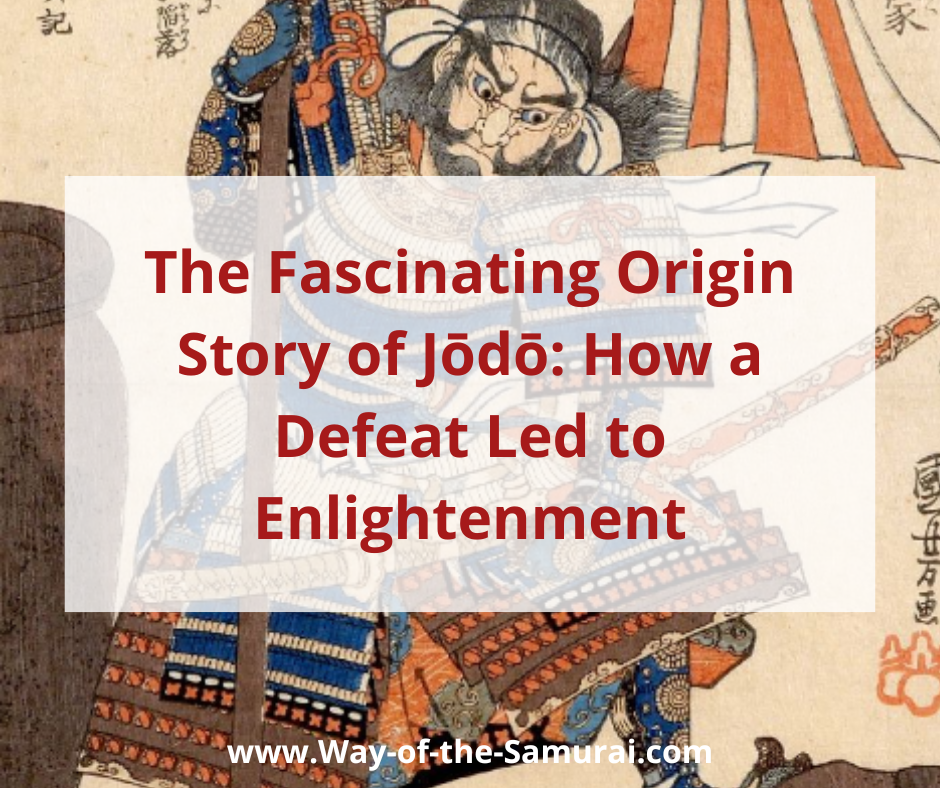
The history of Jodo, like many classical Japanese Martial Arts, rises from necessity, innovation, or a profound personal experience. In the case of jōdō, its origin story combines all three elements into a compelling narrative of defeat, spiritual awakening, and martial innovation. This tale, set against the backdrop of feudal Japan's tumultuous early Edo period (1603-1868), demonstrates how humility and perseverance can transform failure into lasting achievement.
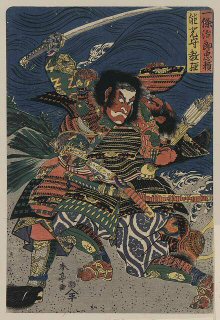
The Fateful Encounter: Musō Gonnosuke Meets Miyamoto Musashi
The history of Jodo begins with Musō Gonnosuke Katsuyoshi (夢想 權之助 勝吉), a formidable martial artist of the early 17th century. Historical records indicate that Gonnosuke was menkyo (licensed) in two of the most dominant martial arts of the day: Tenshin Shōden Katori Shintō-ryū (天真正伝香取神道流) and the Kashima Shinryū (鹿島神流) (or possibly Kashima Jikishinkage-ryū depending on who relates the story). These credentials marked him as an accomplished swordsman, well-versed in the martial traditions of his time.
Like many skilled warriors of the period, Gonnosuke travelled throughout Japan testing his skills against other martial artists. During the Keicho period (1596-1614), his journeys brought him to Edo (modern-day Tokyo), where he engaged in numerous contests with prominent swordsmen. Success followed success until he encountered the man who would change the course of his life: Miyamoto Musashi (宮本 武蔵).
Sometimes the fight between the two great undefeated warriors took place in a garden, sometimes on a roadside, with Musashi carving a child’s bow from a willow branch when Gunnosuke challenged him. Other times, Musashi had a six-foot staff, a bokken (wooden sword) or two bokken. No matter the differences, there is one thing on which they all agree: Gunnosuke lost.
Wayne Muromoto translates the earliest description of the fight, found in the Kaijo Monogatari of 1629, as follows:
"There was a heihosha (martial artist) named Miyamoto Musashi. He engaged in duels from the age of 16 and was in about 60 matches. In the sixth month, in Akashi, Harima province, he met Musō Gonnosuke, who was a six foot tall strapping warrior. Gonnosuke was armed with an odachi (a long sword), a two layer overcoat with sleeves, and a haori with a large hi no maru (rising sun). On his lapels were written: "The best martial artist in the land" (heiho tenka ichi), and "Nihon Kaizan Musō Gonnosuke."
...Gonnosuke was surrounded by about six deshi followers who accompanied him on a journey to Kyūshū. He boasted to Musashi that no one was his equal. In his travels, he had apparently encountered Musashi's father, Shinmen Munisai, a master of the jutte (truncheon).
"I have seen your father's techniques, but I haven't seen yours," he said, goading Musashi.
(Shinmen) Miyamoto Genshin Musashi was irritated. He was in the middle of carving a willow branch and replied, "If you saw my father's techniques, I am no different."
Gonnosuke pressed the issue, badgering Musashi to show his martial arts off for the benefit of Gonnosuke's students.
"My heiho is not for display," Musashi snapped. "No matter how you attack me, I'll stop it. That's all there is to my heiho. Do what you will, with any technique."
Gonnosuke pulled out a four-shaku (a shaku is roughly equivalent to an English foot) wooden sword from a brocade bag. (To draw a comparison, the usual practice sword is but a little longer than two shaku.) He attacked Musashi without any formalities. Musashi stood up from his crouch. With what seemed to be very little effort, he forced Gonnosuke back across the tatami mat room with his willow branch and, pressing him against a wall, struck him lightly between the eyebrows” (1)
Author Dave Lowry recounts this version of the history of Jodo from the "Niten Ki",
“Musashi was sitting in a garden working on a bow he was making from a length of mulberry wood. Without warning, Gonnosuke approached and, dispensing with an introduction or even a bow, he shouted a challenge at Musashi, immediately swinging his bo in a potentially lethal attack. Without so much as rising from his seat, Musashi countered, avoiding the bo and striking Gonnosuke smartly with the unfinished piece of wood in his hand” (2)
And according to "The History of Shindō Musō Ryū Jōjutsu" by Matsui Kenji Sensei, a record written by one of Musashi's successors describes the encounter this way:
“While Musashi was in Edo, a man named Musō Gonnosuke came, looking for a match. Gonnosuke was armed with a bokuto (wooden sword). At the moment, Musashi had a willow bow, but he immediately took up a stick to confront Gonnosuke. Without even a nod, Gonnosuke attacked. Musashi struck him down in one stroke. Thwarted, Gonnosuke quit." (3)
The history of Jodo preserved within Shindō Musō Ryū provides additional detail, suggesting that Musashi defeated Gonnosuke using a technique called "jūjidome" or "cross-shaped block." This defensive manoeuvre, executed with Musashi's two-sword style, effectively neutralised Gonnosuke's attack and led to his defeat.
The Journey to Mt. Homan: Spiritual Quest and Divine Revelation
For a warrior of Gonnosuke's stature, this defeat represented more than a simple loss. It challenged his understanding of combat and the limitations of his training. Rather than abandoning his martial pursuit in shame, Gonnosuke channelled his disappointment into a quest for deeper knowledge.
This quest led him to Mount Homan in Chikuzen province (present-day Fukuoka Prefecture) in Kyūshū. Mt. Homan was a significant centre for shugendō, a syncretic religion combining elements of mountain worship, Shintō, and esoteric Buddhism. Practitioners of shugendō, known as yamabushi (mountain warriors), underwent intense ascetic training in the mountains, believing that such practices would grant them spiritual power and insights.
At a temple on Mt. Homan, Gonnosuke engaged in rigorous ascetic practices alongside Buddhist hermits. His training included meditation, fasting, cold-water purification, and other demanding spiritual disciplines. Through these austerities, Gonnosuke sought not just physical technique but spiritual insight that might transcend his previous understanding of martial arts.
On the final night of his ascetic practice, Gonnosuke experienced what can only be described as a mystical revelation. In a dream, a divine being appeared to him and transmitted a cryptic message: "maruki wo motte, suigetsu wo shire" ("holding a round stick, know the suigetsu").
This phrase contains profound martial wisdom. "Maruki" refers to a round wooden staff, distinct from the squared edges of traditional wooden training weapons. The roundness of the jo means there is no beginning and no end. "Suigetsu" has multiple interpretations - it can refer to the solar plexus, a vulnerable target on the human body, but it also carries connotations of proper distancing and timing in combat. This ambiguity suggests that Gonnosuke's revelation encompassed both technical knowledge and deeper philosophical understanding.
Upon his awakening, Gonnosuke understood that he had received divine guidance toward creating a new martial system centred around a round wooden staff. This weapon would become the jo.
“A saying of the Jo
The stick became a soldier's stick. In other words, it became a weapon. It became round. Then the form was complete. The shape was fixed. It became hard and tough. And the material was wood” (4)

The Birth of a Weapon: How the Jo Became a Formidable Answer to the Sword
Inspired by his spiritual revelation, Gonnosuke set about developing a comprehensive fighting system using the jo. He designed the weapon to be 128 centimetres long (about 4.2 feet) with a diameter of 2.4 centimetres (approximately 0.94 inches). This length was carefully chosen - longer than a sword for reach advantage, yet shorter than the rokushakubo (six-foot staff) for greater manoeuvrability in close quarters.
The jo's dimensions provided several tactical advantages. It was long enough to keep a swordsman at bay but short enough to be quickly reversed and manipulated in tight spaces. Its round shape allowed it to slide along a sword blade rather than binding against it, facilitating deflections and redirections. Perhaps most importantly, both ends could be used equally effectively for striking or thrusting, creating a versatility that would prove decisive against the sword.
Gonnosuke meticulously developed techniques that exploited these advantages. He created methods to strike, thrust, sweep, and block that could counter a swordsman's cutting and thrusting attacks. The techniques incorporated subtle body movements and precise timing to overcome the sword's cutting power and speed.
“When one sees the jo, it looks like the most common of weapons but, if you only use it once, you discover that it can strike like a sword, thrust like a spear, and even sweep like a naginata. The jo' s ability to be used in so many different ways is what makes it a great weapon, and its strengths can well be seen.
From the right - strike, thrust. From the left -strike, thrust. The jo can be used equally from the right or the left. And because techniques from the left and right can be used in a continuous, unbroken flow, an opponent has no opportunity to counter-attack. The ability of the jo to freely attack from both the left and right is a strong point, doubling its power to attack, and increasing its defensive capabilities as well. From the perspective of medicine, the bones, muscles and nerves on the right and left sides are equally useful, and this is a great thing”.(5)
Legend suggests that after developing his new art, Gonnosuke sought out Musashi for a rematch. While this second encounter isn't documented in Musashi's own writings or the oldest historical records, tradition within Shindō Musō Ryū holds that Gonnosuke successfully countered Musashi's techniques with his newly developed jo methods, ending their contest in a draw or possibly even with Gonnosuke's victory.
Whether this rematch actually occurred is less important than what it symbolises: the transcendence of limitation through dedicated practice and innovative thinking. Gonnosuke's response to defeat wasn't to abandon his martial path but to transform it into something new and uniquely effective.
The Symbolism of the Jo: Three Virtues in Wood
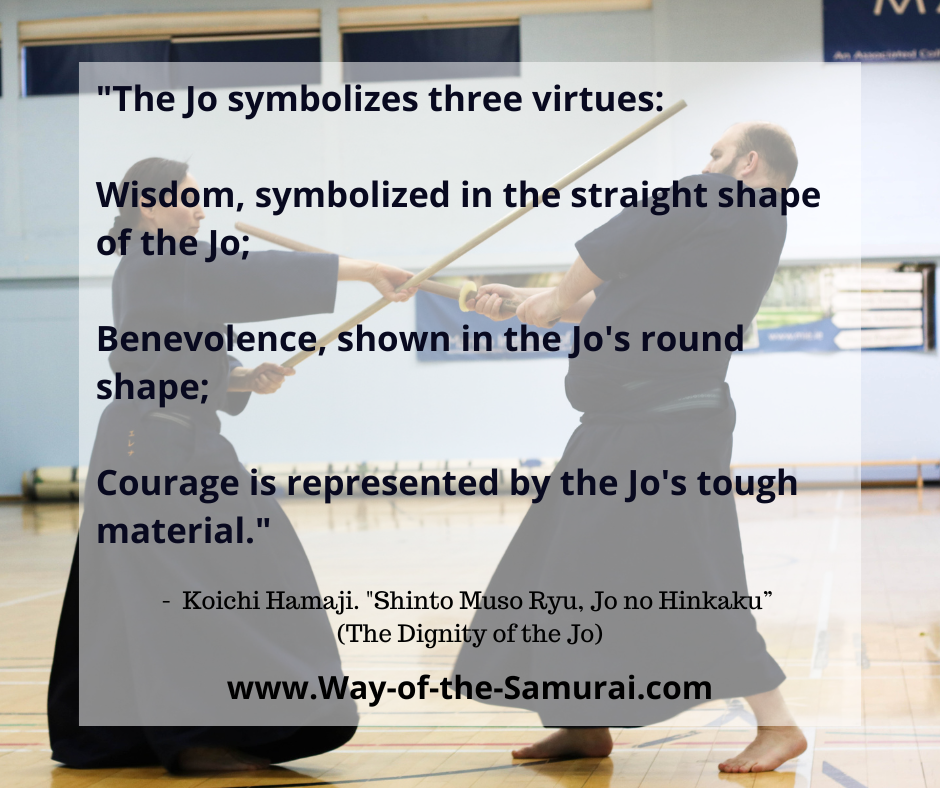
Beyond its practical applications, the jo came to embody deeper philosophical principles. According to Koichi Hamaji Sensei, whose insights are preserved in "Jo no Hinkaku" (The Dignity of the Jo), the jo symbolises three essential virtues:
- Wisdom - represented by the straightness of the jo, symbolising direct, clear understanding and perception.
- Benevolence - represented by the jo's round shape, which has no edges or corners, symbolising completeness and compassion.
- Courage - represented by the tough material of the jo, symbolising resilience and strength of character.
These virtues suggest to me that Gonnosuke intended his art to develop character alongside combat skill. The jo becomes not just a weapon but a physical manifestation of philosophical ideals.
This symbolism extends to the nature of jōdō practice itself. Unlike many martial arts focused primarily on defeating an opponent, jōdō emphasises control and restraint.
“In the traditions of Jodo it is recorded:
Without inuring, the jo can punish the wicked,
Besides instructing, the jo has other abilities”.
The First Golden Rule of Jo, according to Hamaji Sensei, states: "As the jo helps a man, it is also the path of the samurai." This rule indicates that the jo is meant to support and guide, not primarily to harm.
Hamaji further explains that according to Gonnosuke's interpretation, bushido through jōdō means:
- To cultivate wisdom, benevolence, and courage constantly
- Not to kill or injure others with the weapon
- To sacrifice oneself in case of a social crisis and to support society with all the might which one has acquired through one's jo practice
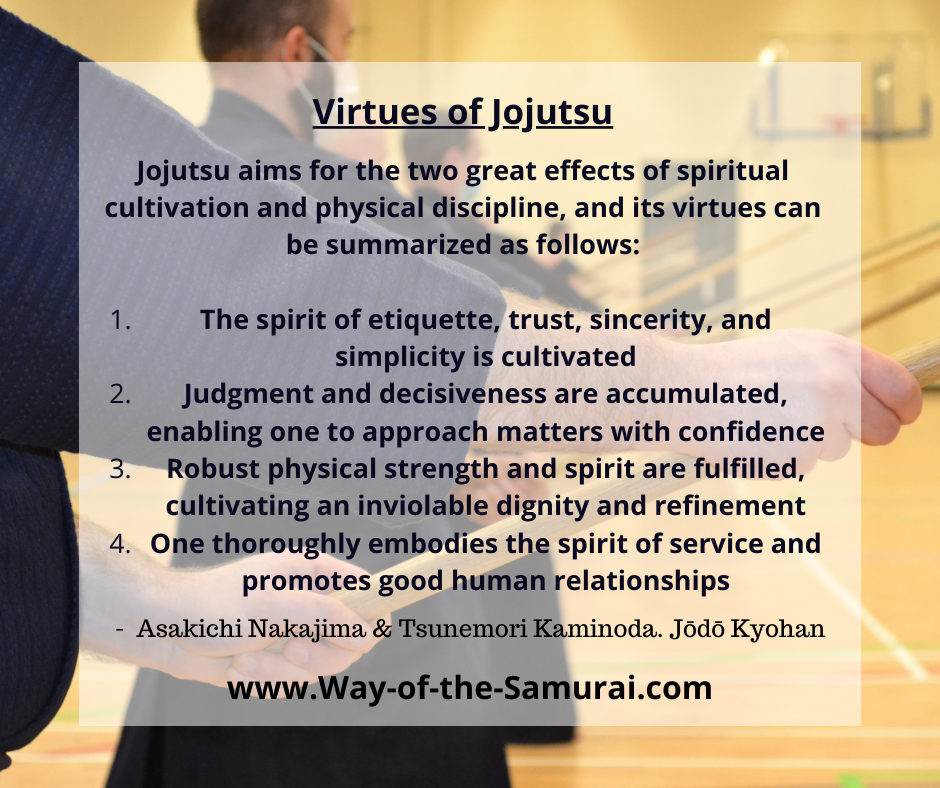
This ethical framework transformed what might have been merely a combat method into a comprehensive path of personal development - truly making it a "do" (way) rather than merely a "jutsu" (technique).
From Battlefield to Classroom: Evolutions in the History of Jodo
After developing his art, Gonnosuke was invited to teach the Kuroda clan in Kyūshū. This patronage provided institutional support for the preservation and transmission of his techniques. Although historical records of Gonnosuke himself are sparse, the art he created survived and evolved through generations of dedicated practitioners.
The early transmission of what was then called the "True-Path Musō Ryū bōjutsu" followed traditional master-to-disciple lineages. By the early 18th century, Harada Heizô Nobusada (died 1733) received full transmission and renamed the art "New-Just Musō Ryū," which became popularly known as Kansai Ryū after Harada's unofficial title.
Under the seventh-generation headmaster, Nagatomi Kōshirō Hisatomo (1717-1772), the art flourished, with the number of disciples reaching approximately three hundred. This expansion ensured the art's survival through subsequent generations.
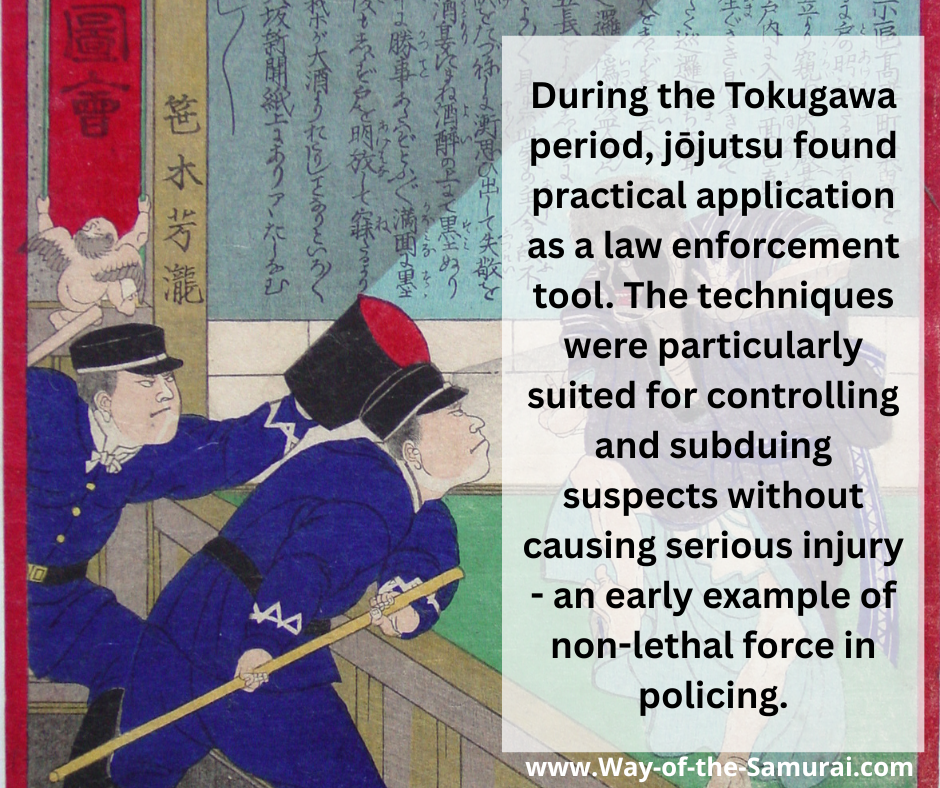
During the Tokugawa period, jōjutsu found practical application as a law enforcement tool. The techniques were particularly suited for controlling and subduing suspects without causing serious injury - an early example of non-lethal force in policing. This practical application helped preserve the art during an era of relative peace when many combat arts declined.
The Meiji Restoration of 1868 brought dramatic changes to Japanese society, including the dissolution of the samurai class. Many traditional martial arts faced extinction during this period of rapid modernisation. However, jōjutsu survived thanks to dedicated practitioners who recognised its value beyond battlefield application.
The modern era in the history of Jodo began with Shiraishi Hanjirō (1842-1927), who maintained a dojo in Fukuoka where he taught a new generation of practitioners. His student Shimizu Takaji (1896-1978) would later become instrumental in preserving and spreading jōdō throughout Japan and eventually worldwide.
In 1940, Shimizu Sensei changed the name from jōjutsu to jōdō, reflecting the art's evolution from purely martial technique to a path of personal development. This change paralleled similar developments in other Japanese martial arts, such as the transition from kenjutsu to kendo and iaijutsu to iaido.
After World War II, jōdō was one of the few martial arts not banned by occupation authorities, as it was considered primarily a police training method rather than military combat. This allowed practice to continue uninterrupted.
In 1968, the All Japan Kendo Federation (ZNKR) formally adopted standardised jōdō kata, further ensuring the art's preservation in the modern era.
Connecting to Tradition: How Beginners Join This Historical Lineage
For the beginning student, this background in the rich history of Jodo might seem distant from the immediate challenges of learning proper grip and stance. Yet from your very first practice, you become part of this unbroken chain of transmission stretching back to Musō Gonnosuke himself.
When you bow in at the beginning of class, you acknowledge not just your current teacher but all the teachers who preserved and transmitted these techniques through the centuries. When you hold the jo for the first time, you connect physically with the same implement that Gonnosuke designed after his spiritual revelation on Mt. Homan.
As you learn the fundamental techniques of jōdō, you'll discover that they contain principles developed through Gonnosuke's insight and refined by generations of practitioners. Even as a beginner, you'll practice techniques such as honte uchi (basic overhead strike) and kaeshi tsuki (thrust) that form the foundation of the art's most advanced applications.
The etiquette and ceremonial aspects of jōdō training, the proper way to hold the jo, formal bowing procedures, and respectful interaction with training partners connect you to the cultural context in which the art developed. These elements aren't merely formalities but embodiments of the same philosophical principles that guided Gonnosuke and his successors.
Modern jōdō training typically begins with the twelve basic techniques (kihon) developed by Shimizu Takaji to make group instruction more accessible. These fundamentals prepare you for the kata practice that forms the heart of traditional training. Through these structured partner practices, you'll experience both sides of each encounter, wielding both the jo (as shidachi) and the sword (as uchidachi), gaining a comprehensive understanding of the art's principles.
The History of Jodo: A Living Tradition
For me, the history of jodo demonstrates how apparent failure can become the catalyst for innovation and growth. Musō Gonnosuke's defeat led not to despair but to self-reflection, spiritual practice, and ultimately to the creation of an entirely new martial system that has enriched countless lives over four centuries.
As you begin your own journey in jōdō, remember that you practice not just physical techniques but embody a living tradition that combines martial effectiveness with philosophical depth. The same qualities that allowed Gonnosuke to transform defeat into creation - humility, perseverance, and openness to new insights - remain essential for progress in jōdō today.
Each time you pick up the jo, you hold in your hands not just a piece of oak but a physical connection to the remarkable history of Jodo and a narrative of resilience, innovation, and spiritual insight. Through dedicated practice, you'll discover that the jo has as much to teach about character and personal development as it does about martial technique - truly making it a "way" worth following.
If you'd like to train in authentic Japanese Martial Arts, those same warrior skills developed by the samurai, check out my dojo at DublinKendo.com
- - - -
If you want to get in great physical, mental and emotional shape using the same principles and techniques inspired by the feudal warriors and healers of Japan, check out my Samurai Strength Programs.
References
- Muramoto, W. “Musō Gonnosuke and the Shintō Musō-ryu Jō”. https://koryu.com/library/wmuromoto1.html
- Lowry, D. “The Evolution of Classical Jojutsu”. https://www.koryu.com/library/dlowry11.html
- Kenji, M. “The History of Shindo Musō Ryū Jojutsu”. Trans. Armstrong, H.B. International Hoplology Society, Inc. 2019
- Yoneno Kotaro and Hiroi Tsunetsugu. “Jodo Kyoten”. Airyudo. 2005
- Ibid.
You've been reading a very brief History of Jodo. Check out my Shodan Jodo Grading here.
Click here to return to the Way of the Samurai Home Page.
You might like these
Jodo The Way of the Staff: A Basic Introduction
Jodo The Way of the Staff: A Basic Introduction
Jodo Shodan Grading: Sticking it to Irish Martial Arts History
Jodo Shodan Grading: Sticking it to Irish Martial Arts History
The Hidden Benefits of Jodo
The Hidden Benefits of Jodo

About the Author

Paul Batman O’Brien is passionate about sharing the wisdom of martial arts to help solve our daily problems. He teaches both gendai (modern) and koryu (classical) Japanese martial traditions for Dublin Kendo Kobukai, holding 5th Dan in Iaido, 4th Dan in Jodo, and serving as dojo leader for Hyōhō Niten Ichi Ryū in Ireland.
With over 40 years in martial arts and 20+ teaching, he is a multi-time international medalist, and has represented Ireland at the European Championships for both Iaido and Jodo many times.
He was a lead writer for Irish Fighter Magazine for over 15 years, with over 100 published articles and is the author of multiple books on martial arts, strength and fitness, eastern medicine, and philosophy.
When not teaching martial arts, he owns and operates the Meridian Acupuncture Clinic.


Free Samurai E-books
Get Free Exclusive Samurai Guides and E-books
Subscribe Now

My Best Selling Samurai Fitness Program
Top Viewed Pages