The Language of Jodo: Essential Terms and Concepts for Beginners
The Language of Jodo can often be overwhelming and confusing for newcomers stepping into this world for the first time. Beginners encounter an unfamiliar language that extends beyond mere terminology. This specialised vocabulary encompasses not only the names of techniques and equipment but also concepts central to understanding the art's principles and philosophy. For Western beginners, especially, this linguistic dimension can initially seem daunting. However, gaining familiarity with these essential terms and concepts creates a foundation for deeper learning and more effective communication within the dojo environment.
Below, I have shared a brief selection of key terms from my Jodo Beginners Manual. But, before diving into specific terms, let's consider why traditional Japanese martial arts like jodo maintain their original terminology rather than translating everything into local languages. This preservation serves several important purposes:
- Precision of Meaning
Many Japanese martial arts terms convey nuanced concepts that don't have precise equivalents in other languages. For example, "zanshin" encompasses aspects of awareness, readiness, and presence that would require multiple English words to describe, and even then might not capture its full meaning within a martial context.
- Consistency Across Borders
The retention of Japanese terminology creates a universal language for practitioners worldwide. A jodo student from Spain can train with one from Canada without linguistic barriers because the technical vocabulary remains consistent regardless of their native languages.
- Cultural and Historical Context
Japanese martial arts terms often carry cultural and historical significance beyond their literal meanings. Understanding these terms connects practitioners to the traditions and philosophy from which the art emerged.
For example, perhaps the most important phrase in jodo is,
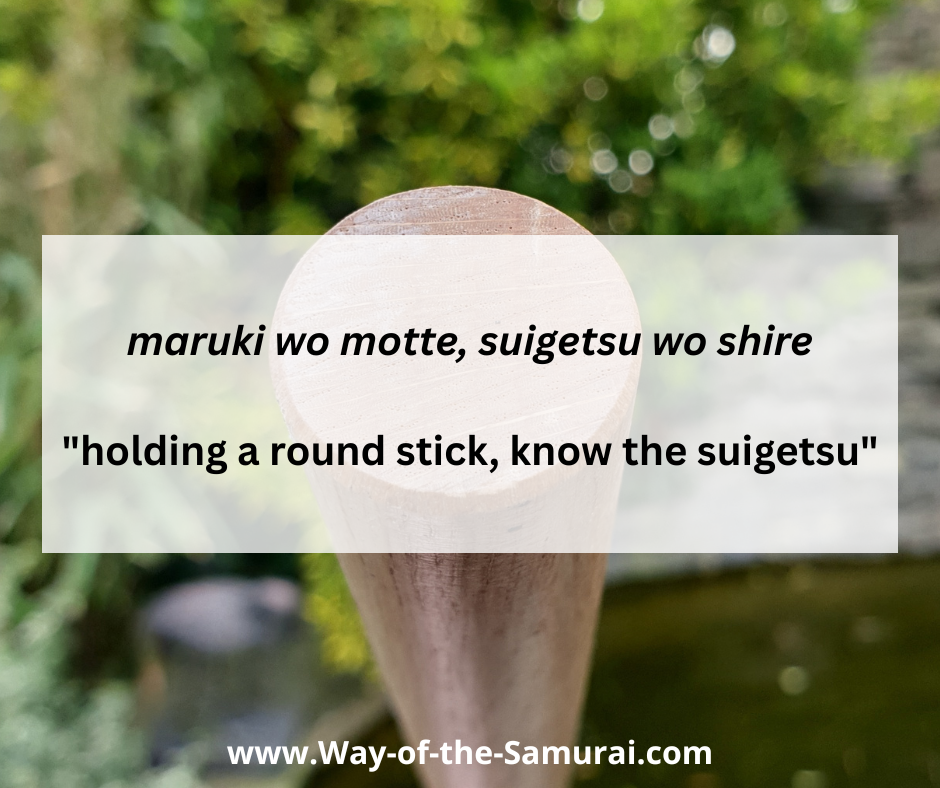
"maruki wo motte, suigetsu wo shire"
("holding a round stick, know the suigetsu").
Note, we don’t translate “suigetsu”.The reason for this is because of these cultural and historical contexts. The suigetsu could refer to the anatomical location of the solar/celiac plexus. It could equally be a suggestion to know all the vital points of the body (see my series on the Vital Points of Jodo!). Equally, it could be a reference to a watery moon, suggesting the idea of harmonising with an opponent, like the moon’s reflection on a still lake.
- Respect for Lineage
Using the original terminology acknowledges and respects the Japanese origins of the art and the generations of practitioners who have preserved and transmitted it.
With these benefits in mind, let's explore the essential terminology that will enhance your jodo journey.
The Basic Language of Jodo You'll Encounter in the Dojo
General Dojo Terms
These terms relate to the training environment and general practice:
- Dojo (道場): Literally "place of the way"; the training hall where martial arts are practised
- Sensei (先生): Teacher or instructor; literally "one who has gone before"
- Senpai (先輩): Senior student
- Kohai (後輩): Junior student
- Rei (礼): Bow; also refers to etiquette more broadly
- Seiza (正座): Formal kneeling position
- Mokuso (黙想): Meditation, usually performed at the beginning and end of practice
- Shomen (正面): Front of the dojo, usually marked by a kamidana (shrine) or calligraphy
- Kamiza (上座): Upper seat or place of honour in the dojo
- Keiko (稽古): Practice or training session
When entering the dojo, you'll often hear these commands:
- Seiretsu (整列): Line up
- Seiza (正座): Kneel in formal position
- Shomen ni rei (正面に礼): Bow to the front (of the dojo)
- Sensei ni rei (先生に礼): Bow to the teacher
- Otagai ni rei (お互いに礼): Bow to each other
- Onegaishimasu (お願いします): "Please teach me" or "Please practice with me" (said at the beginning of practice)
- Domo arigato gozaimashita (どうもありがとうございました): "Thank you very much" (said at the end of practice)
- Yame (やめ): Stop
- Hajime (始め): Begin
Equipment Terms
These terms refer to the weapons and equipment used in jōdō:
- Jo (杖): The wooden staff used in jōdō, typically 128 cm long
- Josaki (杖先): The tip or end of the jo
- Tachi (太刀): The wooden sword used by the partner in jōdō practice
- Bokuto (木刀): Wooden sword; sometimes used interchangeably with "tachi" in jōdō context
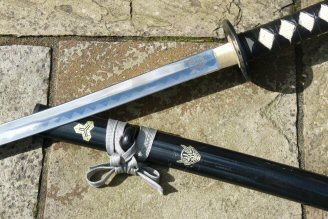
- Tsuba (鍔): The hand guard on the sword
- Tsuka (柄): The handle of the sword
- Tsukagashira (柄頭): The pommel or end cap of the sword handle
- Keikogi (稽古着): Practice uniform, the jacket worn for training
- Hakama (袴): The pleated, skirt-like pants worn in traditional Japanese martial arts
- Obi (帯): The belt worn with the keikogi, under the hakama
Practice Structure Terms
These terms describe the organisation of practice:
- Kihon (基本): Basic techniques or fundamentals
- Kata (型): Predetermined patterns or forms practised with a partner
- Tandoku Dosa (単独動作): Solo practice of techniques
- Sotai Dosa (相対動作): Paired practice of techniques
- Reigi (礼儀): Etiquette or proper behaviour
- Embu (演武): Demonstration of techniques
- Shinsa (審査): Examination for rank advancement
A Pronunciation Guide for Common Commands
Accurate pronunciation helps you respond appropriately to instructions during practice. Here's a simplified guide for commonly heard commands:
- Seiza (say-zah) - Formal kneeling position
- Rei (ray) - Bow
- Hajime (hah-jee-may) - Begin
- Yame (yah-may) - Stop
- Mawatte (mah-wah-tay) - Turn around
- Motoe (moh-toh-eh) - Return to starting position
- Yasume (yah-soo-may) - Relax/take a break
- Sōgo ni rei (Sow-go-knee-ray) — Bow to each other
The Meaning of Specific Commands
Kamae (構え)
- 本手に構え (Honte ni kamae) - Assume honte stance
- 逆手に構え (Gyakute ni kamae) -Assume reverse grip stance
- 引落の構え (Hiki-otoshi no kamae) - Assume draw-down stance
- 左本手に構え (Hidari honte ni kamae) - Assume left honte stance
Yōi (用意) – Preparation commands
- 本手打用意 (Honte-uchi yōi) - Prepare for standard strike
- 逆手打用意 (Gyakute-uchi yōi) - Prepare for reverse strike
- 引落打用意 (Hiki-otoshi-uchi yōi) - Prepare for draw-down strike
- 返し突用意 (Kaeshi-zuki yōi) - Prepare for returning thrust
- 逆手突用意 (Gyakute-zuki yōi) - Prepare for reverse thrust
- 巻落用意 (Maki-otoshi yōi) - Prepare for winding drop
- 繰付用意 (Kuri-tsuke yōi) - Prepare for pressing action
- 繰放用意 (Kuri-hanashi yōi) - Prepare for releasing action
- 体当用意 (Tai-atari yōi) - Prepare for body check
- 突外打用意 (Tsuki-hazushi-uchi yōi) - Prepare for thrust evasion strike
- 胴払打用意 (Dō-barai-uchi yōi) - Prepare for torso sweep strike
- 体外打用意 (Tai-hazushi-uchi yōi) - Prepare for body evasion strike
- 左体外打用意 (Hidari tai-hazushi-uchi yōi) - Prepare for left-side evasion strike
Remember that the language of Jodo is the same as the Japanese syllabic, where each syllable receives approximately equal emphasis. Avoid the tendency to stress certain syllables as in English. Listen carefully to your instructor's pronunciation and try to replicate it as accurately as possible.
How Understanding The Language of Jodo Enhances Your Training Experience
Beyond simply knowing what to call things, understanding the language of jodo and its concepts provides several benefits:
- Improved Learning Efficiency
When you understand the language of jodo instruction, you can respond more quickly and accurately to your teacher's guidance. Rather than stopping to interpret what "honte ni kamae" means, you can immediately adopt the correct stance, allowing practice to flow more smoothly.
- Deeper Conceptual Understanding
Many Japanese terms encapsulate concepts that would require paragraphs to explain in English. By learning these terms, you gain access to nuanced ideas that inform your physical practice. For example, understanding ma-ai as more than just physical distance opens new dimensions in your technique.
- Connection to Tradition
The language of jodo connects you to centuries of martial tradition. When you use the same language as practitioners from previous generations, you participate in a living lineage that transcends individual practice.
- Community Integration
The shared language of jodo creates bonds within the practice community. Being conversant in these terms helps you integrate more quickly into the dojo environment and communicate effectively with practitioners from different backgrounds.
- Cultural Appreciation
Learning the language of jodo provides insight into Japanese cultural concepts and values. This linguistic window enhances appreciation of the cultural context from which the art emerged.
The language of Jodo is a Gateway to Deeper Understanding
The language of jodo might initially seem like an obstacle - another layer of complexity added to the already challenging task of learning new physical skills. However, with time and practice, this specialised vocabulary transforms from a barrier into a gateway leading to deeper understanding.
As you become familiar with these terms and concepts, you'll find that they provide a framework for your physical practice, connecting individual techniques to broader principles and philosophies. The effort invested in learning this language pays dividends in more efficient learning, richer understanding, and a stronger connection to the tradition.
Remember that mastery of terminology, like mastery of technique, comes gradually through consistent practice and exposure. Don't feel pressured to memorise every term immediately. Instead, absorb them naturally through your training, asking questions when needed and allowing your understanding to deepen over time.
By approaching jodo's linguistic dimension with the same patience and persistence you bring to physical training, you'll discover that the language itself becomes a valuable tool in your martial arts journey - opening doors to insights that might otherwise remain inaccessible and enhancing your appreciation of this remarkable art.
If you'd like to train in authentic Japanese Martial Arts, those same warrior skills developed by the samurai, check out my dojo at DublinKendo.com
- - - -
If you want to get in great physical, mental and emotional shape using the same principles and techniques inspired by the feudal warriors and healers of Japan, check out my Samurai Strength Programs.
You've been reading about the language of Jodo. Check out the story of it's origin here
Click here to return to the Way of the Samurai Home Page.
You might like these
Jodo The Way of the Staff: A Basic Introduction
Jodo The Way of the Staff: A Basic Introduction
Jodo Shodan Grading: Sticking it to Irish Martial Arts History
Jodo Shodan Grading: Sticking it to Irish Martial Arts History
The Fascinating History of Jodo: How a Defeat Led to Enlightenment
The Fascinating History of Jodo: How a Defeat Led to Enlightenment

About the Author

Paul Batman O’Brien is passionate about sharing the wisdom of martial arts to help solve our daily problems. He teaches both gendai (modern) and koryu (classical) Japanese martial traditions for Dublin Kendo Kobukai, holding 5th Dan in Iaido, 4th Dan in Jodo, and serving as dojo leader for Hyōhō Niten Ichi Ryū in Ireland.
With over 40 years in martial arts and 20+ teaching, he is a multi-time international medalist, and has represented Ireland at the European Championships for both Iaido and Jodo many times.
He was a lead writer for Irish Fighter Magazine for over 15 years, with over 100 published articles and is the author of multiple books on martial arts, strength and fitness, eastern medicine, and philosophy.
When not teaching martial arts, he owns and operates the Meridian Acupuncture Clinic.


Free Samurai E-books

Get Free Exclusive Samurai Guides and E-books
Subscribe Now

My Best Selling Samurai Fitness Program
Top Viewed Pages