Shinto Ryu Kenjutsu
The Art of Sword Saints and Demons
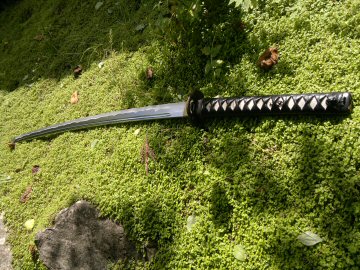
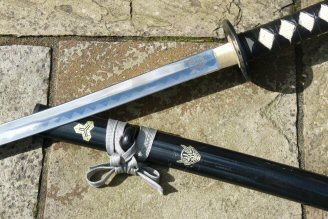
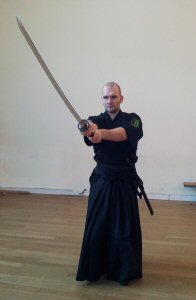
 An image of Shinto Ryu Kenjutsu taken from Kaminoda Tsunemori Sensei's Shintō Kasumi-ryū Kenjutsu, 2013.An image of Shinto Ryu Kenjutsu taken from Kaminoda Tsunemori Sensei's Shintō Kasumi-ryū Kenjutsu, 2013.
Within the broader tradition of Shintō Musō Ryū jōjutsu, the classical Japanese staff art founded by Musō Gonnosuke Katsuyoshi, there exists a set of twelve kenjutsu kata, eight performed with the long sword (ōdachi) and four with the short sword (kodachi), collectively known as Shinto Ryu Kenjutsu (霞神道流剣術). Today, I am going to tell you a story...connecting the earliest myths of Japanese martial arts, through saints and demons, to today.
The Oldest Divine Revelation
The history of Shinto ryu kenjutsu is inseparable from the two great wellsprings of Japanese swordsmanship: Tenshin Shōden Katori Shintō-ryū and Kashima Shintō-ryū. According to Kaminoda Tsunemori Sensei, the tradition goes that the roots of the Kashima sword arts stretch back some 1,660 years, (1) when a man named Kuninazu no Mahito (國摩直人) erected a sacred altar on the grounds of Kashima Jingū and, through prayer and austere devotion, journeyed to the "High plane of Heaven...where this deep philosophy of Heavenly Swordsmanship was revealed". This divine guidance, the earliest in Japanese martial mythology, led him to realise the principle of Ichi no Tachi (一の太刀), meaning "the single stroke of the sword." This revelation became known as Kashima no Tachi, the Sword of Kashima.
Kuninazu no Mahito was not just a senior "ritualist", but a warrior of fiercesome renown, and he was appointed the lead guardian (head of security - hafuribe) of Kashima Jingū and taught a comprehensive system of martial arts based on his revelations to the shrine guards and his descendants, the Yoshikawa Urabe, as a closely guarded martial inheritance.
Over the centuries, the Kashima no Tachi divided into two broad streams: the Jōko-ryū (上古流, the "ancient current") and the Chūko-ryū (中古流, the "middle-age current"). By the reign of Emperor Sutoku in the twelfth century, the tradition had flourished to such a remarkable degree that it was commonly spoken of as the Kantō Shichiryū (関東七流) or Kashima Shichiryū (鹿島七流), the "Seven Schools of Kashima", a designation invoked in conscious parallel with the famous Kyō Hachiryū (京八流), the "Eight Schools of Kyoto." This east-versus-west framing speaks to just how central the Kashima tradition had become to the martial culture of the Kantō region and, by extension, to the entire Japanese swordsmanship landscape.
The Sword Saint Bokuden
The formal progenitor of the Shintō-ryū lineage as a systematised school (ryūha) was Iizasa Chōisai (飯篠長威斎), whose tradition is officially known as Tenshin Shōden Katori Shintō-ryū. Iizasa's school was remarkable for its comprehensive scope: it encompassed not only kenjutsu but also military strategy (gunpō), naginata, nagamaki, spear (sōjutsu), sword-drawing (iai), and staff arts (bōjutsu). Among its notable students were Morooka Ippa (諸岡一羽) and Matsumoto Bizen-no-kami Masanobu (松本備前守政信), the latter of whom was the father of the legendary Tsukahara Bokuden (塚原 卜伝). From these early disciples, a great number of derivative schools eventually emerged, spreading the Shintō-ryū technical and spiritual DNA across Japan.
Tsukahara Bokuden Takamoto (塚原卜伝高幹) was born in 1489 into the family of hafuribe, the Kashima shrine guards, as the second son of Urabe Kakuken (卜部覚賢). He occupies a singular position in the history of Japanese martial arts. He studied Katori Shintō-ryū under his birth father and threw himself into the gruelling life of musha shugyō, the warrior's pilgrimage. Despite years of dedication, living the life of an itinerant warrior, training through travel and combat, Bokuden found himself unable to penetrate the deepest secrets of the Kashima no Tachi. Resolving to break through this impasse, Bokuden undertook a period of one thousand days of secluded prayer (sanrō) at Kashima Jingū. At the end of this extended retreat, he received a divine revelation: "Kokoro arata ni koto ni atare", meaning "Approach the task with a renewed heart." It was through this spiritual awakening that he is said to have at last grasped the gokui (極意), the innermost secrets of the tradition.
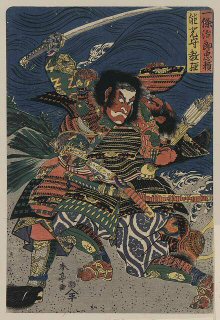
 An ukiyo-e by the artist Yoshitoshi (1839–1892) depicting Miyamoto Musashi and Tsukahara Bokuden. This is an entirely fictional encounter - Bokuden died 13 years before Musashi was born.An ukiyo-e by the artist Yoshitoshi (1839–1892) depicting Miyamoto Musashi and Tsukahara Bokuden. This is an entirely fictional encounter - Bokuden died 13 years before Musashi was born.
Following this realisation, Bokuden, who became a "Kensei" (Sword Saint), reorganised the school, renaming it Kashima Shintō-ryū (鹿島神當流). Even after the eventual decline and fall of the Tsukahara house, the tradition continued to be maintained by the Urabe and Yoshikawa families, ensuring its survival across the turbulent centuries that followed.
Enter the Demon
The Kashima Shinryū produced many exceptional swordsmen in the generations after Bokuden, and the martial arts passed along interconnected lines of teacher and student: from Matsumoto Umanosuke Mikiyasu (松本右馬允幹康), who inherited from his father Matsumoto Bizen-no-kami, through Ogano Echizen-no-kami Mikimichi (小神野越前守幹通) to Ogano Harima-no-kami Sadakatsu (小神野播磨守定勝), and from Makabe Aki-no-kami Hisamiki (真壁安芸守久幹) to Ogura Kazusa-no-kami Yoshitsugu (小倉上総守吉次).
Makabe Aki-no-kami Hisamiki was the seventeenth lord of Makabe Castle (真壁城), active from approximately 1523 to 1589, and was known as a vigorous promoter of martial training within the castle domain. His son, Makabe Ujimoto (真壁氏幹), succeeded him as the eighteenth lord of Makabe Castle and is said to have been a direct high-ranking disciple (takadeshi) of Tsukahara Bokuden himself. Known in his youth as Kojirō (小二郎), Ujimoto later took the tonsure and assumed the name Makabe Dōmu (真壁道無). He was, however, far more than a reclusive sword scholar. Born into the chaos of the Sengoku period, he rose to prominence as a formidable warlord who distinguished himself on numerous battlefields. His martial prowess was not merely theoretical; the many arts he cultivated proved their worth in actual combat.
Contemporary accounts describe Ujimoto as a man of extraordinary physical power and boldness. When he went to war, he famously carried a distinctive personal weapon: an oak staff approximately eight sun (roughly 24 cm) in diameter and one jō (approximately 3 meters) in length, densely studded with iron rivets. When this weapon struck, it was said to sweep both horse and rider to the ground. The local villagers feared him not as "Makabe Dōmu" but by the more terrifying nickname "Oni Dōmu" (鬼道無)... the "Demon Dōmu."
It was this fearsome warrior-lord who took the Shintō-ryū tradition inherited from Bokuden's Shintō-ryū line and, drawing upon it, established a distinct school that became known as Shintō Kasumi-ryū (神道霞流). The name kasumi (霞), meaning "mist" or "haze," was the designation under which the tradition was known roughly four hundred years ago, as confirmed by multiple ancient documents. According to Kaminoda Sensei, on May 5, Heisei 1 (1989), he met Mr Sakurai Keiji, a former retainer of the old Makabe Castle family and a direct descendant of Sakurai Ōkuma-no-kami Naokatu, who had preserved numerous old documents relating to Ibaraki sword traditions. These documents show that a tradition with "eight forms of ōdachi and four forms of kodachi" had been referred to around 400 years ago as “Shinto ryu kenjutsu”, “Shintō Kasumi-ryū” and “Kasumi no ryū.”
Enter the Jō
Musō Gonnosuke Katsuyoshi (夢想 權之助 勝吉), the founder of Shintō Musō Ryū, is recorded as having trained in the Shintō Ryū swordsmanship lineage connected to the Makabe Castle retainers. According to the research of Matsui Kenji, Gonnosuke was reportedly the seventh generational headmaster of the Tenshin Shōden Katori Shintō Ryū through the Matsumoto line, and tradition holds that he was also taught the secrets of Ichi-no-tachi of Kashima Shin Ryū.
Sometime during the Keichō period (1596–1614), Musō travelled to Edo and engaged in numerous contests with eminent swordsmen. He is said to have been undefeated until he faced Miyamoto Musashi, who defeated him with a technique called jūjidome (cross-shaped block). This encounter is corroborated by accounts from within Musashi's own lineage, notably in the Niten ki (Annals of the Niten), written by Toyota Masatake, a successor in Musashi's tradition.
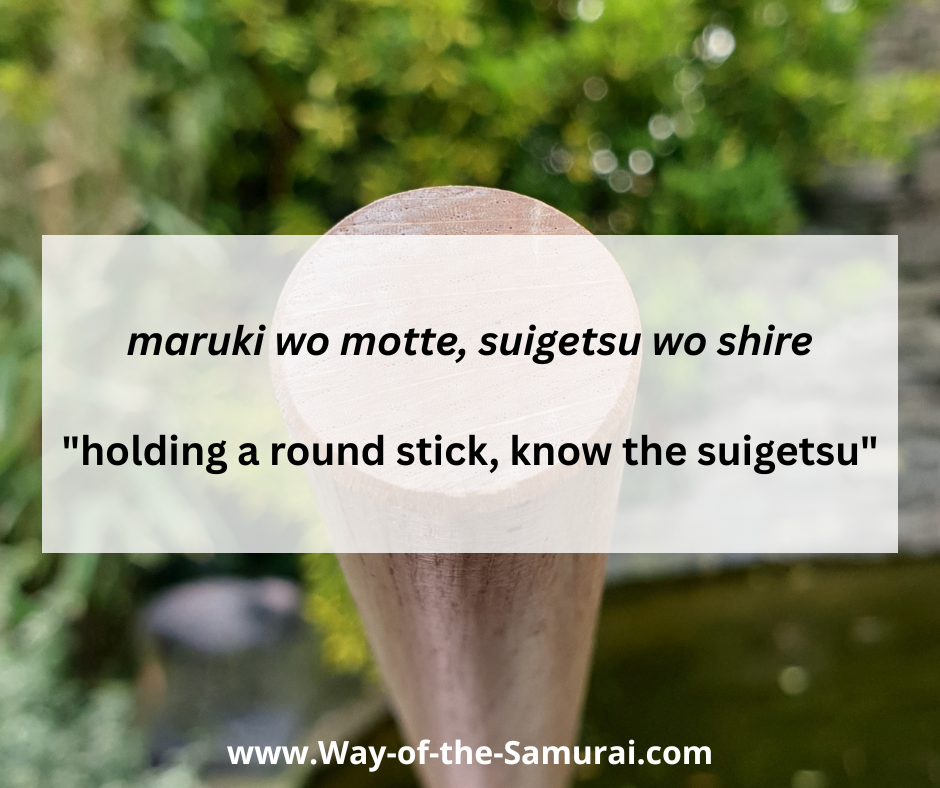
Following his defeat, Gonnosuke withdrew to Mount Hōman in Chikuzen for a period of rigorous ascetic training. There, during a dream-vision on his final day of austerities, he received the divine message: "Maruki o motte, suigetsu o shire", meaning, "Holding a round stick, know the suigetsu." From this revelation, Gonnosuke developed the art of the four-shaku wooden staff and founded what would become Shintō Musō Ryū. He subsequently entered the service of the Kuroda clan in Fukuoka, where the tradition took root and was transmitted through successive generations of instructors.
Critically, Musō Gonnosuke's art was rooted in swordsmanship. The transmission records of his lineage include not only staff techniques but also those earlier 12 sword forms: eight kata of ōdachi (long sword) and four kata of kodachi (short sword), the "Oku: Yatsu no Tachi Yotsu no Kodachi". These kenjutsu forms, traceable through Musō's training in the Shintō Ryū lineage, were transmitted alongside the jōjutsu from the earliest period.
The Formal Title
According to Matusi Kenji Sensei, the formal codification of these kenjutsu methods under the name "Shinto Ryu kenjutsu" was the work of Hirano Kichizō Yoshinobu, the Haruyoshi district instructor during the Bakumatsu period (c. 1845–1865).
Yoshinobu was the son of a poor merchant who arranged for his son to inherit the family name of an ashigaru (foot soldier) named Hirano, thus granting him the social status needed to pursue the warrior arts. With this standing, Yoshinobu studied Shintō Musō Ryū jō, Ikkaku Ryū torite, and Ittatsu Ryū nawa, mastering each thoroughly. He received his menkyo in jō in 1833 from Konishi Bunta Tomoaki and was appointed dangyō (instructor) in the Haruyoshi district in 1845. His primary occupation was as a Kuroda clan courier on the Fukuoka-to-Edo route, a journey of approximately one thousand kilometres that he is said to have made more than one hundred times. The number of disciples training under him eventually reached upwards of one thousand.
Yoshinobu was described as a man of sincere and gentle character with a broad field of knowledge, who excelled not only in the martial arts but also in worldly affairs. Recognising the intellectual abilities of one of his disciples, a man named Umezaki, Yoshinobu tasked him with investigating the lineage of both Ikkaku Ryū torite and Shintō Musō Ryū. In the course of this investigation, two significant changes were made to the tradition's formal records.
First, the lineage founder was changed from Matsumoto Bizen-no-kami to Iizasa Yamashiro-no-kami Ienao, the founder of Tenshin Shōden Katori Shintō Ryū. This aligned the tradition's claimed ancestry with the broader Shintō Ryū family of martial arts.
Second, Yoshinobu formally listed the eight kata of tachi and four of kodachi that had been transmitted within the tradition and combined them under the designation "Shinto Ryu kenjutsu." As Matsui states:
“As there is no documentary evidence before that, it is likely that it was Yoshinobu who gave these arts the name of 'Shintō Ryū .”
- Matsui Kenji (2)
This codification did not represent an invention of new material. The kenjutsu techniques predated Yoshinobu's formalisation, having been transmitted alongside the jōjutsu from the time of Musō Gonnosuke. What Yoshinobu accomplished was to give these pre-existing sword forms a recognised name, an articulated lineage, and a defined place within the densho system, thereby ensuring their preservation as an integral and identifiable component of the tradition.
What Does Training in Shinto ryu Kenjutsu Involve?
Today, the twelve Shinto Ryu kenjutsu kata, collectively referred to as "Hachitōri ōdachi" (eight long-sword forms) and "Yontōri kodachi" (four short-sword forms), are practised as an integral part of the Shindō Musō Ryū curriculum under the Fuzoku Ryūha (Assimilated Schools). They are performed as paired forms in which both partners use bokutō (wooden swords). The individual kata names were not originally described in the densho, a detail that reflects the somewhat informal manner in which the kenjutsu was originally integrated into the written transmission system, even after Yoshinobu's codification.
Kaminoda Sensei characterises these forms as shinken-gata - "true sword forms" - emphasising that they were born from genuine combat experience rather than abstract exercise. The founders created these kata through actual encounters with life-and-death situations, applying in practice what allowed for no second attempt. For this reason, practitioners are urged to approach them with the same utmost seriousness and spiritual intensity.
The kenjutsu forms are generally studied after significant progress in the jō curriculum. They occupy a position in the overall syllabus that reflects both their historical importance and their technical demands, requiring the practitioner to embody correct sword principles alongside the staff work that forms the core of Shintō Musō Ryū.
The Shinto ryu Kenjutsu Curriculum
- Ai sun (Yu) (相寸 右)
- Ai sun (Sa) (相寸 左)
- Jū (鷲)
- Chi barai (乳拂)
- Sarin (左輪)
- Uke kaeshi (受返)
- Nitō ai (二刀合) (long sword vs long sword and short sword)
- Suri komi (摺込)
- Inchū (咽中) (Short sword vs long sword)
- Uke nagashi (受流) (Short sword vs long sword)
- Miuke dome (三受留) (Short sword vs long sword)
- Tsuki dashi (突出) (Short sword vs long sword)
“For me, Shinto Ryu kenjutsu represents a thread of true, serious swordsmanship that runs from the very earliest myth of Japanese martial arts to today. It is the through line connecting the ancient Kashima and Katori traditions, Sword Saints and Demons, through the martial culture of the Makabe Castle lords and their retainers, into the tradition founded by Musō Gonnosuke Katsuyoshi. Today, the twelve kata of Shintō Ryū kenjutsu continue to be practised and transmitted as a living component of one of Japan's most complete classical martial traditions.”
- Batman O'Brien
If you'd like to train in authentic Japanese Martial Arts, those same warrior skills developed by the samurai, check out my dojo at DublinKendo.com
- - - -
If you want to get in great physical, mental and emotional shape using the same principles and techniques inspired by the feudal warriors and healers of Japan, check out my Samurai Strength Programs.
References
- Kaminoda,Tsunemori. Shintō Kasumi-ryū Kenjutsu / Uchida-ryū Tanjōjutsu: Including Sasumata-jutsu. Revised ed. Japan: Hagiwara Printing Co., 2013.
- Hamaji, Koichi. Shintō Musō-ryū Jō no Hinkaku (The Dignity of Jō). Translated by Hiroshi Matsuoka. Edited by Russ Ebert. Nagoya, Japan: Aijōkai, 2010.
You've been reading about Shinto Ryu kenjutsu. Check out the History of Jodo here.
Click here to return to the Way of the Samurai Home Page.
You might like these
Jodo The Way of the Staff: A Basic Introduction
Jodo The Way of the Staff: A Basic Introduction
Jodo Shodan Grading: Sticking it to Irish Martial Arts History
Jodo Shodan Grading: Sticking it to Irish Martial Arts History
The Fascinating History of Jodo: How a Defeat Led to Enlightenment
The Fascinating History of Jodo: How a Defeat Led to Enlightenment
About the Author

Paul Batman O’Brien is passionate about sharing the wisdom of martial arts to help solve our daily problems. He teaches both gendai (modern) and koryu (classical) Japanese martial traditions for Dublin Kendo Kobukai, holding 5th Dan in Iaido, 4th Dan in Jodo, and serving as dojo leader for Hyōhō Niten Ichi Ryū in Ireland.
With over 40 years in martial arts and 20+ teaching, he is a multi-time international medalist, and has represented Ireland at the European Championships for both Iaido and Jodo many times.
He was a lead writer for Irish Fighter Magazine for over 15 years, with over 100 published articles and is the author of multiple books on martial arts, strength and fitness, eastern medicine, and philosophy.
When not teaching martial arts, he owns and operates the Meridian Acupuncture Clinic.


Free Samurai E-books
Get Free Exclusive Samurai Guides and E-books
Subscribe Now
My Best Selling Samurai Fitness Program
Top Viewed Pages