- Home
- Samurai History
- Samurai Weapons and Armour
Samurai Weapons and Armour: The Evolution of Samurai Weapons and War

In Part One of Samurai Weapons and Armour (called Samurai Arms and Armour - blame SEO), we covered the ancient origins...Before the katana. Before the samurai. There was iron, horse, and bow.
We journeyed back to ancient Japan, where armoured foot soldiers clashed in close formations wearing tankō - rigid iron shells that turned warriors into walking fortresses. We discover the fearsome "battering-ram" helmets designed to deflect killing blows, and the straight-bladed chokutō swords inherited from the Asian mainland.
Then we witnessed a revolution. Horses thunder onto Japanese battlefields, and everything changes. Rigid armour gives way to flexible lamellar keikō, built from hundreds of overlapping scales that move with the rider. Helmets sprout visors to shield eyes from the sun and arrows. And the bow - the deadly asymmetric yumi standing taller than a man - rises to become the weapon that defines a warrior.
By the Heian period, a new class of elite fighters emerged: the samurai. Clad in magnificent ō-yoroi "great armour" laced with colourful silk, these mounted archers announce their names before battle and fight for honour as much as victory. Their curved tachi swords glint at their sides—not as primary weapons, but as elegant backups for when the arrows run dry.
This is where the legend begins.
But in this, Part Two: Samurai Weapons and Armour...
The age of the mounted archer is over. Now the real bloodshed begins.
As Japan plunges into centuries of relentless conflict, the battlefield transforms. Elegant duels give way to brutal close combat. Massive armies clash in muddy fields and mountain passes. The old "great armour" is too heavy, too slow - warriors who cling to tradition become corpses.
Enter a new, sleek, flexible armour that wraps the body like a second skin. Helmets grow thicker, forged from dozens of iron plates to survive crushing blows. A new weapon becomes king of the battlefield, its lethal reach cutting down cavalry and infantry alike.
Then comes the Sengoku - the Age of Warring States - and warfare becomes an industry. Armourers craft bullet-proof plates, testing them with actual gunfire. Commanders don towering helmets shaped like horns, shells, and monsters to terrify enemies and rally troops through the chaos. The sword of the samurai transforms - shorter, faster, worn edge-up for lightning-quick draws when death stands inches away. And thunder echoes across Japan as firearms change everything.
Yet all wars end. Under the Tokugawa peace, swords become souls rather than weapons. Armour transforms into art. The samurai legacy crystallises into ceremony, philosophy, and the martial traditions that endure to this day.
From battlefield necessity to timeless legend - this is the complete story.
Part Two: Samurai Weapons and Armour
Changing Battlefields and The Rise of Close Combat (1185–1392)
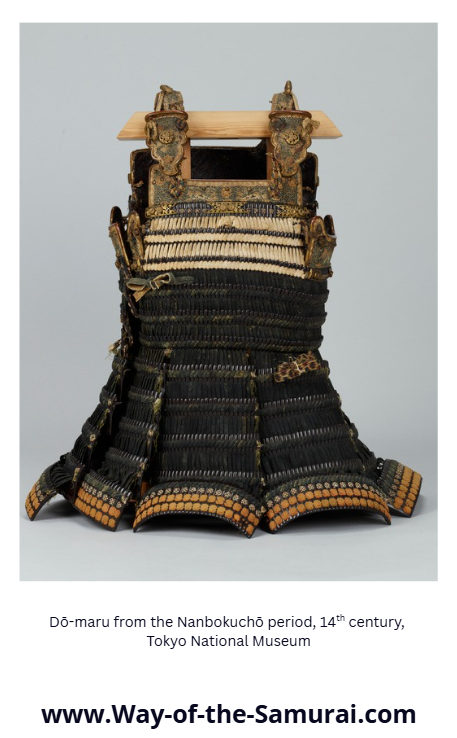
As warfare intensified during the Kamakura (1185–1333) and Nanbokuchō (1336–1392) periods, combat became less formal and more continuous. Battles increasingly involved infantry fighting in rough terrain, prolonged engagements, and coordinated group tactics. The heavy, rigid ō-yoroi proved ill-suited to this new style of warfare, and weapons designed for close combat rose in importance.
Dō-maru and Haramaki: Lighter Armour for a New Era
In response to changing battlefield conditions, lighter and more flexible armours gained prominence.
Dō-maru (胴丸), meaning "body wrap," was designed to encircle the torso and fasten at the side. Its advantages included better weight distribution, increased mobility, and easier donning without assistance. Introduced in the late Kamakura period, the dō-maru closed at the back and represented a significant departure from earlier armour designs.
A related style, haramaki (腹巻), meaning "belly wrap," opened at the back and was often worn by lower-ranking warriors. The haramaki wrapped around the torso and overlapped under the right arm. Though simpler, it offered effective protection and excellent freedom of movement.
Both styles were lighter and more flexible than ō-yoroi, allowing greater freedom of movement at the cost of some protection. These armours reflect a major shift in samurai identity. Warriors were no longer defined solely as mounted archers but as adaptable fighters skilled with swords, spears, and polearms. Group cohesion and battlefield awareness became increasingly important.
Helmet Refinement and Reinforcement
As warfare intensified during the Kamakura and Nanbokuchō periods, helmets needed to withstand heavier impacts. Armourers responded by increasing the number of plates used in the bowl, sometimes exceeding sixty narrow plates.
These multi-plate helmets distributed force effectively and reduced the chance of catastrophic failure. Rivets became more numerous and prominent, contributing both to strength and to the helmet's distinctive appearance.
Helmets of this era often included deep, flared shikoro for expanded protection, improved interior padding, and stronger chin ties (shinobi no o, 忍緒).
These developments reflect a battlefield environment in which close combat, not just archery, was increasingly common.
Yari and Naginata: The Rise of Infantry Polearms
As warfare shifted toward larger, less formal battles, close combat became increasingly common. Weapons that favoured control of distance and group tactics, marking a shift away from purely individual combat and the dominance of the bow, came to prominence.
Spears, known as yari (槍), rose in importance. Unlike earlier hoko, yari featured straight blades mounted on long shafts, making them ideal for thrusting in formation or individual combat. Their reach made them highly effective against both mounted and foot soldiers. Sōjutsu (槍術), meaning "art of the spear", is still taught today in many koryū, including Saburi-ryū Sōjutsu, Fuden-ryū Sōjutsu, Tenshin Shōden Katori Shintō-ryū, Hōzōin-ryū, Kashima Shintō-ryū, Owari Kan-ryū, Shintō Musō-ryū and more.
The naginata (薙刀), characterised by a curved blade mounted on a long shaft, continued to be important during this period. The naginata excelled at sweeping cuts and was especially effective against cavalry. The naginata is still taught in classical schools such as Tenshin Shōden Katori Shintō-ryū, Tendō-ryū Naginatajutsu, Jikishinkage-ryū, Kashima Shin-ryū, Takenouchi-ryū, Araki-ryū Gun’yō Kogusoku, Yagyū Shingan-ryū and several others. The Naginata is now taught in a more modern sport form through Atarashii Naginata, developed in the 1950’s and following a similar path as Kendō.
Samurai Weapons and Armour: The Age of Mass Warfare (15th–16th Centuries)
The Sengoku Period (15th–16th Centuries) was marked by near-constant warfare between rival domains. Armies grew larger, battles more frequent, and survival depended on efficiency and adaptability. This era saw revolutionary changes in armour, helmet design, and weaponry.
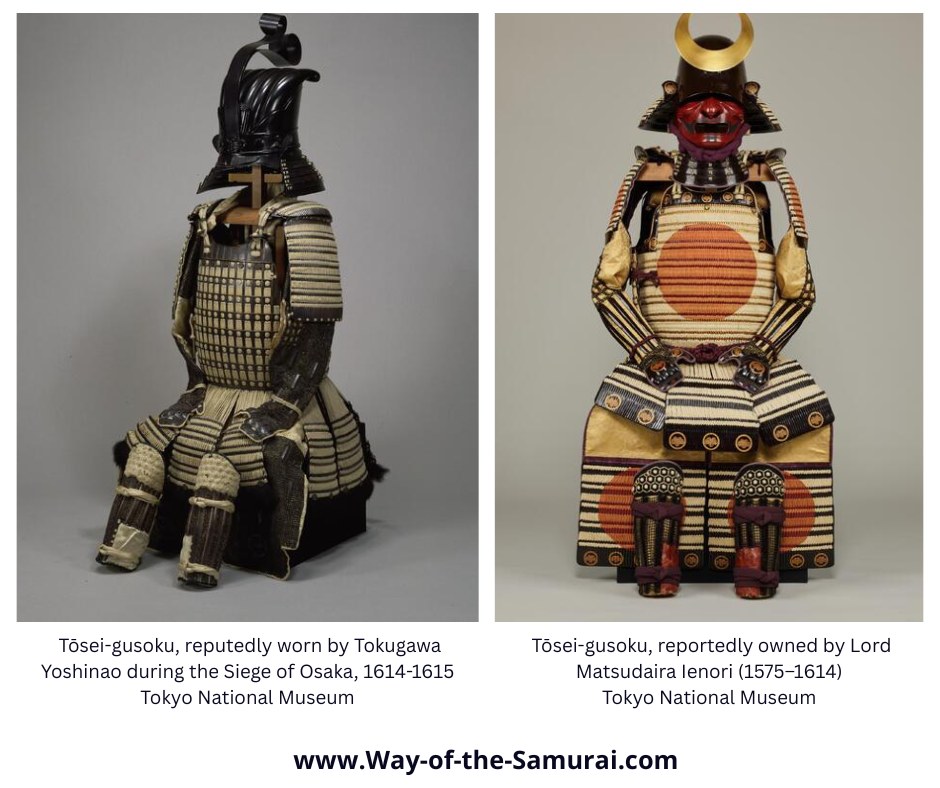
Tōsei-gusoku: Practical Armour for Total War
Armour of this era is known as tōsei-gusoku (当世具足), or "modern armour." Unlike earlier designs, tōsei-gusoku emphasised practicality over tradition.
Key features included large iron plates replacing small scales, hinged construction for rapid donning, improved helmets with reinforced bowls, and bullet-resistant armour (tameshi-gusoku, 試具足).
With the introduction of firearms, armourers tested their designs by firing bullets at finished plates. Armour that survived bore visible dents as proof of effectiveness. This period represents the most technically advanced stage of Japanese armour development.
Helmets for Mass Warfare
During the Sengoku period, Japan was engulfed in continuous warfare. Helmets needed to be produced quickly, worn comfortably for long periods, and provide reliable protection against increasingly diverse threats.
This period saw the rise of simplified yet robust helmet forms, including bowls with fewer, thicker plates, reinforced frontal areas, and reduced decorative complexity.
At the same time, some commanders adopted dramatic helmet designs to stand out on chaotic battlefields.
Kawari Kabuto: Individuality and Intimidation
One of the most distinctive developments of the Sengoku period was the kawari kabuto (変わり兜), or "unusual helmet." These helmets featured extraordinary shapes, including animal horns, seashells, religious symbols, and abstract or architectural forms.
While often associated with vanity, kawari kabuto served practical purposes. They made commanders visible to their troops, intimidated enemies, and reinforced authority. In a battlefield filled with identical armour, a unique helmet was a powerful tool of command.
From Tachi to Katana: Swords for Close Combat
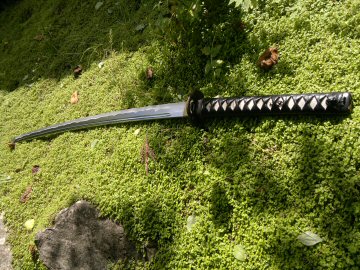
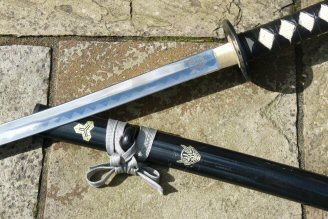
The katana's mounting style supported rapid responses in sudden encounters, reflecting the realities of foot combat and castle fighting. Swordsmanship increasingly emphasised speed, timing, and decisive action.
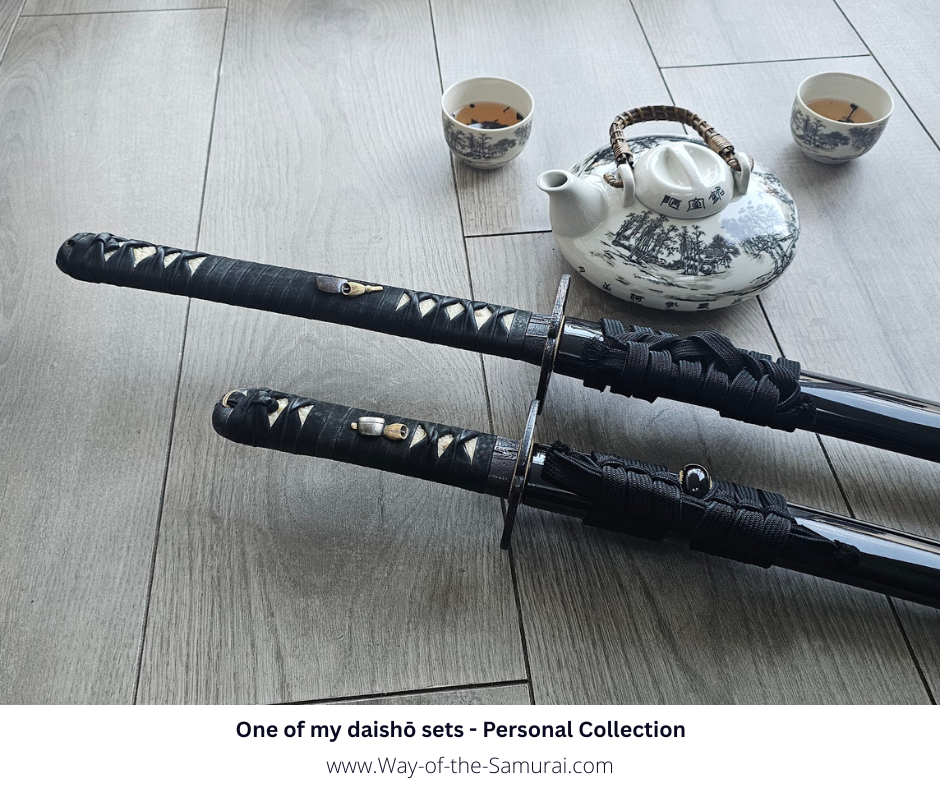
Paired with the katana was the wakizashi (脇差), a shorter companion sword. Together, they formed the daishō (大小), symbolising samurai status.
I was taught to use both the katana and the wakizashi simultaneously through the study of Hyōhō Niten Ichi Ryū (兵法二天一流). I also study the techniques of the katana and the wakizashi in Shintō Musō-ryū and Musō Jikiden Eishin-ryū, among others.
Spears, Swords, and Firearms
The Sengoku period saw the rise of large, organised armies. Spears became the primary battlefield weapon due to their effectiveness, ease of training, and ability to be used in dense formations.
The introduction of firearms, known as teppō (鉄砲), in the 16th century transformed warfare. Matchlock guns could penetrate armour and changed battlefield tactics permanently.
Traditional weapons did not disappear, but they were used alongside firearms in coordinated systems. Swordsmanship increasingly became a backup skill rather than the primary method of fighting.
Samurai Weapons and Armour Part Six: The Peace and Pageantry of The Edo Period
Following the establishment of the Tokugawa shogunate in 1603, Japan entered a long period of peace. Large-scale warfare all but disappeared, and armour was rarely used in battle. Yet military equipment remained deeply important as a symbol of samurai status.
Armour in the Edo Period
Edo-period armour was often highly decorative, inspired by earlier historical styles, and intended for ceremonies and processions.
Elaborate lacquer, family crests (mon, 紋), and dramatic helmet ornaments transformed armour into a visual statement of lineage and loyalty. While still functional in theory, much of this armour was never meant to be worn in combat.
Helmets as Symbols of Rank and Heritage
With the establishment of peace under the Tokugawa shogunate, helmets gradually shifted from practical military equipment to ceremonial and symbolic objects.
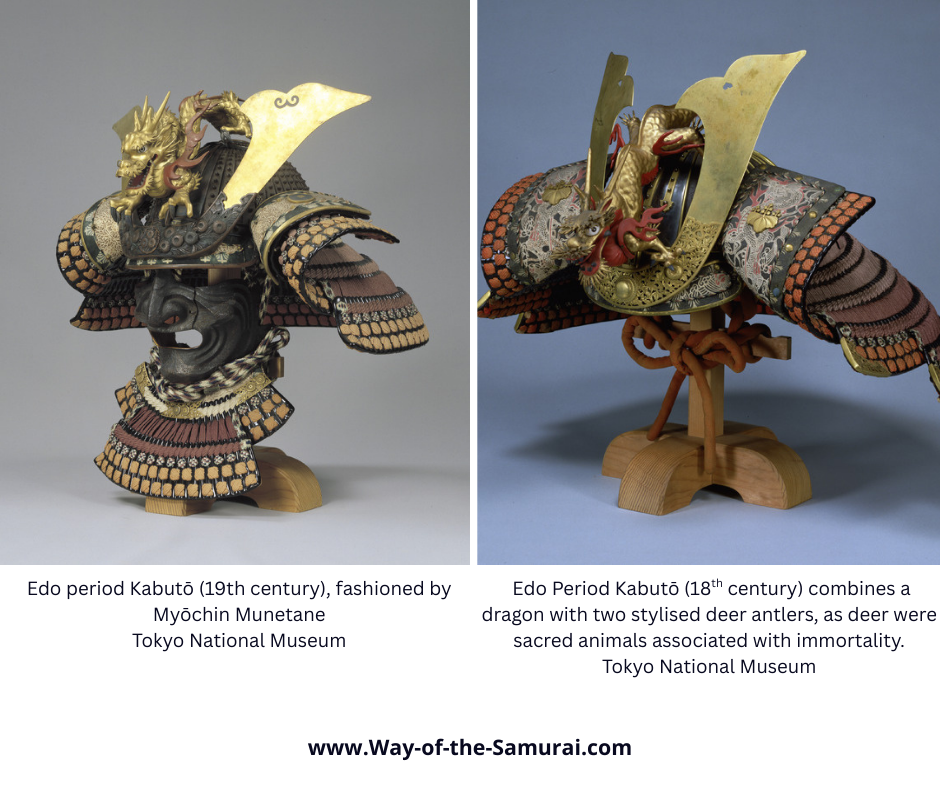
Edo-period kabuto were often meticulously lacquered, inspired by earlier historical styles, and decorated with elaborate crests (maedate, 前立).
These helmets were worn during processions, inspections, and formal occasions. They communicated lineage, loyalty, and cultural continuity rather than readiness for battle.
Samurai Weapons as Cultural Symbols
Under the Tokugawa shogunate, Japan experienced prolonged peace. Weapons were no longer tools of daily warfare but symbols of social identity.
Swordsmanship evolved into formal schools (ryūha, 流派) emphasising discipline, ethics, and self-cultivation. The sword became known as the "soul of the samurai," a phrase reflecting ideology more than battlefield reality.
Weapons of the Edo period were often beautifully crafted, carefully preserved, and used in training, duels, and ceremony rather than war.
Craftsmanship and Maintenance
The tools of the samurai trade, samurai weapons and armour, were not merely functional - they were also works of art. Swordsmiths, armourers, and bowyers were highly respected craftsmen who passed their skills from generation to generation. The aesthetic appeal of samurai arms and armour reflected both the samurai's social status and the Japanese cultural value placed on the marriage of function and beauty. Even today, surviving examples of samurai arms and armour are treasured as masterpieces of craftsmanship.
The specialised nature of samurai weapons and armour required equally specialised training to use effectively. Young warriors spent years mastering not only how to fight with these tools but also how to maintain them properly. Keeping armour cords tight, bowstrings dry, and sword blades oiled was as much a part of a samurai's routine as practice with the weapons themselves.
Consider the account of one warrior who lost a battle because rats had gnawed through his bowstrings while he camped overnight. When enemies attacked the next morning, he and his men were forced to draw swords instead of shooting arrows - with disastrous results. As the chronicle relates:
“Their bowstrings severed, Kagehisa and his men unsheathed their swords and brandished them, but they could not thus contend against arrows and stones. Many were shot... Kagehisa cast away his pride and fled like lightning.”
- Azuma Kagami, 1180 (1)
This story illustrates how critical proper equipment maintenance was to battlefield success. It also shows the tremendous disadvantage faced by warriors without functioning missile weapons when confronting opponents who could shoot at them from a distance.
Understanding Warfare Through Samurai Weapons and Armour
The evolution of samurai weapons and armour mirrors the evolution of Japanese warfare itself. From rigid infantry protection to flexible lamellar designs, from elite mounted equipment to mass-produced battlefield gear, each stage reflects changing realities on the ground.
Samurai weapons evolved not because of abstract ideals, but because warriors adapted to changing conditions. From bows and curved swords to spears and firearms, each weapon tells a story about how battles were fought and how warriors survived.
The kabuto was at once shield, banner, and personal statement - a unique fusion of function and meaning that stands at the heart of samurai material culture. From heavy infantry protection to refined mounted combat gear, from mass-produced battlefield equipment to symbolic expressions of identity, the helmet reflects changing ideas about warfare, leadership, and honour.
By studying these developments, we gain a clearer picture of the samurai as practical fighters shaped by necessity rather than myth. Arms and armour were not merely instruments of violence; they were teachers, revealing lessons about distance, timing, cooperation, and restraint. Armour is not merely a relic of the past - it is a key to understanding the lived experience of the warrior and the world that shaped him.
For modern martial artists, understanding the tools used by early samurai provides valuable context for techniques practised today. The weight and balance of traditional weapons, the restrictions imposed by armour, and the specialised movements developed to overcome these limitations all influenced the development of Japanese martial arts.
When you practise sword techniques in iaidō, you are connecting with methods originally developed for the tachi. When you learn stances and footwork in various martial arts, you are experiencing movements that evolved in response to the constraints and opportunities presented by samurai equipment. Even the dōgi (training uniform) worn in modern dōjō has connections to samurai equipment. The jacket's crossover design resembles the kosode (undergarment) worn beneath armour, while the obi (belt) recalls the broader belts used to secure armour components.
By appreciating the specialised nature of samurai arms and armour, we gain deeper insight into both historical warfare and modern martial arts practice. The samurai's tools were not merely weapons but extensions of the warrior himself - physical manifestations of skills honed through years of discipline and training.
In understanding samurai arms and armour, we come closer to understanding the warriors themselves - and the historical realities behind the legend.
As you continue your martial arts journey, remember that you're participating in traditions shaped by these historical tools of the trade. The equipment may have evolved, but the principles of discipline, precision, and continuous improvement remain as relevant today as they were in the age of the early samurai.
If you'd like to train in authentic Japanese Martial Arts, those same warrior skills developed by the samurai, check out my dojo at DublinKendo.com
- - - -
If you want to get in great physical, mental and emotional shape using the same principles and techniques inspired by the feudal warriors and healers of Japan, check out my Samurai Strength Programs.
References
- Friday, Karl F. Samurai, Warfare and the State in Early Medieval Japan. New York: Routledge, 2004.
You've been reading about Samurai Weapons and Armour! Check out part 1 - here.
Click here to return to the Way of the Samurai Home Page.
You might like these
History of the Samurai
History of the Samurai - An Introduction to the Story of the Samurai
The Bansenshukai - A Period Fantasy Document
The Bansenshukai - A Period Fantasy Document
The Gunpo Jiyoshu and the Ninja Myth
The Gunpo Jiyoshu and the Ninja Myth
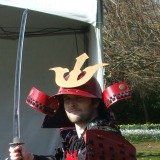

About the Author

Paul Batman O’Brien is passionate about sharing the wisdom of martial arts to help solve our daily problems. He teaches both gendai (modern) and koryu (classical) Japanese martial traditions for Dublin Kendo Kobukai, holding 5th Dan in Iaido, 4th Dan in Jodo, and serving as dojo leader for Hyōhō Niten Ichi Ryū in Ireland.
With over 40 years in martial arts and 20+ teaching, he is a multi-time international medalist, and has represented Ireland at the European Championships for both Iaido and Jodo many times.
He was a lead writer for Irish Fighter Magazine for over 15 years, with over 100 published articles and is the author of multiple books on martial arts, strength and fitness, eastern medicine, and philosophy.
When not teaching martial arts, he owns and operates the Meridian Acupuncture Clinic.


Free Samurai E-books
Get Free Exclusive Samurai Guides and E-books
Subscribe Now
My Best Selling Samurai Fitness Program
Top Viewed Pages