- Home
- Samurai History
- Samurai Arms and Armour
Samurai Arms and Armour: Tools of the Trade
Samurai Arms and Armour was originally a lecture I gave at Dublin City University in May 2012, which I have now updated for this article. This is, of course, an extremely brief discussion. Even still, I have to divide this into two parts. Volumes have been written on the subject of Samurai Arms and Armour, and it is a topic that covers nearly 1,000 years of history. That history can be analysed from multiple points of view, including, but not limited to, the actual construction of Samurai Arms and Armour, changing social and combative considerations, philosophical and religious components, and most importantly, use and tactics.
It’s important to understand that Samurai Arms and Armour did not appear fully formed. Instead, it evolved over more than a thousand years in response to changes in warfare, technology, social structure, and the ideals of combat. This evolution of Samurai Arms and Armour begins before the Samurai, with the warriors of Ancient Japan.
Samurai Arms and Armour Part One: Before the Samurai - Warriors of Ancient Japan
The Yamato Period: Infantry Warfare and Its Equipment
Long before the samurai emerged as a distinct social class, the people of Japan had already developed sophisticated forms of armour, helmets, and weapons. During the Yamato period (approximately the 3rd to 7th centuries), warfare was dominated by infantry fighting with swords, spears, and bows. Mounted combat was rare, and military equipment reflected the needs of foot soldiers who fought in close formations.
Tankō: Armour for the Foot Soldier
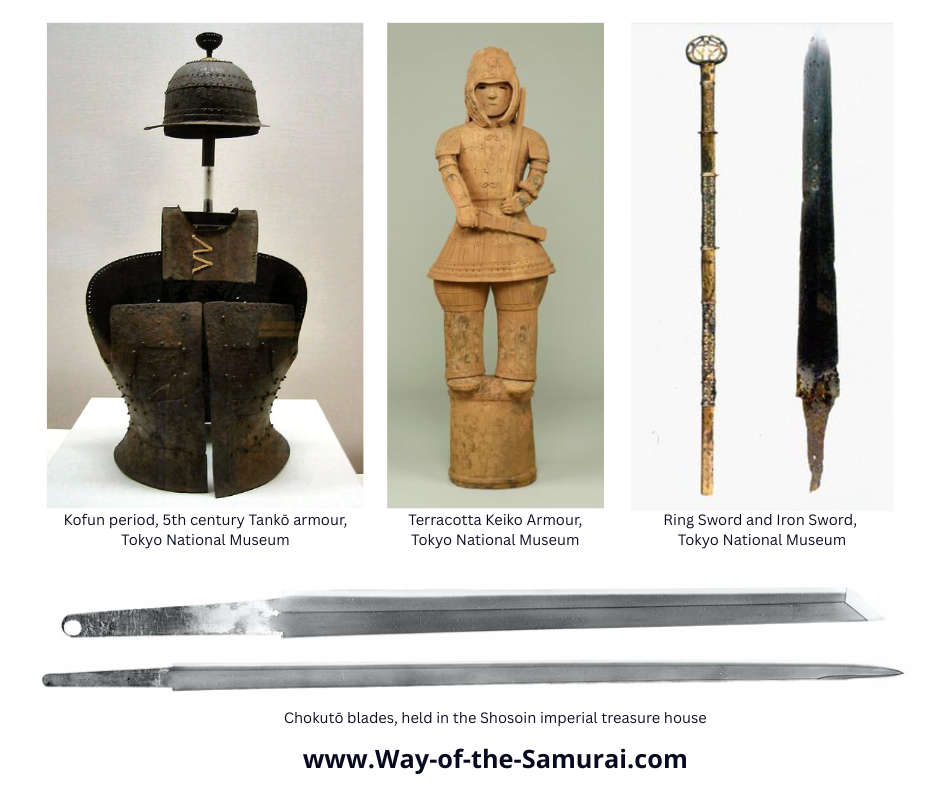
The primary armour of this era was known as tankō (短甲), meaning "short armour." Tankō was constructed from relatively large iron plates riveted together into a rigid shell that closely followed the shape of the torso. Unlike later samurai armour, which relied on flexibility, tankō emphasised solid protection.
Tankō typically included:
- a tightly fitted iron cuirass (dō, 胴) protecting the torso,
- a flared skirt (kusazuri, 草摺) to protect the hips and upper thighs, and
- a helmet (kabuto, 兜) with a prominent forward-projecting brow.
One particularly interesting feature of early tankō is the use of leather thongs to bind plates together. This suggests that Japanese armour may have evolved from even earlier leather or organic armour, later translated into iron as metalworking technology improved. In this way, tankō represents a bridge between prehistoric protection and historical armour.
Shōkaku-tsuki Kabuto: The "Battering-Ram" Helmet
The earliest Japanese helmets date to the Yamato period, the same era that produced tankō body armour. These helmets were constructed for infantry combat and emphasised frontal protection.
A characteristic early form is the shōkaku-tsuki kabuto (衝角付兜), often translated as a "battering-ram helmet." The name comes from the pronounced forward-projecting ridge or beak extending from the brow.
Key features included:
- a bowl formed from iron plates riveted together,
- a strong frontal projection to deflect blows,
- a relatively close-fitting shape, and
- a neck guard (shikoro, 錣) made from horizontal iron lames.
These helmets were heavy but robust, designed to withstand sword and spear strikes during close combat. Their construction shows advanced ironworking skills and suggests influence from continental Asian armour traditions.
Chokutō and Hoko: Weapons of Ancient Japan
In ancient Japan, before the rise of the samurai class, warfare was dominated by infantry combat. The primary weapons of this era were relatively simple and heavily influenced by surrounding Asian models.
The most common sword was the chokutō (直刀), a straight, single- or double-edged sword modelled after Chinese and Korean designs. These swords were effective for thrusting and chopping, but less suited to the cutting techniques that later Japanese swords would emphasise.
Pole weapons were equally important. Early warriors used the hoko (矛), an early spear with a leaf-shaped blade, along with simple halberd-like weapons designed for formation fighting. Roald Knutsen Sensei credited the hoko with being “the first elegant representatives of truly artistic weapons” (1). In the martial arts of today, the influence of the hoko continues - often used in Shintō ceremonies, its traditions are also seen in the jumonji-yari (cross-shaped spear) of Hōzōin-ryū.
These weapons reflect a style of warfare based on organised units rather than individual combat skill. Together with tankō armour and shōkaku-tsuki kabuto helmets, they formed an integrated system of infantry equipment that would serve Japanese warriors for centuries before the rise of mounted warfare.
Samurai Arms and Armour: Horses and Mobility - The Rise of Mounted Warfare (7th–9th Centuries)
Between the 7th and 9th centuries, Japanese warfare underwent a major transformation with the introduction of horses from the Asian mainland. Mounted warriors needed armour that allowed movement, balance, and endurance over long distances. Heavy, rigid plate armour like tankō was poorly suited to these demands. Similarly, helmet design and weaponry had to adapt to the new realities of combat from horseback.
Keikō: Lamellar Armour for the Mounted Warrior
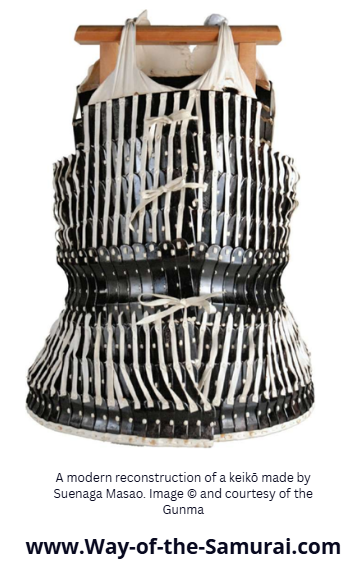
The solution to the mobility problem was lamellar armour, constructed from many small overlapping plates laced together. In Japan, this early mounted armour was called keikō (挂甲), often translated as "hanging armour."
Lamellar plates, known as kozane (小札), were typically made of iron or hardened leather and tied together with leather cords. This construction allowed armour to flex with the body while still absorbing the force of blows. Rather than resisting impact through rigidity, lamellar armour dispersed energy through its lacing.
Keikō armour included:
- a sleeveless, coat-like torso covering,
- scale-based arm and leg protection, and
- a helmet with a projecting visor (mabisashi, 眉庇).
This style of armour closely resembles lamellar armour found across Central and East Asia, reflecting Japan's active exchange of military technology with neighbouring cultures. Keikō marks the beginning of a distinctly Japanese approach to mounted warfare.
Mabisashi-tsuki Kabuto: Helmets for Horsemen
As horses became central to warfare, helmet design adapted to mounted combat. Riders needed protection from arrows descending at angles rather than from straight-on blows.
This led to helmets with a pronounced visor known as mabisashi (眉庇), meaning "brow shade." Helmets incorporating this feature are called mabisashi-tsuki kabuto.
These helmets typically featured a rounded bowl constructed from multiple iron plates, a projecting visor riveted to the front, and a shikoro for neck protection.
The visor helped shield the eyes from the sun, rain, and arrows while riding. Some examples were highly decorative and may have been reserved for elite warriors or ceremonial use, indicating that helmets were already serving symbolic as well as practical functions.
Yumi: The Bow Takes Centre Stage
The introduction of horses elevated the bow, or yumi (弓), to the most important weapon of the emerging warrior class.
The Japanese bow developed a distinctive asymmetrical shape, with the grip positioned below the centre. Standing over two metres tall, it featured an asymmetric design with the grip positioned about one-third of the way from the bottom. This unusual configuration allowed mounted archers to use these lengthy weapons effectively from horseback, swinging the long upper portion of the bow around the horse's head when necessary.
The earliest bows were made from a single piece of wood (usually catalpa, zelkova, sandalwood, or mulberry), but by the late Heian period, composite bows with bamboo facings laminated to the wood core became common. These takefuse yumi offered greater power and durability than simple wooden bows, though they still lacked the devastating range and penetrating power of the composite bows used by steppe nomads like the Mongols.
Arrows used by samurai were equally specialised. Measuring between 86 and 96 centimetres - longer than arrows used in most other cultures - they featured various types of heads designed for different purposes. Some had narrow, four-sided points for penetrating armour, while others had broader, leaf-shaped heads for causing larger wounds. Warriors often marked their arrows with their names so that kills could be properly attributed in the chaotic environment of battle.
Mounted archery emphasised long-range engagement, individual skill and accuracy, and ritualised combat and personal identification. In early samurai warfare, victory often depended more on archery than on swordsmanship. Swords were secondary weapons, used only when distance collapsed.
Samurai Arms and Armour: The Birth of the Samurai — The Way of Horse and Bow (10th–12th Centuries)
By the late Heian period, a professional warrior class had emerged: the samurai (侍). These warriors served aristocratic families and the imperial court, fighting primarily as mounted archers. Their armour, helmets, and weapons were designed to support this role above all others. See my previous article “The Way of the Horse and Bow" for more.
Ō-yoroi: Great Armour for the Mounted Archer
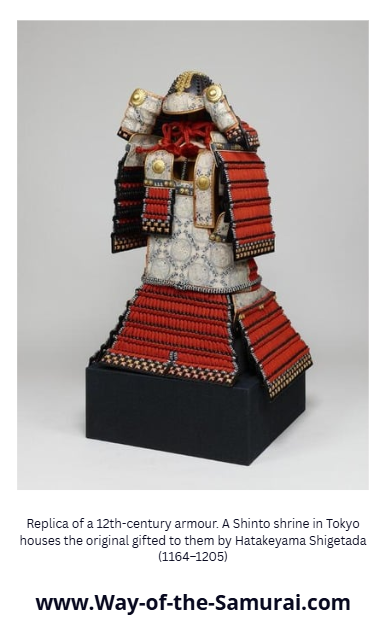
The defining armour of this era was ō-yoroi (大鎧), meaning "great armour." Developed during the Heian period (794–1185), ō-yoroi was specifically designed for mounted archers. This is the armour most people imagine when they think of classical samurai.
Ō-yoroi was characterised by its distinctive box-like shape, weighing approximately 30 kilograms. It consisted of small iron or leather scales (sane) laced together with colourful silk cords to form protective plates. Key features included heavy lamellar plates laced with silk or leather, a massive right shoulder guard (ō-sode, 大袖), and a rigid chest section opening on the right side.
The construction of ō-yoroi reveals much about early samurai combat priorities. Unlike European plate armour designed primarily to defend against direct sword strikes and lances, ō-yoroi was engineered to absorb the impact of arrows. Its layered construction diffused the energy of incoming projectiles, while the loose fit created space between the armour and the warrior's body - meaning that arrows penetrating the outer layer might not reach the flesh beneath.
One particularly fascinating feature of ō-yoroi was its asymmetric design. The cuirass (dō, body armour) wrapped around the left, front, and back of the wearer's chest, while a separate piece called the waidate protected the right side. This arrangement allowed maximum flexibility for drawing and shooting a bow, the primary weapon of early samurai. The right side of the body was kept as free as possible to allow the warrior to draw and release a bow while mounted. Protection was concentrated where arrows were most likely to strike during cavalry engagements.
Perhaps the most distinctive elements of ō-yoroi were the large rectangular shoulder guards, those ō-sode I mentioned above. These plates, measuring about 30 centimetres square, served as mobile shields. When a samurai was not shooting, the ō-sode hung forward, protecting his face and upper body. When he drew his bow, they swung back out of the way. As one warrior instructed his son before battle:
“Stay calm as the enemy approaches. Keep the shoulder plate that faces incoming arrows opposite your helmet. Close the gaps in your armour—keep shaking and hiking it up so that you do not let an arrow through. Do not let your armour open as you move.”
- Kumagae Naozane, at the battle of Ichinotani in 1184 (2)
Interestingly, within the primary school of Japanese swordsmanship I study, Musō Jikiden Eishin-ryū (無双直伝英信流), we still have teachings regarding the tactical use of the ō-sode in specific waza such as Sode Surigaeshi 袖摺返.
Battles in this period often began with ritualised exchanges of arrows and formal self-identification. Warriors announced their names and lineages before combat, reinforcing the social and symbolic dimensions of warfare. Armour, therefore, was not just protection - it was a visible declaration of status, honour, and identity.
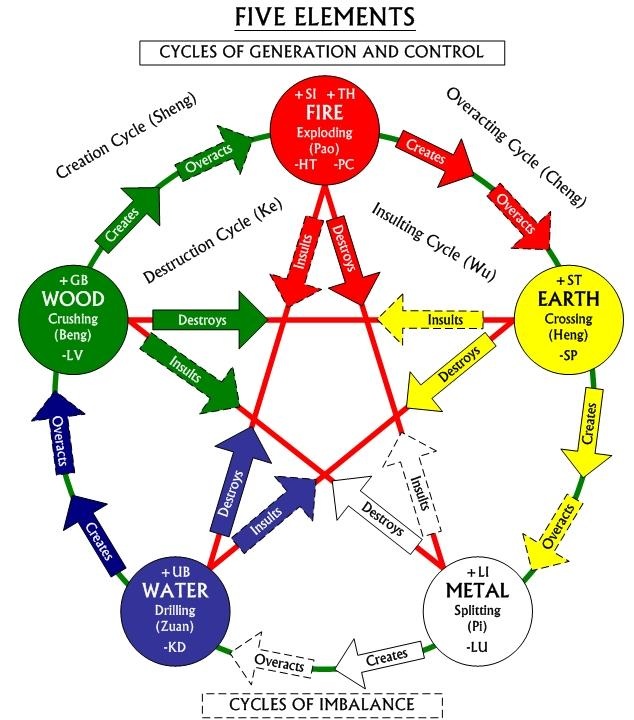
And speaking of the symbolic nature of armour, the colours and patterns of armour lacings were not merely decorative - they served as identification on the battlefield, and often invoked spiritual protection using Gogyō (五行) - the same 5 Phases/Elements system I use daily in TCM practice. By the late Kamakura period, many warriors incorporated family crests (mon) into their armour designs.
Classical Kabuto Construction
By the late Heian period, helmet construction had become standardised to support the needs of mounted archers. Helmets were built from vertical iron plates called tate-hagi ita (竪矧板), riveted together to form the bowl (hachi, 鉢).
At the top of the helmet was an opening known as the tehen (天辺), surrounded by decorative metal fittings (tehen kanamono). Originally, I was told that this hole was thought to accommodate a topknot. However, it seems the tehen more likely allowed heat to escape and served as a mounting point for ornamentation.
In addition, the shikoro became more complex, composed of multiple lacquered lames laced together, allowing flexibility while protecting the neck and shoulders.
Tachi: The Curved Sword Emerges

As mounted combat became dominant during the Heian period, sword design evolved to meet new demands. The straight chokutō gave way to the tachi (太刀), a long, curved sword worn suspended edge-down from the belt.
While popular culture emphasises the samurai's sword, historical evidence shows that early medieval warriors viewed swords as secondary weapons. The tachi - a single-edged, curved sword worn suspended from the waist with the cutting edge downward - was used primarily when a warrior had exhausted his arrows or been unhorsed. Around 90-100 centimetres in length, the tachi was optimised for slashing rather than thrusting and complemented the bow as a secondary weapon.
The distinctive curve of Japanese swords was not initially designed for cutting from horseback, as is sometimes claimed. Rather, it resulted from the unique differential hardening process used by Japanese swordsmiths. When a blade was heated and then rapidly cooled during quenching, the thinner edge contracted more than the thicker spine, naturally creating a curve. This same process created the visible temper line (hamon) that is prized in Japanese swords.
Early tachi were often highly decorated, reflecting their status as symbols of rank as well as functional weapons. Nevertheless, the bow remained the primary weapon of the mounted samurai, with the sword serving as a backup for close encounters.
In addition to the tachi, samurai carried smaller companion blades called tantō or koshigatana ("hip sword"). These were used for close combat, for finishing off wounded opponents, and sometimes for taking the heads of defeated enemies - an important practice for proving victories and earning rewards. Teachings regarding how to remove a head from both a dead and still living opponent are still taught in the school of swordsmanship I study, Musō Jikiden Eishin-ryū.
Polearms and Other Equipment
Polearms also continued to feature prominently in early samurai arsenals. While the hoko remained stalwart, the naginata, with its curved blade mounted on a shaft about 120–150 centimetres long, became popular during the late Heian period. Unlike the unidirectional thrust of earlier spears, the naginata could be used to sweep, cut, or strike, as well as to thrust. It was particularly effective for warriors fighting on foot, who needed to keep mounted enemies at bay.
An often-overlooked element of samurai equipment was the horse tack. Japanese saddles featured high front and back arches that provided stability for mounted archers. The distinctive Japanese stirrup (abumi) had a solid plate for the foot to rest on and an enclosed toe box, creating a secure platform from which to shoot. The security provided by this specialised equipment was crucial for the development of mounted archery techniques.
Continue to Part 2 of Samurai Arms and Armour!
Join me for part 2 of Samurai Arms and Armour, where we explore the:
- The Kamakura and Nanbokuchō Periods (1185–1392) with lighter samurai arms and armour for a New Era
- The Age of Mass Warfare - The Sengoku Period (15th–16th Centuries) and "Modern" Bulletproof Armour, and...
- How Peace Led to Pageantry - The Art of the Edo Period
If you'd like to train in authentic Japanese Martial Arts, those same warrior skills developed by the samurai, check out my dojo at DublinKendo.com
- - - -
If you want to get in great physical, mental and emotional shape using the same principles and techniques inspired by the feudal warriors and healers of Japan, check out my Samurai Strength Programs.
References
- Knutsen, Roald, and Patricia Knutsen. Japanese Spears: Polearms and Their Use in Old Japan. Kent: Global Oriental, 2004.
- Friday, Karl F. Samurai, Warfare and the State in Early Medieval Japan. New York: Routledge, 2004.
You've been reading about Samurai Arms and Armour! Continue with part 2 - here.
Click here to return to the Way of the Samurai Home Page.
- Home
- Samurai History
- Samurai Arms and Armour
You might like these
History of the Samurai
History of the Samurai - An Introduction to the Story of the Samurai
The Bansenshukai - A Period Fantasy Document
The Bansenshukai - A Period Fantasy Document
The Gunpo Jiyoshu and the Ninja Myth
The Gunpo Jiyoshu and the Ninja Myth

About the Author

Paul Batman O’Brien is passionate about sharing the wisdom of martial arts to help solve our daily problems. He teaches both gendai (modern) and koryu (classical) Japanese martial traditions for Dublin Kendo Kobukai, holding 5th Dan in Iaido, 4th Dan in Jodo, and serving as dojo leader for Hyōhō Niten Ichi Ryū in Ireland.
With over 40 years in martial arts and 20+ teaching, he is a multi-time international medalist, and has represented Ireland at the European Championships for both Iaido and Jodo many times.
He was a lead writer for Irish Fighter Magazine for over 15 years, with over 100 published articles and is the author of multiple books on martial arts, strength and fitness, eastern medicine, and philosophy.
When not teaching martial arts, he owns and operates the Meridian Acupuncture Clinic.


Free Samurai E-books
Get Free Exclusive Samurai Guides and E-books
Subscribe Now
My Best Selling Samurai Fitness Program
Top Viewed Pages