Irish Iaido Spring Seminar 2026 Report
Record-Breaking Attendance with
Peter West, Nanadan Kyoshi Sensei
Thirty swords in line
Silence before the first draw
Eire inhales deeply
- Batman's Bad Haiku
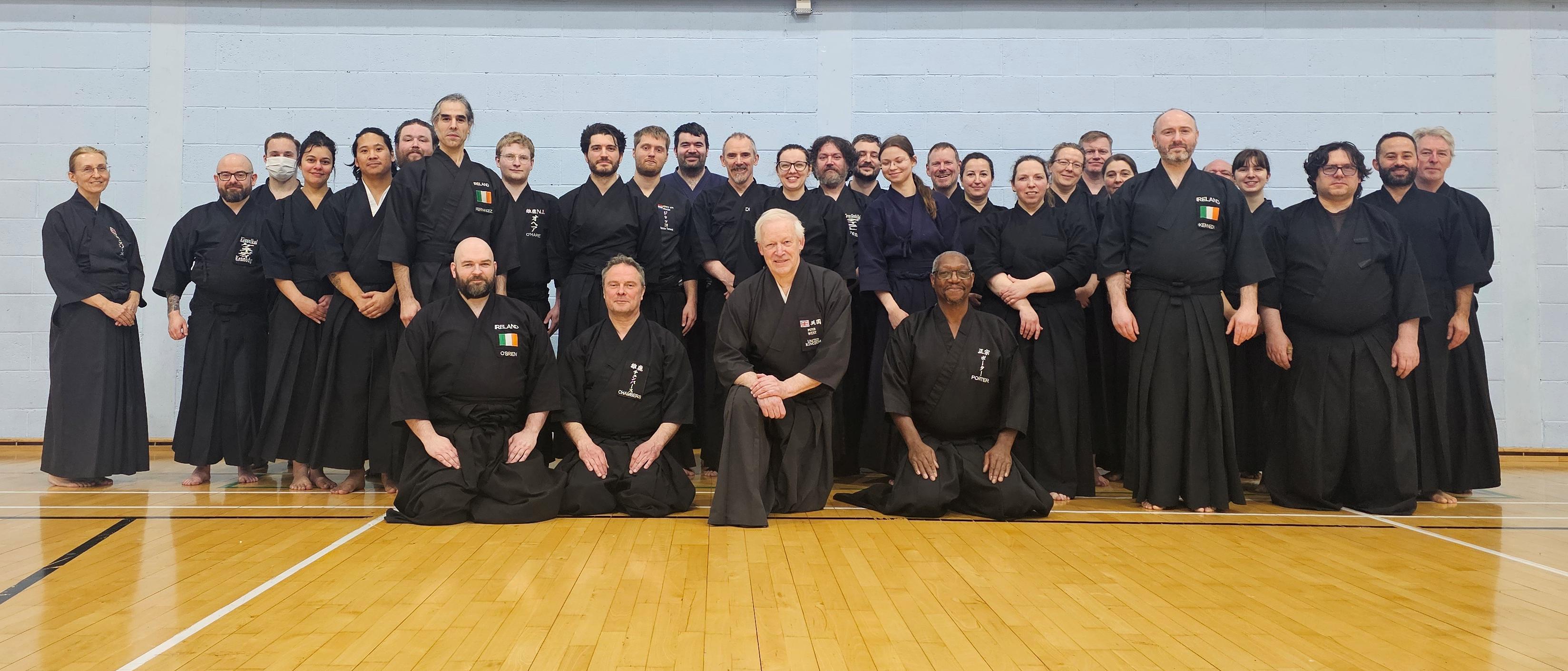
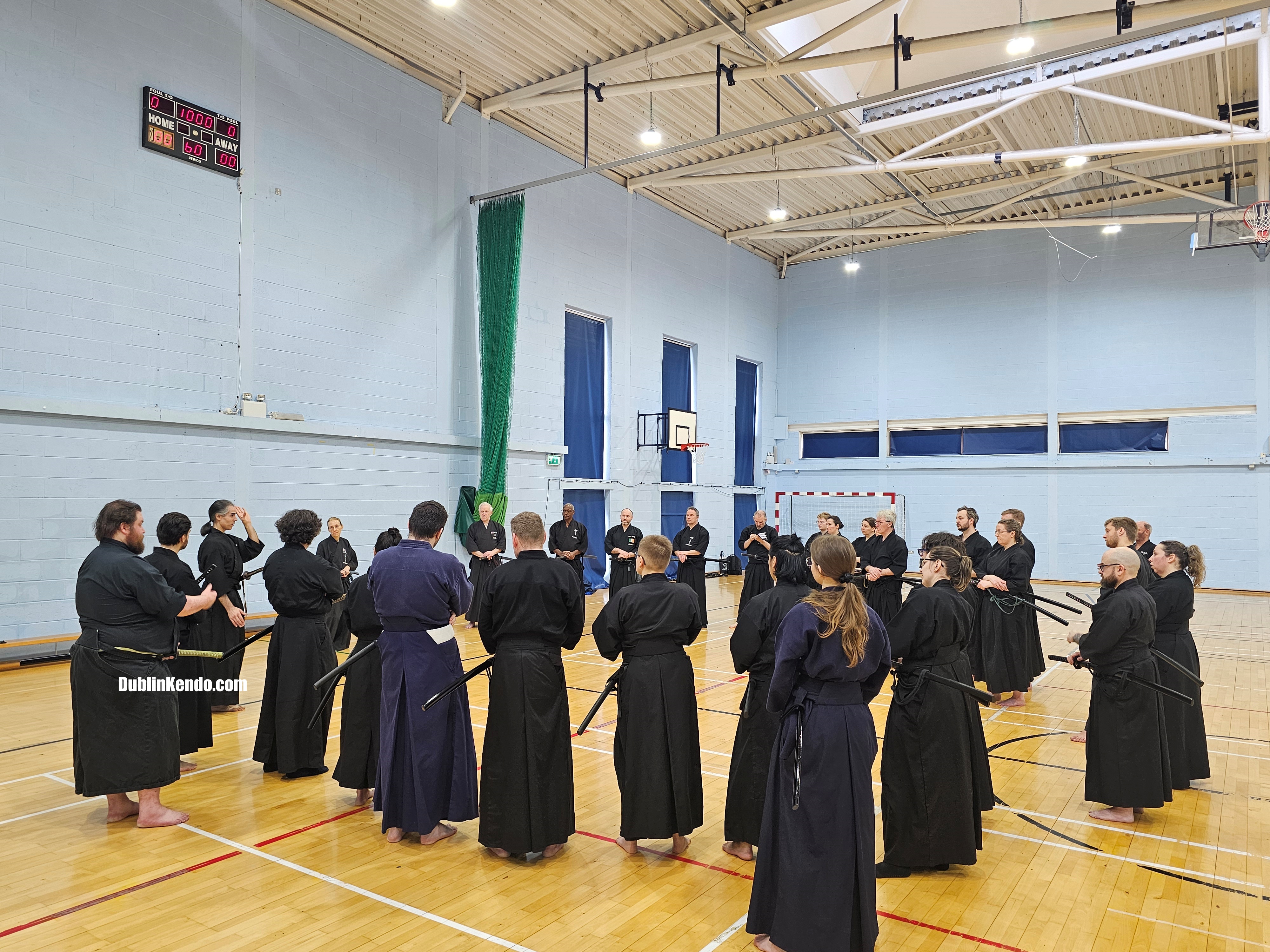
I have never seen so many armed martial artists in this hall. On February 7th 2026, an Irish record-breaking 34 Iaidoka (students of Iaido, the Art of using a Japanese Sword) were packed into our usual Saturday training space (with over 37 registered attendees over the 2 days!). All here to receive the wisdom and guidance of Peter West Sensei, Kyoshi, Nanadan. Assisted by Martin Chambers Sensei, Rokudan, and with a special and most welcome appearance by Colin Porter Sensei, Rokudan, this was set to be an absolutely incredible weekend of Japanese Swordsmanship.
First Impressions Last
After a few words from West Sensei, the seminar started with a fabulously detailed, high-level examination of opening and closing reiho. Reiho (the rituals of respect and courtesy to your environment, teachers and weapons). This was mindblowing. Not just for me, but equally for our students here in Ireland. We all knew how to perform reiho - but not like this.
Using Porter Sensei to demonstrate, and Chambers Sensei to explain, West Sensei elevated our reiho to whole new levels. West Sensei emphasised subtle movements of the eyes, simplified prescribed hand movements, slight angle adjustments and the introduction of gravitas. Placing the sword on the ground and bowing to it is simple, but West Sensei elevated this with elegance, smoothness and commanding confidence. As West Sensei said, “First impressions, last”.
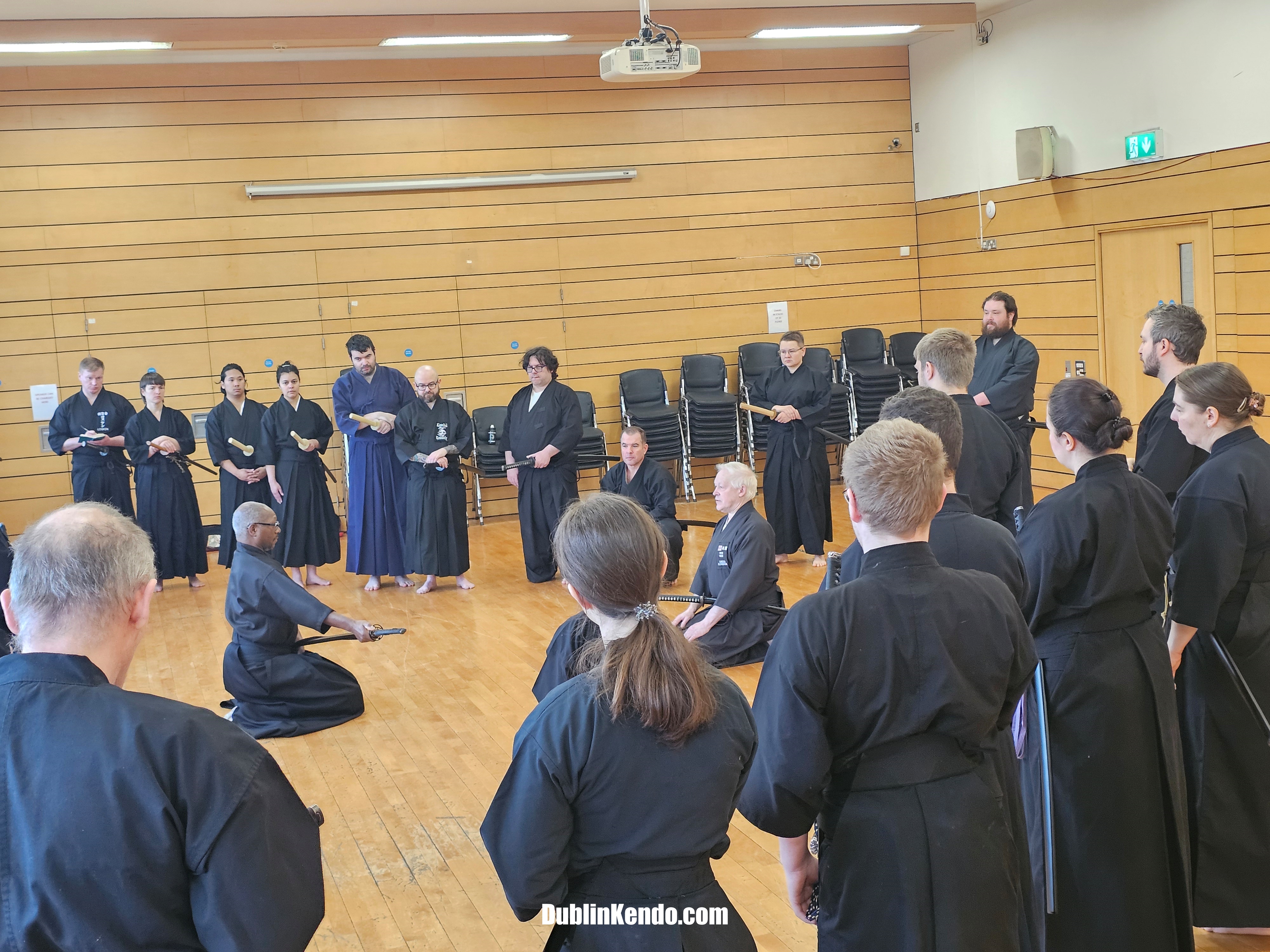
After this, we moved to a very high-level explanation of nukitsuke with West Sensei having Chambers Sensei demonstrate. Everyone attending was familiar with the mechanics of performing nukituske, the opening draw and cut of the first kata. However, West Sensei focused on our psychological understanding of this movement and the strategy being employed. This new understanding of the purpose radically changed the movement for everyone. West Sensei was able to demonstrate the various levels of progression of nukitsuke, highlighting the differences between a yondan, godan, rokudan and nanadan nukitsuke. The subtle difficulties progressing exponentially.
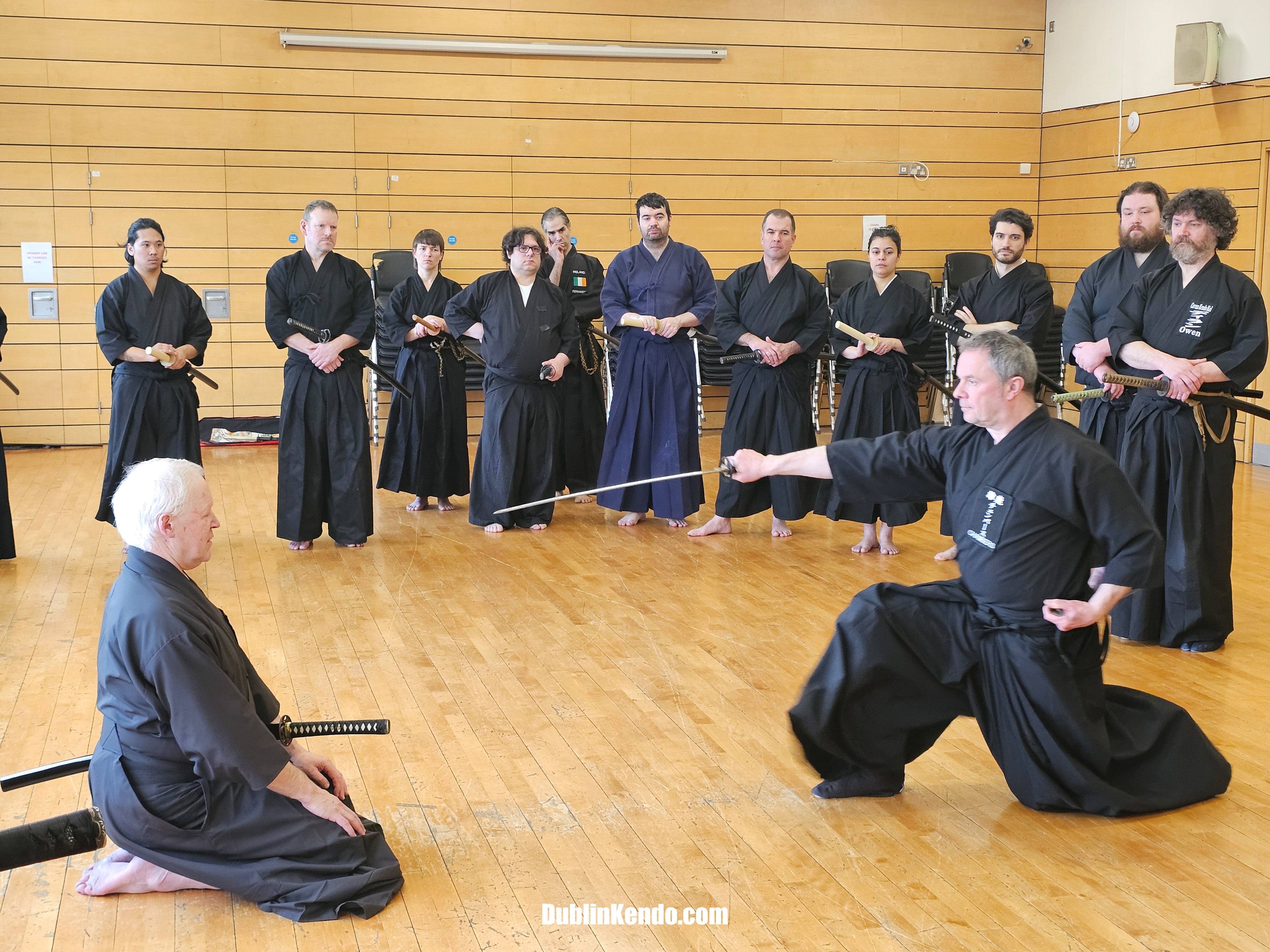
Due to the space constraints, West Sensei taught us how to isolate particular features of the kata, really dial it in and focus on the small, but vitally important aspects of these movements. Frankly, this was VERY high-level stuff, but even our newer beginners were able to grasp some of these concepts and apply them.
We broke up into three groups: the first, our lower kyu beginners, led by Sandra Mesrine (Sandan) and Raúl Fernandez Sensei (Yondan); the second, mostly comprised of the shodan grading candidates, led by me and Colin Porter Sensei (Rokudan), and dan grades led by John Kennedy Sensei (Yondan) and Martin Chambers Sensei (Rokudan), all overseen by West Sensei (Kyoshi, Nanadan).
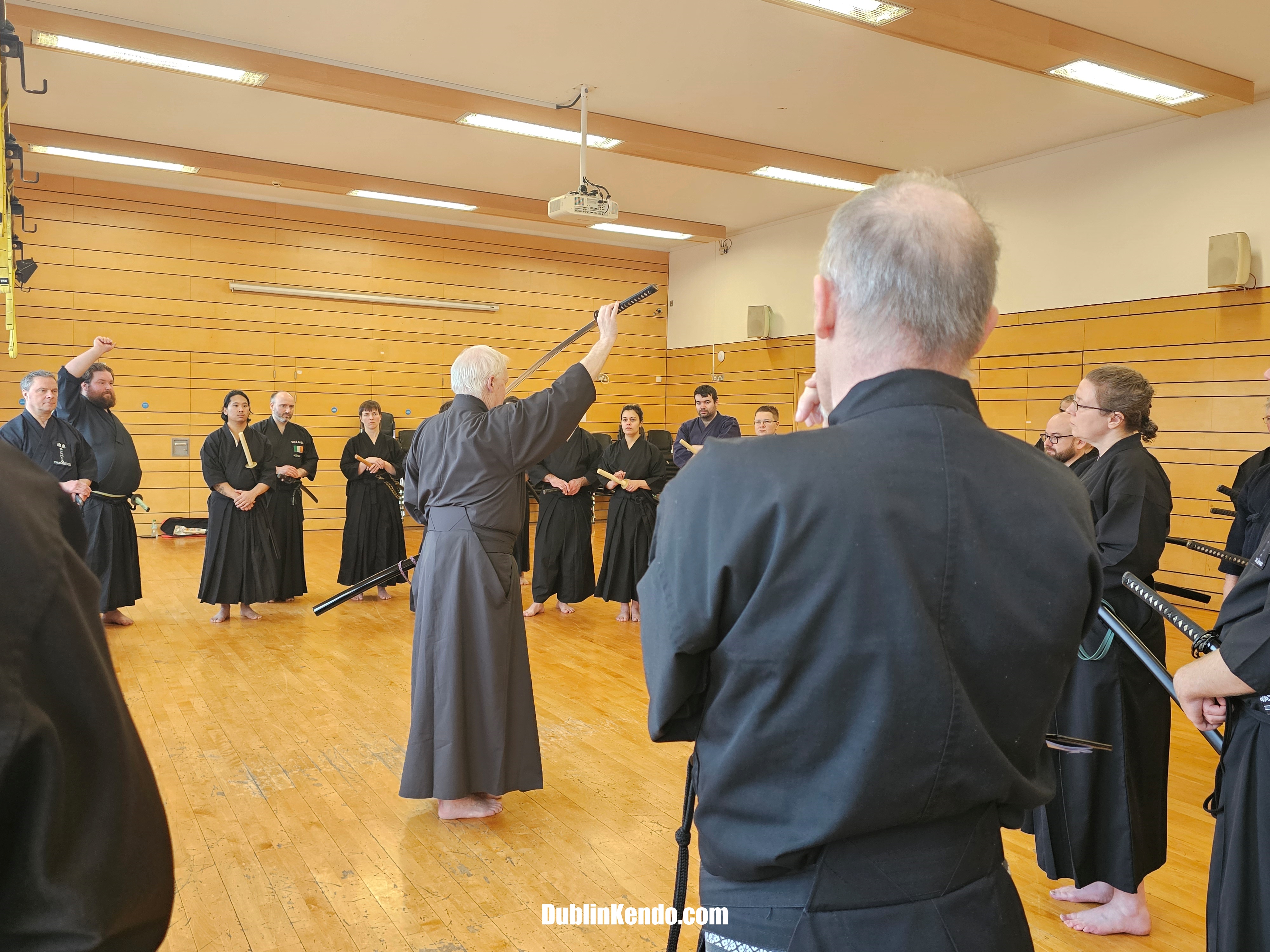
We began with an intensive practice of the reiho, followed by a very detailed examination of nukitsuke. West Sensei then had us investigate the incredibly subtle movement of kaburi (the method of raising the sword above the head). West Sensei helped us refine and remove extraneous movement, peeling back the layers to create an effective, efficient and graceful movement. He then taught us how to connect this with our footwork to deliver the sword to the cut in seamless transition.
The Myoken Dojo Waltz
Next, West Sensei had the teachers move to the next group, for the Myoken Dojo Waltz - a wonderful exercise that West Sensei taught me many years ago. This drill allows you to practice the crucial footwork placement, hip weight shifts, and stepping mechanics for 受け流し Ukenagashi. After some initially confused faces and bodies facing in all directions, everyone got the hang of it. Once the foundations were in place, West Sensei showed us how to produce the block and cut, highlighting geometric shapes that switched on lights above nearly every head in the room.
After this, West Sensei highlighted the precise timing of footwork, mei-seme and tai-seme necessary to make the opening draw and cut of 三方切り Sanpōgiri work. There was an absolutely wonderful application of the knee and hip here that I had not seen - and massively improved my understanding of not just tai-seme, but the turning mechanics needed.
After significant work on this, we began to examine the opening of 四方切りShihōgiri, 総切り Sōgiri, and 抜き打ちNukiuchi and included a fascinating talk on what the chakuganten are and are not - and how these points often lead to a confused technique.
Day 1 then ended with a demonstration of 前 Mae from the instructors.
Then, after a little rest, it was off to Chilli Banana for a packed Sayonara Party dinner, with Sandra displaying the results of her kimono studies, and West Sensei sharing fabulous stories; the evening flew by.
Cornish Pixies and Leprechauns
The next day, we headed to the larger Rice-Nagle Hall in the Marino Institute of Education. The great space afforded us the opportunity to integrate the focused work of the first day into the kata as a whole.
West Sensei had Porter Sensei explain, and Kennedy Sensei demonstrate, the first 4 Zen Nihon Kendō Renmei (全日本剣道連盟) Iai kata:
- 前 Mae
- 後ろ Ushiro
- 受け流し Ukenagashi
- 柄当て Tsuka-ate
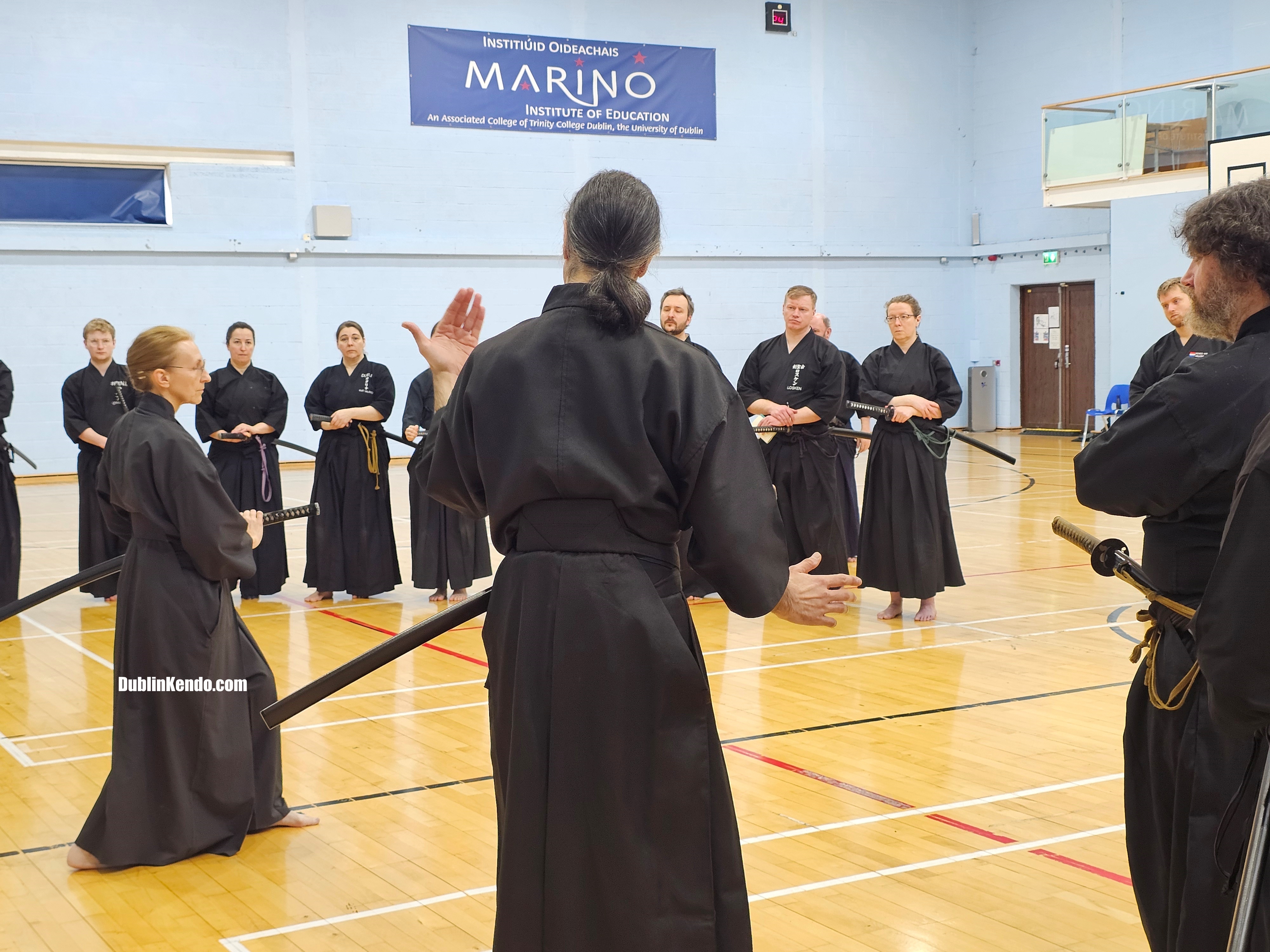
We then splintered off into 3 teaching groups. This time, Sandra and I took the beginners. During this practice, I took the opportunity to teach the students West Sensei’s Ushiro rotation method, and explained that West Sensei is able to perform this with Cornish Pixies under his hakama, seemingly rotating him without any visible means. I am only able to poorly approximate this thanks to finding Leprechauns to assist me - unfortunately, they take the drink, so my turning is a lot less smooth than West Sensei’s. This is not because of my poor technique, but entirely the fault of substandard Leprechaun’s.
Once the students had the hang of it, West Sensei came over to demonstrate the Cornish Pixie magic in person and then revealed the importance of securing the left foot to anchor the rotation and prevent accidental misplacement of the foot in Ushiro, which would defeat the point of learning the kata. After he left us to continue our practice, everyone agreed that pixies were, in fact, the only way that smooth turn was possible.
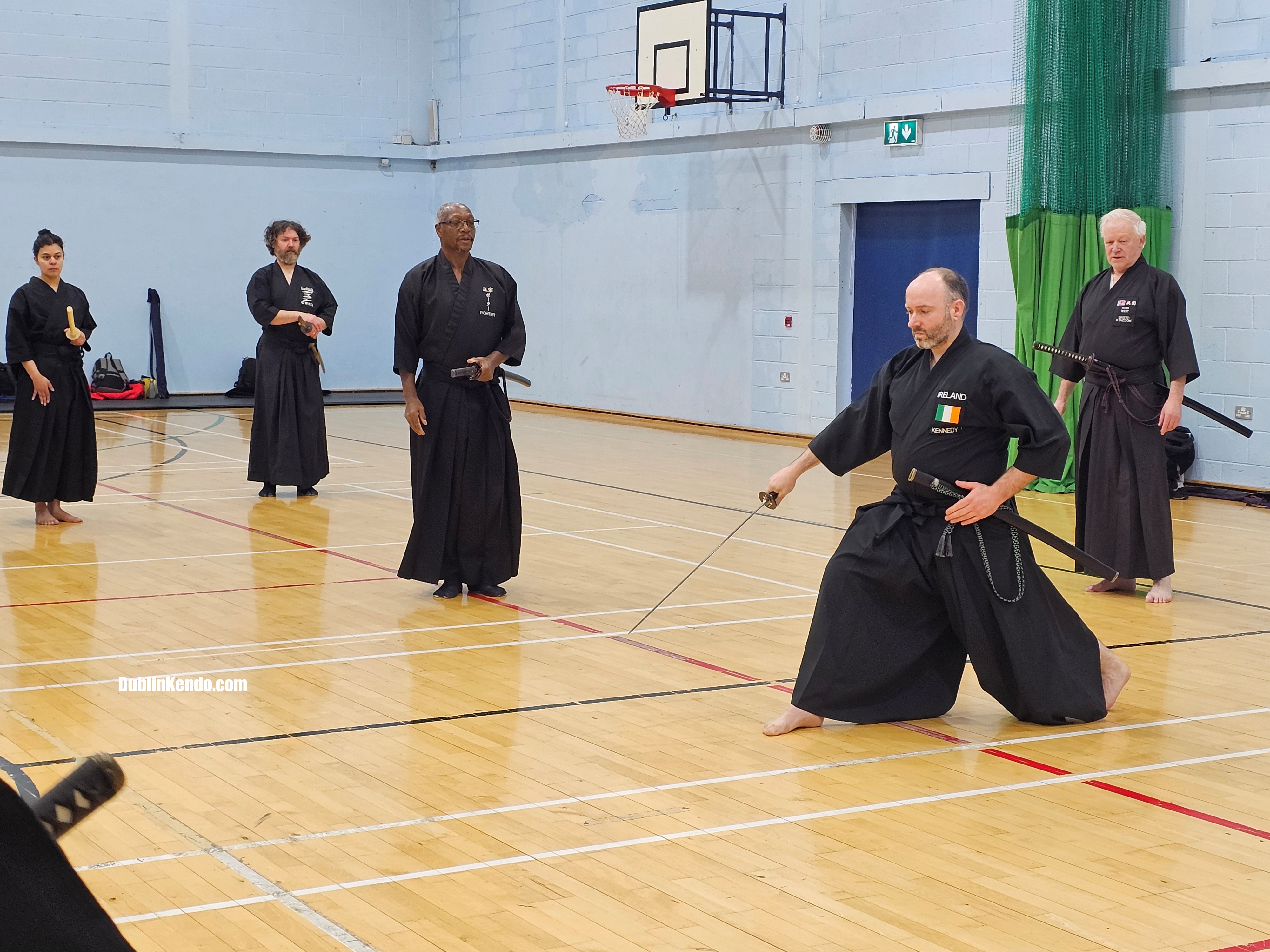
After a short break, we moved to the next third of the seminar, with Raúl Sensei explaining, as Sandra demonstrated kata:
- 袈裟切り Kesa-giri
- 諸手突き Morote-tsuki
- 三方切り Sanpōgiri
- 顔面当て Ganmen-ate
These in-depth explanations also afforded West Sensei the opportunity to refine the demonstrator's technique. This was an invaluable opportunity to not just learn the kata, but to see how advanced students are corrected, what they need to focus on, and how quickly they can implement the changes requested.
Sandra and I then took charge of the more advanced Dan grade group, where I continued on from West Sensei’s teaching the day before and focused on very small details and the refinement of the existing technique. Subtle weight shifts, how to tsuki with vigour, with West Sensei dropping in to elevate the instruction to a higher understanding.
Then…lunch. 🙂
Imps, Pixies and Leprechauns
After the break, I hurried back to the hall for my turn under the microscope as Chambers Sensei explained as I demonstrated kata:
- 添え手突き Soete-tsuki
- 四方切りShihōgiri
- 総切り Sōgiri
- 抜き打ちNukiuchi
This was one of the best moments for me in the entire seminar as I got focused correction from West Sensei and Chambers Sensei -
- Watch my hand position on the tsuki.
- Keep the line of the sword straight overhead when passing through waki-gamae
- Watch that right-hand unless I want to be a one-handed swordsman - (note to self: rewatch Monty Python and the Holy Grail)
But Sōgiri was where I was given the best advice - there was not enough trust in my sayabiki, leading to a lean that was unnecessary, transitioning into heavy, laboured footwork, which in turn led to heavy, laboured cuts. This is a particularly hard kata for me, as with Multiple Sclerosis, without very focused attention, it can be hard to move my feet. The more tired I am, the more they can slap and drag - but West Sensei took time out from the whole seminar to help me through this mental block and by the end, I was able to glide with a lightness in footwork and cut that I had not realised I was capable of. That evening, I added some of these teachings to the mobility program I show my MS patients.
Once the demonstration was complete, the teachers moved again to new groups, with Sandra and me now supervising the shodan grading candidates. But this was the BEST bit of the seminar for me. With a twinkle in his eye, West Sensei rapidly displayed a series of movements that we had been discussing the previous night. I was grinning from ear to ear, and I got to practice that and a few other goodies before I resumed working with my group. West Sensei asked me to work with the students on their angles, so I got to practice one of my favourite paired drills for learning the hasugi (blade alignment) for Sōgiri.
I have to confess, I was greatly impressed by the significant improvements everyone made during the seminar. But now, it was time for the real test as we prepared for a national grading.
Everyone got to practice embu, with Sandra providing direct support to the first-time graders.
The Moment of Truth
We began with the kyu grading with a panel made of Raúl Fernandez Sensei (Technical Officer), John Kennedy Sensei (Grading Officer), and me, Batman O’Brien (Chief Examiner). We were very happy to award:
- 6th Kyu: Viktoriia Yevsiukova
- 5th Kyu: Ottavio Roda
- 4th Kyu: Markuss Zakss
- 3rd Kyu: Eoin Meyler, Conor Reddin, Yulianna Tsaruk
- 1st Kyu: David Leonard, Dylan Owen, Paulo Panhoto
John, Raúl and I were then joined on the grading panel by Martin Chambers, Rokudan Sensei, and led by Peter West, Kyoshi, Nanadan Sensei, for the shodan grading.
This was the largest (and only 2nd) shodan grading in Ireland, with 5 candidates challenging for Shodan:
- Simon Brummer
- Mercedes Gonçalves
- Amanda Hill
- Brian Kennedy
- Jacco Terwel
Among these 5 were students who joined the first Iaido beginners course I led back in Jan 2024. At that time of their first grading in March 2024, I wrote how Raúl, John, and I were deeply impressed with the standard shown at the grading, how each of the students exceeded my expectations and how much I was looking forward to their progress.
As I sat and Emmanuel Clark passed the grading papers to us, I recalled the lyrics of Survivor’s 1984, Karate Kid classic;
“It's the moment of truth
It's all on the line
This is the place
This is the time”
- Survivor, The Moment of Truth, 1984
And now, Sunday, 8th February 2026, this was the place, this was the time for some of those beginners.
All passed.
I was incredibly proud of what I saw out there, and proud for Ireland.
To put this in context, in late 2024, we had only 6 people ranked Shodan up in ZNKR Iaido in Ireland. Today, after this grading, we now have 18!!
In a little over a year, we have tripled the number of Dan-level Iaidoka here, a 200% rise. That’s phenomenal growth in just over a year.
I am immensely proud of all our students who have worked so hard to achieve this. I am equally proud to see the continued growth of kyu-level gradings, as they, too, are on the path that our new Shodan are now walking.
West Sensei and Chambers Sensei both commented several times over the weekend on just how much everyone had improved — and how proud they should be of the work they produced.
Every single participant levelled up under their detailed, precise, and generous instruction. Hesitant cuts disappeared, replaced with conviction. Rushed, panicked transitions gave way to calm, controlled assurance. Wobbly turns became smooth pixie magic. Angles became precise and focused. The transformation across the room was undeniable.
I truly could not be prouder of everyone who stepped onto the floor. Watching the hard work, focus, and determination pay off meant more to me than I can properly put into words. Seeing that growth — and sharing in it — was an absolute privilege.
I couldn’t be happier.
Reflections on the Irish Iaido Spring Seminar 2026
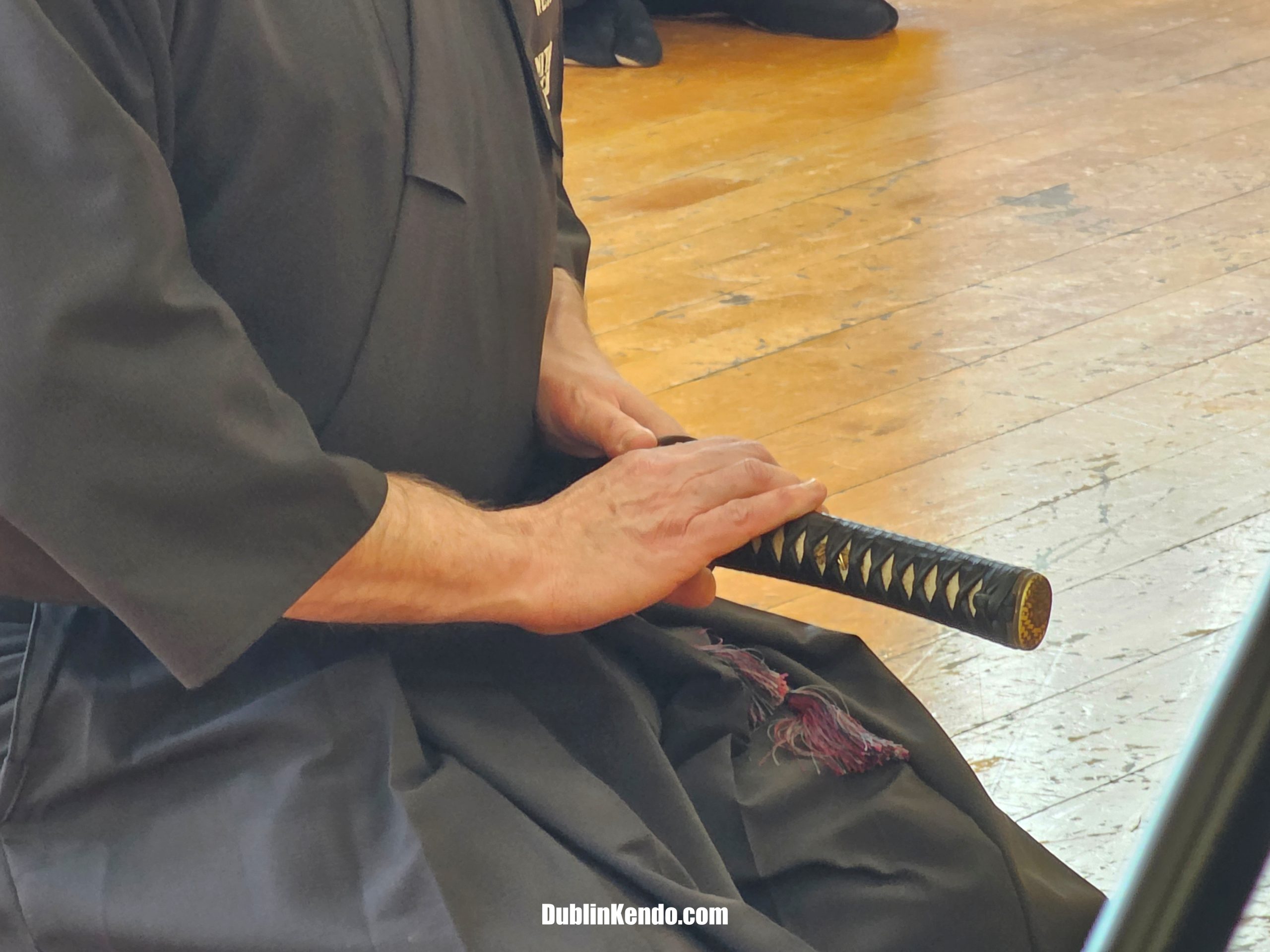
The following day, after the Sensei had been dropped back to the airport, I joined some of the beginners in the hall where it all started for them. I set my jo down, took up my sword and looked over a row of new Shodan. We bowed to the shomen and offered up a quiet embu of 12 kata in thanks for all we have been taught by our sensei, all we have learned from our study of Iaido, and in the acknowledgement that there is so much more to learn for all of us.
My heartfelt thanks to West Sensei for his tremendous hard work and generous guidance throughout the weekend, and of course for facilitating the gradings. Had he not agreed to take John and me on as students over ten years ago, this continued development in Irish Iaido would simply not have been possible. His steadfast support of us, of our students, and of Iaido in Ireland cannot be overstated and will always be remembered with deep gratitude.
My sincere thanks as well to our good friend Martin Chambers Sensei of our sister dojo, Ojika. Chambers Sensei has been a constant and valued ally, supporting us from the very first time we met in Okehampton, and continuing to stand with us every step of the way. Many thanks also go to Colin Porter Sensei, who was drafted to the teaching side without notice!
I would also like to express my warmest appreciation to Martin Kiosew Sensei, Kendo Renshi Rokudan and Kathryn Cassidy Sensei, Kendo Rokudan. Without them, there would have been no halls, no panel, no grading - in truth, none of this at all. They work tirelessly, and often without the recognition they so greatly deserve, in support of all our arts. My thanks also to John, Raúl, and Sandra for their unwavering efforts in supporting the Sensei, the students, and the seminar, and to Emmanuel and Greg for their assistance in the gradings.
We move confidently into the next stage of Irish Iaido’s development. Our focus now turns to guiding and supporting our newly graded Shodans as they prepare for Nidan. It will demand renewed dedication and sustained effort, but our students have shown - clearly and convincingly - that they are ready for the challenge. Irish Iaido is bright, and we step forward together with determination and pride.
“Island at the edge
Strong in quiet purpose —
Iaido blossoms here”
- more of my bad haiku
If you're interested in learning more about Iaido and Japanese Swordsmanship, authentic Budo taught by qualified instructors and international medalists, Dublin Kendo routinely holds new beginner courses throughout the year.
You can contact them at https://dublinkendo.com/ and find them on Facebook at https://www.facebook.com/DublinKendoKobukai
Click here to return to the Way of the Samurai Home Page.
You might like these
Iaido - The Art of Japanese Swordsmanship
Iaido - The Art of Japanese Swordsmanship
Iaido FAQ
Iaido FAQ - A Q and A for the Beginner
Oe Masamichi and Iai - A Translated Excerpt
Oe Masamichi and Iai - A Translated Excerpt from the Koryu Iai No Hondo
About the Author

Paul Batman O’Brien is passionate about sharing the wisdom of martial arts to help solve our daily problems. He teaches both gendai (modern) and koryu (classical) Japanese martial traditions for Dublin Kendo Kobukai, holding 5th Dan in Iaido, 4th Dan in Jodo, and serving as dojo leader for Hyōhō Niten Ichi Ryū in Ireland.
With over 40 years in martial arts and 20+ teaching, he is a multi-time international medalist, and has represented Ireland at the European Championships for both Iaido and Jodo many times.
He was a lead writer for Irish Fighter Magazine for over 15 years, with over 100 published articles and is the author of multiple books on martial arts, strength and fitness, eastern medicine, and philosophy.
When not teaching martial arts, he owns and operates the Meridian Acupuncture Clinic.


Free Samurai E-books

Get Free Exclusive Samurai Guides and E-books
Subscribe Now
My Best Selling Samurai Fitness Program
Top Viewed Pages